
Aptos since 2004 · Zagreb & Daruvar
Aptos Thread Lift in Croatia
An Aptos thread lift is intended for early and moderate tissue laxity, when fillers and Botox cannot raise descended contours and there is not yet enough excess skin for a surgical facelift. At Polyclinic Maletić we have applied the method since 2004, and at the exam we assess whether it can achieve the change you expect.
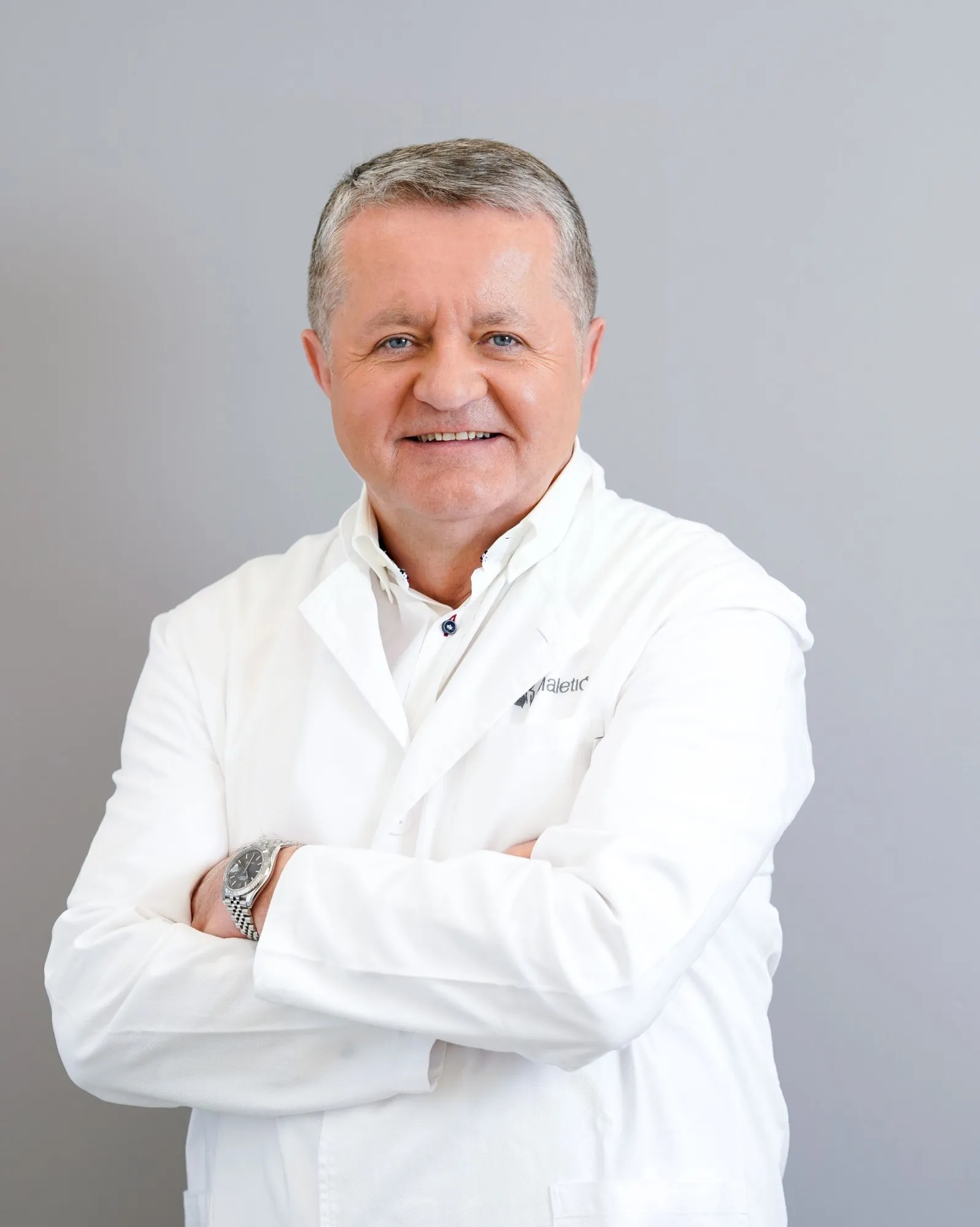
Loss of a clear jawline, descent of the cheeks, and early laxity of the tissue cannot always be addressed with fillers or Botox. At the same time, if there is not yet significant excess skin, a surgical facelift can be a more extensive procedure than the findings call for. An Aptos thread lift is intended precisely for selected cases of early and moderate descent of tissue, and its suitability is assessed at the exam.
Is this for me?
What an Aptos thread lift is and who it really helps
The Aptos thread lift, also known as thread lifting or the feather lift, is a minimally invasive method of raising lax facial tissue. The name comes from the term anti-ptosis — against sagging. The method does not remove excess skin and does not change the basic features of your face; it raises descended tissue back toward its earlier position. The technique was developed by the surgeon Dr. Marlen Sulamanidze, and it is based on special threads with microscopic barbs that are placed under the skin with a needle and anchor themselves in the surrounding tissue.
The procedure is performed without a surgical incision or stitches, under local anesthesia, and takes about 30–60 minutes, depending on the number of threads. The lifting effect is visible immediately after the procedure, while over the following months connective tissue forms around the threads, further stimulating collagen production, which can also affect skin quality.
When fillers are no longer enough, and surgery is too big a step
Botox and fillers can soften certain lines or replace lost volume, but they cannot always raise tissue that has descended. On the other hand, a surgical facelift is intended for more pronounced laxity and excess skin. The Aptos thread lift sits between those options and is intended for patients with early or moderate descent of tissue without significant excess skin.
The Aptos thread lift is the method for that middle ground. It is intended for people with early or moderate tissue laxity who do not yet have the more significant excess skin that would call for surgery. Reference institutions cite people from their late thirties to early fifties as typical candidates, but age is only a guideline. The findings at the exam decide.
The method is also applied several years after a surgical facelift, to maintain the result achieved and to soften further descent of tissue. Because it is performed under local anesthesia, an Aptos thread lift can also be an option for certain people for whom surgery is not appropriate because of their health, including high blood pressure, diabetes, or heart disease. That decision is made individually, after an assessment of your health.
Which areas we lift
The areas most often treated are the cheeks, the cheekbones, and the jawline. Threads can also be used to raise the eyebrows and to treat the neck and double chin, and the method is also applied for early skin laxity on other parts of the body. The number, type, and arrangement of the threads are determined at the exam, according to the area being treated, your anatomy, and the degree of tissue laxity.
A word from the expert
The Aptos thread lift — Duško Maletić, MD, MSc
How we work
What an Aptos thread procedure looks like with us
The procedure is preceded by an exam and a conversation, during which we assess the condition of your skin, the degree of laxity, and the expected result. On the day of the procedure we mark the planned paths of the threads and the direction of the lift on the skin. After the marking, local anesthesia is applied.
The threads are introduced with needles along the previously marked paths. Once a thread is placed, the needle is withdrawn while the thread stays in the tissue. Barbs oriented in several directions anchor in the surrounding tissue and support it in the lifted position. The procedure takes about 30–60 minutes, depending on the number of threads, and you go home the same day, after the treated area has been cooled and you have received your recovery instructions.
- Duration
- about 30–60 minutes, depending on the number of threads
- Anesthesia
- local
- Recovery
- everyday activities in 5–7 days
- Performed by
- Duško Maletić, MD, MSc
What kinds of threads we use
Threads can be resorbable or non-resorbable. Resorbable threads break down in the body over time, while the collagen and connective tissue that formed remain. Non-resorbable threads stay in the tissue permanently. The choice of thread type depends on the area being treated, the quality of your skin, and whether you are planning a surgical procedure in the foreseeable future — and it is determined during the exam and the planning of the procedure.
“More than twenty years of experience with Aptos threads allows us to assess with which findings they can achieve a visible change — and when another method is more appropriate.”
The procedure is planned and performed by Duško Maletić, MD, MSc, specialist in surgery, founder of the Polyclinic, and a trainer in this method.
See the full price listRealistic expectations
What you can realistically expect — and what not
Threads allow a moderate lift of the tissue, and even a smaller change in position can affect the clarity of the facial contours. They cannot remove excess skin. When excess skin is pronounced, threads can only shift it without removing it, which is why the result can be insufficient. The method is also less suitable for a heavy lower third of the face, where the weight of the tissue can exceed what the threads can carry, and for very thin skin, where there is a greater chance that a thread will be visible or palpable.
The result is visible immediately after the procedure, and the full impression settles over a few weeks, once the swelling subsides and connective tissue begins to form around the threads. That process takes about three months.
Once the swelling has subsided, the change shows most in the contours: the jawline can become clearer, and the cheeks and cheekbones can sit in a higher position. Because the threads raise tissue without changing the basic features of your face, facial expression and mobility remain preserved. The degree of change depends on the initial findings, skin quality, and the number of threads placed. The procedure does not stop further aging and the gradual loosening of tissue.
“An Aptos thread lift is not a replacement for a surgical facelift. Threads allow a moderate, not a dramatic, lift of the tissue, so the result can be sufficient for early laxity, but not for significant excess skin.”
How long the effect lasts, and why the answers vary so much
The available sources contain very different claims about how long the effect lasts — from roughly one year to decades. The differences come from different materials, thread thicknesses, placement techniques, and the characteristics of the patients themselves. Some of the published data also come from studies financed by thread manufacturers, as the authors of systematic literature reviews point out.
The effect of an Aptos thread lift is temporary. Reference institutions for non-surgical thread lifting cite an approximate duration of one to three years. How long it lasts for an individual depends on the type and number of threads, skin quality, age, and lifestyle — and the procedure can be repeated.
“The lifting result is visible immediately, but it is not permanent. The available data support a temporary effect, whose duration depends on the type of thread, skin quality, and the individual aging process.”
Recovery
Recovery after an Aptos thread lift
Although an Aptos thread lift is a minimally invasive procedure, you should plan a few days of recovery and follow the postoperative instructions.
Immediately after the procedure. Cold compresses are applied to reduce swelling and bruising. You go home the same day, because a procedure under local anesthesia does not require an overnight stay.
The first few days. Swelling, bruising, sensitivity to touch, and a pulling feeling with facial expressions are possible. During this period it is important to avoid pronounced facial expressions, sleeping face down or on a hard surface, and hard food that requires forceful chewing, to reduce the mechanical load on the treated area.
Days five to seven. Swelling and bruising generally subside, and most people return to everyday activities.
The first two weeks. Strenuous sport, facial massages, saunas, and anything that mechanically loads the treated area are avoided.
Over three months. Connective tissue forms around the threads, further stimulating collagen production and contributing to skin quality.
If you are coming to Daruvar from far away, you can ask about patient accommodation when booking your appointment. Staying overnight is not medically necessary, but the accommodation can be a practical option for people who prefer not to travel right after the procedure.
Why us
Why choose us for your Aptos thread lift
The Aptos method since 2004
We introduced the method among the first in Croatia and have applied it for more than twenty years.
Face and neck surgery since 1998
We have performed face and neck surgery for more than 25 years, and the Polyclinic is today an internationally recognized reference center.
Planned and performed by the surgeon
The Aptos thread lift is planned and performed by Duško Maletić, MD, MSc, founder of the Polyclinic and a trainer in this method.
Modern, fully equipped operating rooms
The procedure is performed with modern instruments, with precise planning of the direction and depth at which the threads are placed.
No surgical incision
The threads are placed through a needle, so there is no scalpel incision and no stitches to remove.
The threads can be removed
If the result does not satisfy you, or another indication for removal arises, the threads can be taken out after an assessment at a follow-up visit.
The indication is assessed before the procedure
At the exam we assess the degree of laxity, the quality of your skin, and whether an Aptos thread lift can achieve the change you expect.
Two generations of the family
Two generations of the family work at the Polyclinic today, with continuity of care from the exam to follow-up visits.
Why trust us
When an Aptos thread lift is not the right method
“Threads do not remove excess skin — they raise tissue that has descended over time. If the excess skin is pronounced, what threads can lift is limited, and a surgical facelift may be the more appropriate method.”
An Aptos thread lift has a clearly defined area of application. If the exam shows that the main problem is surface lines or loss of volume, Botox, dermal fillers, or 4D laser tightening of the face, neck & décolletage may be more suitable. If there is pronounced excess skin, thread lifting will likely not achieve a sufficient result, and a surgical facelift is considered instead.
In some cases it is appropriate to postpone the procedure. If the tissue laxity is still minimal, threads placed too early can bring too small a change relative to the extent of the procedure and the patient's expectations. In that case, the exam may lead to a recommendation to monitor the changes and reassess after some time.
Honest about the risks
An Aptos thread lift is considered a low-risk procedure, but side effects and complications are possible. The most common are temporary bruising, swelling, and sensitivity of the treated area, which subside within a few days. Less commonly, a slight dimple or unevenness of the skin at the site of the lift, asymmetry, a palpable or visible thread, or a transient feeling of numbness may appear. Infection is rare, and if its signs appear, you should contact your physician.
Unlike the changes made by a surgical facelift, placed threads can be removed if the result does not satisfy you or if there is another medical indication for it. Whether and when to remove them is decided after an exam and an assessment of the tissue.
Threads or surgery
When threads are enough, and when surgery is needed
The choice between an Aptos thread lift and a facelift does not depend on which method is better in general, but on the amount of excess skin, the degree of tissue descent, and the expected result.
An Aptos thread lift repositions tissue and raises it, without an incision, under local anesthesia, with a recovery of a few days and an effect that lasts a limited time. A facelift tightens the deeper layers, the SMAS and the platysma of the neck, and removes excess skin, so it gives a larger and longer-lasting result — but it involves surgery, scars hidden in the natural folds, and a recovery measured in weeks.
With pronounced excess skin, threads generally cannot achieve a result comparable to a facelift. If there is no excess skin and the laxity is mild, a surgical procedure can be a larger scope of treatment than the findings call for. The exam determines whether an Aptos thread lift or a facelift is appropriate — or whether, for now, neither procedure is needed.
Who we are
Who will be taking care of you
The Aptos thread lift is planned and performed by Duško Maletić, MD, MSc, specialist in surgery, founder of the Polyclinic, and a trainer in the Aptos method. He founded the Polyclinic in 1998 and has applied the Aptos method since 2004. Nurses accompany you from preparation to the last follow-up visit, and the next generation of the family works at the Polyclinic today.
Meet the whole team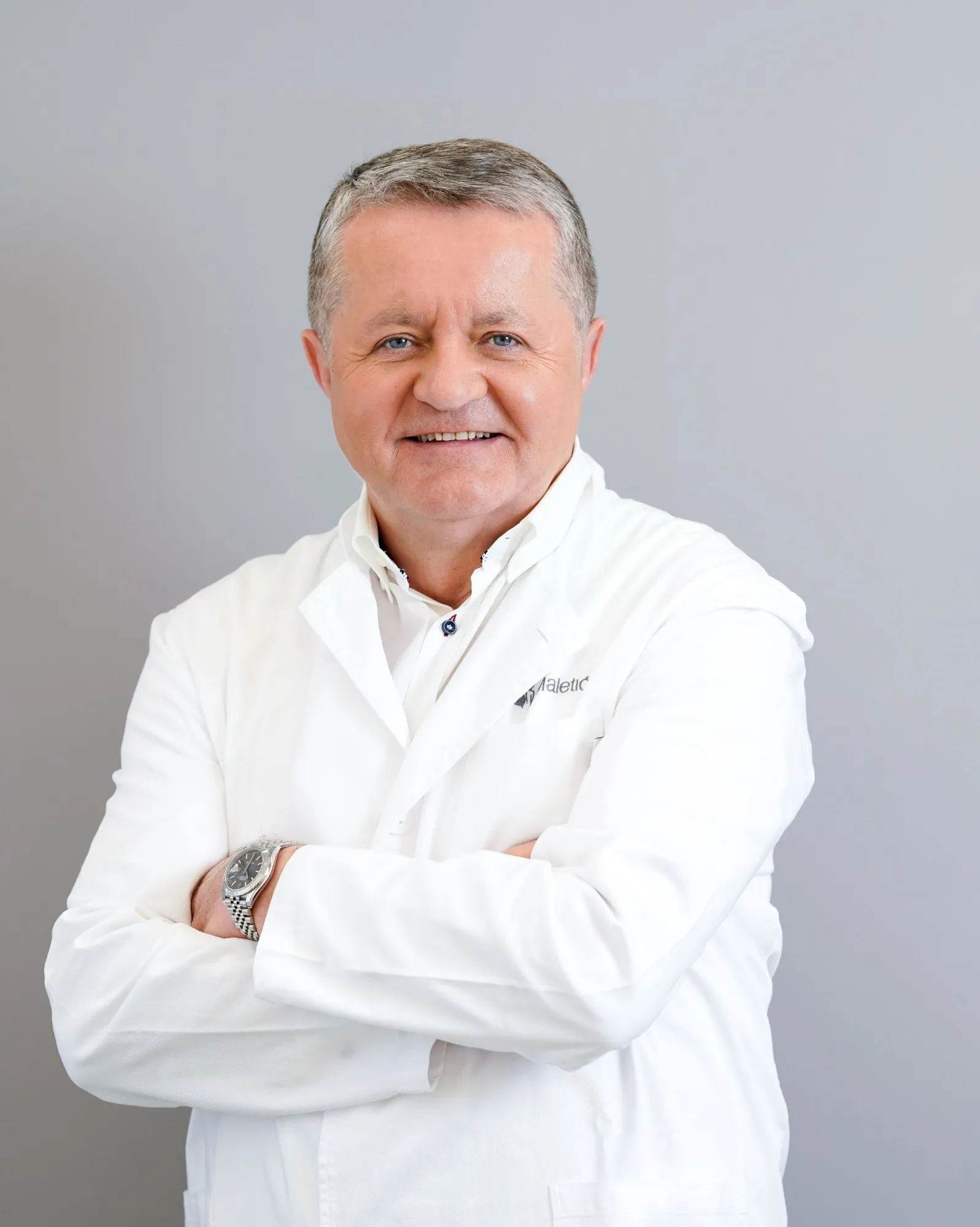
Price
Price and the first step
The price of an Aptos thread lift depends on the number of threads and the area being treated. The exact amount is determined after the exam, when the required number and arrangement of threads are planned. The prices of all procedures are available in the price list.
-
Aptos thread lift (depending on the number of threads)
The exact amount depends on the number of threads and the area being treated, and is determined after the exam.
See the full price listThe first step is a conversation and an exam, at which the degree of tissue laxity, the quality of your skin, and the expected result are assessed. The required number and arrangement of threads are then determined, and we explain how long the effect could last. If an Aptos thread lift is not appropriate for your findings, the physician will suggest another method or postponing the procedure. Contact us to arrange an appointment in Zagreb or Daruvar.
You can find the other procedures in this area under Face & Neck Surgery.
Patient reviews
What our patients say
Reviews taken from our Google Business profiles, Zagreb and Daruvar, translated from Croatian.
★★★★★
“My experience with breast augmentation with Dr. Maletić in Daruvar was excellent. I am extremely satisfied with the result. All the nurses are very kind and professional. I absolutely recommend them.”
★★★★★
“Since high school I watched the double chin I inherited from my father become more and more pronounced — and 15 years later, the double chin is gone. A big thank you to Dr. Maletić and the whole team for making my wish come true. The procedure was painless, as was the recovery, and the results were visible after just a few days. The whole team was extremely kind and cheerful, and the atmosphere very pleasant. I left the polyclinic satisfied, and when I saw, two days after the swelling went down, that the double chin was gone, my satisfaction knew no bounds. I warmly recommend Polyclinic Maletić.”
★★★★★
“All praise for Polyclinic Maletić in Daruvar! I had lip augmentation with fillers and I am very satisfied with the result. I would especially like to praise Dr. Mario Bartol, who is extremely kind and professional and has a wonderful approach to patients, which made me feel comfortable and safe throughout the treatment. All the nurses are also very kind, helpful, and professional. I warmly recommend them to anyone considering aesthetic treatments!”
★★★★★
“Laser acne treatment is the only treatment that helped me, and I would not choose any other facial treatment over it. Dr. Ines is one of the kindest people I have ever met and always has useful advice. Kind staff and top-level service — I warmly recommend her to everyone!”
★★★★★
“I had a wart on my face removed by laser. A very professional service with excellent results. The wart was quite large, but after just one treatment it was gone. All recommendations!”
★★★★★
“I recently had a varicose vein procedure. All praise to the whole team.”
★★★★★
“Blepharoplasty, 4D laser, and double chin. Perfect. All recommendations!”
★★★★★
“The best team of physicians, extremely professional and kind. I have been loyal to Polyclinic Maletić for more than 10 years and I am always satisfied with the results. Thank you.”
★★★★★
“I came to Dr. Maletić with a big problem and a lot of stress. I was met with such warm empathy and kindness, and patience in answering all my questions. Thank you, Dr. Maletić, for the advice and sincere support. I know I can always turn to her for advice, and that means a lot to me. The staff of the Zagreb polyclinic are also very helpful and kind. My thanks to them as well.”
★★★★★
“Dr. Maletić’s practice, both in Daruvar and in Zagreb — and I have had several procedures — I can only recommend, because I felt very comfortable and in expert hands there!”
Questions and answers
Frequently asked questions
Does placing Aptos threads hurt?
The procedure is performed under local anesthesia, so pain is generally not felt while the threads are being placed, although pressure and discomfort are possible. In the first days after the procedure, sensitivity, mild tension, and a pulling feeling with facial expressions may appear, and these can be relieved with common painkillers.
How long does the effect of an Aptos thread lift last?
The effect is not permanent. Reference institutions for non-surgical thread lifting cite a range of roughly one to three years, depending on the type of thread, the number of threads placed, skin quality, and lifestyle. If you are satisfied with the result, the procedure can be repeated.
Can the threads be seen or felt under the skin?
With properly placed threads this is not usual, but a visible or palpable thread is a possible side effect, especially with very thin skin. That is why, before the procedure, we assess the thickness and quality of your skin — and if the risk is too high, we do not recommend placing threads.
What if I do not like the result?
The threads can be removed. Whether and when to remove them is decided at a follow-up visit, once the swelling has subsided and the final result of the procedure can be assessed.
When can I go back to work?
A return to work and everyday activities is most often possible within five to seven days. Swelling and bruising are most pronounced in the first few days and generally subside within a week. Strenuous sport, facial massages, and saunas are avoided for about two weeks.
Do I have to stay at the Polyclinic overnight?
No. The procedure is performed under local anesthesia, and you go home the same day after a short rest and cooling of the treated area. If you are coming to Daruvar from far away, mention it when booking your appointment, because the Polyclinic has accommodation available for patients.
Is an Aptos thread lift the same as a facelift?
It is not. An Aptos thread lift raises descended tissue but does not remove excess skin. A facelift tightens the deeper layers, including the SMAS and the platysma of the neck, and removes excess skin, which is why it can give a more pronounced and longer-lasting result — but it involves surgery and a longer recovery. The choice of method depends above all on the amount of excess skin and the condition of the deeper tissues.
Can I still have a facelift later if the threads are not enough?
You can, and that is a common sequence. An Aptos thread lift is also used several years after a facelift, to maintain the result that was achieved. If you are planning surgery in the foreseeable future, tell us at the exam, because it affects the plan and whether we will recommend threads for you at all.
Is there an age limit for an Aptos thread lift?
There is no strict limit, but the method is intended for the earlier stages of tissue laxity. Reference institutions cite people from their late thirties to early fifties as typical candidates. The findings at the exam decide, not the year of birth.