
A family polyclinic since 1998 · Zagreb & Daruvar
Dermal Fillers in Croatia
Dermal fillers replace lost volume, soften certain wrinkles, and shape the contours of the face. At the exam we assess whether a filler is the right method, in which area to apply it, and what amount matches your findings.
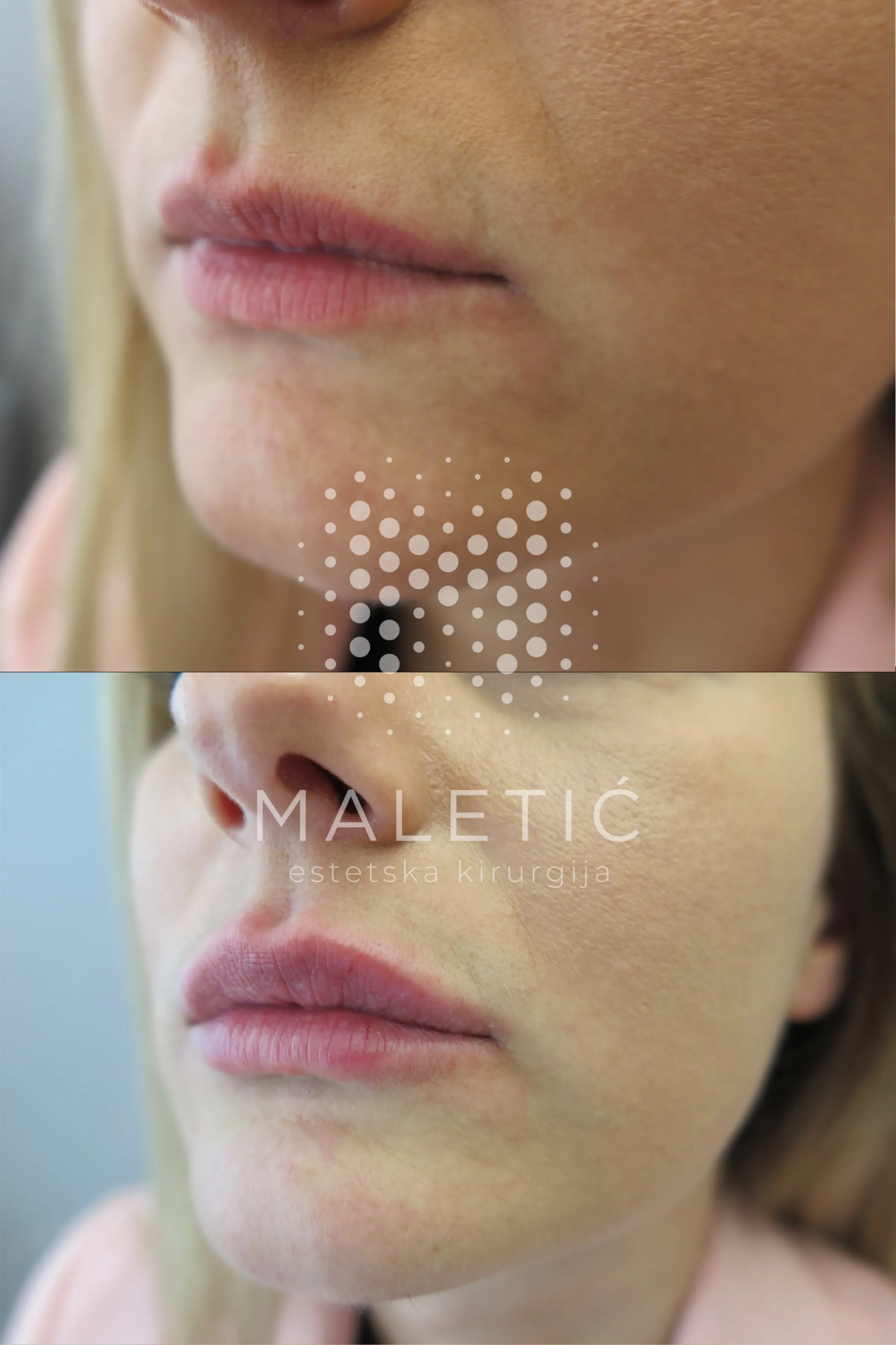
Dermal fillers can replace lost volume, soften certain wrinkles, and shape individual contours of the face. They do not, however, act on every cause of a changed appearance: they do not tighten pronounced excess skin, they do not by themselves improve skin texture, and they do not relax the muscles that create expression lines. That is why the treatment is preceded by an exam at which we assess whether a filler is the appropriate method, where to apply it, and what amount is needed.
Is this for me?
What dermal fillers are, and what they can really do
Dermal fillers are gels injected into the skin or the tissue beneath it to replace lost volume, soften certain wrinkles, and shape the contours of the face. At the Polyclinic we use fillers based on hyaluronic acid, a substance naturally present in the body that binds water and whose amount in the skin decreases with age. These fillers are produced biotechnologically and are biodegradable, so the effect is maintained by repeating the treatment, with no permanent material in the face.
The change is visible immediately after the treatment, but the final impression is assessed only after a few days, once the swelling and any bruising subside.
Permanent fillers also exist, and injectable silicone is still offered in some places for aesthetic purposes. We do not use them at the Polyclinic, because a non-biodegradable material cannot simply be removed in the event of an unsatisfactory result or a complication. The US regulatory agency has not approved injectable silicone for any aesthetic procedure, and the documented consequences include long-lasting pain, infections, and permanent changes in appearance.
Who a filler suits, and who it does not
A filler is appropriate when the main problem is loss of volume — for example in the midface, a weakened contour of the chin or jawline, or the need to correct the shape and volume of the lips.
If the main problem is not loss of volume, a filler will not act on its cause. Uneven skin texture and quality, pronounced excess skin, and wrinkles created solely by muscle activity are not solved by adding volume. In such cases a filler can have an insufficient effect or place additional load on already lax tissues.
We postpone the treatment if there is active inflammation or infection at the injection site, and we take particular care with blood clotting disorders, a history of severe allergic reactions, and known hypersensitivity to local anesthetics, because many fillers contain lidocaine. Fillers are not applied during pregnancy or breastfeeding, because their safety in these conditions has not been studied.
Fillers, Botox, and skin biorevitalization are not the same
Botox, dermal fillers, and biorevitalization act on different causes of facial change. Botox reduces the activity of the muscles that create expression lines, especially on the forehead, between the eyebrows, and around the eyes. A dermal filler does not act on the muscle — it replaces lost volume.
Profhilo is also injected and contains hyaluronic acid, but its goal is not to create volume or contour; it acts on the quality and hydration of the skin. For some patients a combination of methods may be recommended, depending on the findings and the goal of the treatment.
The face
Fillers for the face: volume, contour, and wrinkles
Volume changes do not develop equally in all parts of the face. Loss of support in the midface can contribute to the descent of tissue and to more pronounced lines toward the mouth. That is why the treatment plan is not based only on directly filling an individual wrinkle, but on assessing the balance of volume and contours across the whole face.
Cheekbones and the midface
Replacing volume in the area of the cheekbones and the midface restores support to the surrounding tissues. The change can also be reflected in the lines that descend toward the mouth, even though the filler was not applied directly into those folds.
Nasolabial folds and marionette lines
A nasolabial fold does not always arise only from a lack of volume in the fold itself. Its depth can also be influenced by loss of support in the midface. Filling it directly, without assessing the surrounding structures, can require a larger amount of filler and place additional load on the tissue. When the needed volume is first restored above the fold, the fold can soften, and any remaining line is then treated with a smaller amount if needed.
Patients often come with the wish to fill in the nasolabial fold. In many cases its depth is driven by loss of volume above it. If only the fold is treated, a larger amount of filler may be needed, with additional load on the tissue. — Mario Bartol, MD
Chin and jawline
Fillers can shape the chin and the jawline in both women and men. In this area even a smaller amount can visibly change the contour, so the treatment is planned gradually, according to your anatomy and the result you want.
The lips
Lip fillers: shape, definition, and restraint
When treating the lips, the desired volume needs to be balanced with their initial shape, the proportions of the face, and the anatomical boundaries of the tissue. How natural the change looks depends not only on the amount of filler, but also on where and how it is applied. A larger amount does not necessarily mean a better result.
Your first time, and how much
At a first treatment we can start with a smaller amount, with the option of topping up at the follow-up visit. Correcting an excessive amount is more demanding and may involve an additional treatment with hyaluronidase. The anatomical boundaries of the lips differ from person to person, so the same amount of filler does not give the same result in everyone.
Swelling and bruising — how long they last
Swelling of the lips can be more pronounced than in other parts of the face and is expected immediately after the treatment. Redness and tenderness usually subside within a few hours to a few days, while swelling and any bruising can last up to two weeks. If you are planning an important event, schedule the appointment early enough to leave time for these reactions to settle.
Filler migration in the lips
Migration means the filler moving outside the area where it was applied, most often above the lip border, where a visible or palpable thickening can appear that does not resolve on its own. The risk is reduced by appropriate dosing, correct technique, and avoiding reinjection before the previous filler has broken down. If migration does occur, a hyaluronic acid filler can be dissolved with hyaluronidase.
How it is done
What a filler treatment with us looks like
An exam before the first injection
The first appointment includes an exam of the face as a whole, at rest and in motion, and a conversation about the change you want to achieve. Based on the findings, we determine the treatment area, the type of filler, and the amount needed. The exam and consultation are included in the price of the treatment.
- Duration
- 20–45 minutes, depending on the area
- Anesthesia
- numbing cream or local anesthetic
- Recovery
- back to everyday activities the same day
- Performed by
- Mario Bartol, MD
Needle or cannula — and why it matters
A filler can be applied with a fine needle or with a cannula, a flexible tube with a blunt tip. Because a cannula penetrates the wall of a blood vessel less easily, in some areas it is associated with fewer bruises, while a needle allows more precise placement at an exact spot. Neither technique is better in every situation, so the choice depends on the anatomy and the area being treated.
How many milliliters you actually need
The amount of filler is determined by the findings and the treatment area. The price is calculated per milliliter of filler applied.
The amount of filler you need is not determined by the price list, but by the findings. At the exam we assess whether a filler is needed, in which area to apply it, and how much of it is appropriate.See the full price list
Why us
Why choose us for dermal fillers
Two generations of physicians
Two generations of physicians work at the Polyclinic today, at our locations in Zagreb and Daruvar.
Indication assessed before treatment
At the exam we assess whether the problem is loss of volume and whether a filler can achieve the change you expect.
Continuity of care
The same medical team accompanies you through the exam, the treatment, and follow-up visits.
Treatment in a medical institution
Dermal fillers are applied by a physician in a medical institution.
Treatment performed by Mario Bartol
Mario Bartol, MD, is a specialist in surgery and a member of the Polyclinic’s medical team since 2008.
Fillers can be dissolved
We use hyaluronic acid fillers which, when needed, can be dissolved with hyaluronidase.
Zagreb and Daruvar
the same team and the same standard of work at both locations
Honest about the limits
When a dermal filler is not the right method
A filler is not the right method if the main problem is not loss of volume. Particularly careful assessment is needed with under-eye circles, changes in skin quality, and pronounced excess skin.
Under-eye circles
The area under the eye calls for particularly careful assessment. The skin there is among the thinnest on the body, so the filler can show through more easily, give a bluish tint, or retain water, which can make the area look puffy. The cause of under-eye circles can be loss of volume, but also pigmentation, an anatomical shadow, or excess skin — none of which a filler acts on. The choice of method therefore depends on the cause we identify.
When the problem is the skin, not volume
If the main problem is thinned skin, uneven texture, or reduced skin firmness, a filler will not act on that cause. In such cases we consider treatments that act on skin quality, while the filler is postponed or not recommended.
If the main problem is skin quality or pronounced excess skin, adding volume will not act on its cause and can place additional load on the tissue.
When the real solution is surgery
With pronounced excess skin and advanced laxity, a filler cannot replace a surgical procedure, and adding volume can place additional load on the lower parts of the face. At the exam we assess whether there is an indication for a surgical method — or whether, at the moment, no procedure is needed at all.
Risks
Possible side effects, complications, and how they are managed
Common reactions in the first days
After the treatment, redness, swelling, tenderness, and possible bruising at the injection site are expected. Redness and tenderness most often subside within a few days, while swelling and bruising can last up to two weeks. Small irregularities in the first days can be a consequence of the swelling, so the result is not assessed too early.
Rare but serious complications
Serious vascular complications are very rare, but possible. They occur when filler unintentionally enters a blood vessel, and the consequences can include tissue damage and tissue death and, extremely rarely, visual disturbances. Before the treatment we assess the anatomy and the treatment area, choose the appropriate technique — needle or cannula — and explain the warning signs that require contacting the physician immediately in the hours after the procedure. A hyaluronic acid filler can be dissolved with hyaluronidase when there is an indication for it.
Less commonly, small nodules under the skin, an infection, or a delayed inflammatory reaction can appear — the latter sometimes weeks after the procedure, most often after a viral illness, vaccination, or dental work. If you notice such a change, contact your physician, because early assessment allows timely management.
In a large study among dermatologists, a vascular complication was recorded once per 6,410 needle injections and once per 40,882 cannula injections (JAMA Dermatology, 2021).
No medical procedure is without risk. Before a filler is applied, it is important to understand the expected reactions, the rare complications, and the warning signs that require contacting a physician immediately.
Fillers can be dissolved
A hyaluronic acid filler can be dissolved with the enzyme hyaluronidase. The procedure is used when the result is not satisfactory, when the filler has migrated, or when a complication requires dissolving it. Filler dissolving with hyaluronidase is listed separately in the Polyclinic’s price list.
Realistic expectations
How long the result of dermal fillers lasts
How long the effect lasts differs depending on the type of filler, the treated area, and your individual metabolism. A filler in a mobile area, such as the lips, generally breaks down faster than in less mobile parts of the face.
The effect of hyaluronic acid fillers most often lasts between six and twelve months, while in some areas it can last longer. Whether the treatment needs to be repeated is assessed individually, based on the state of the area at the follow-up visit.
The result
How the result is assessed
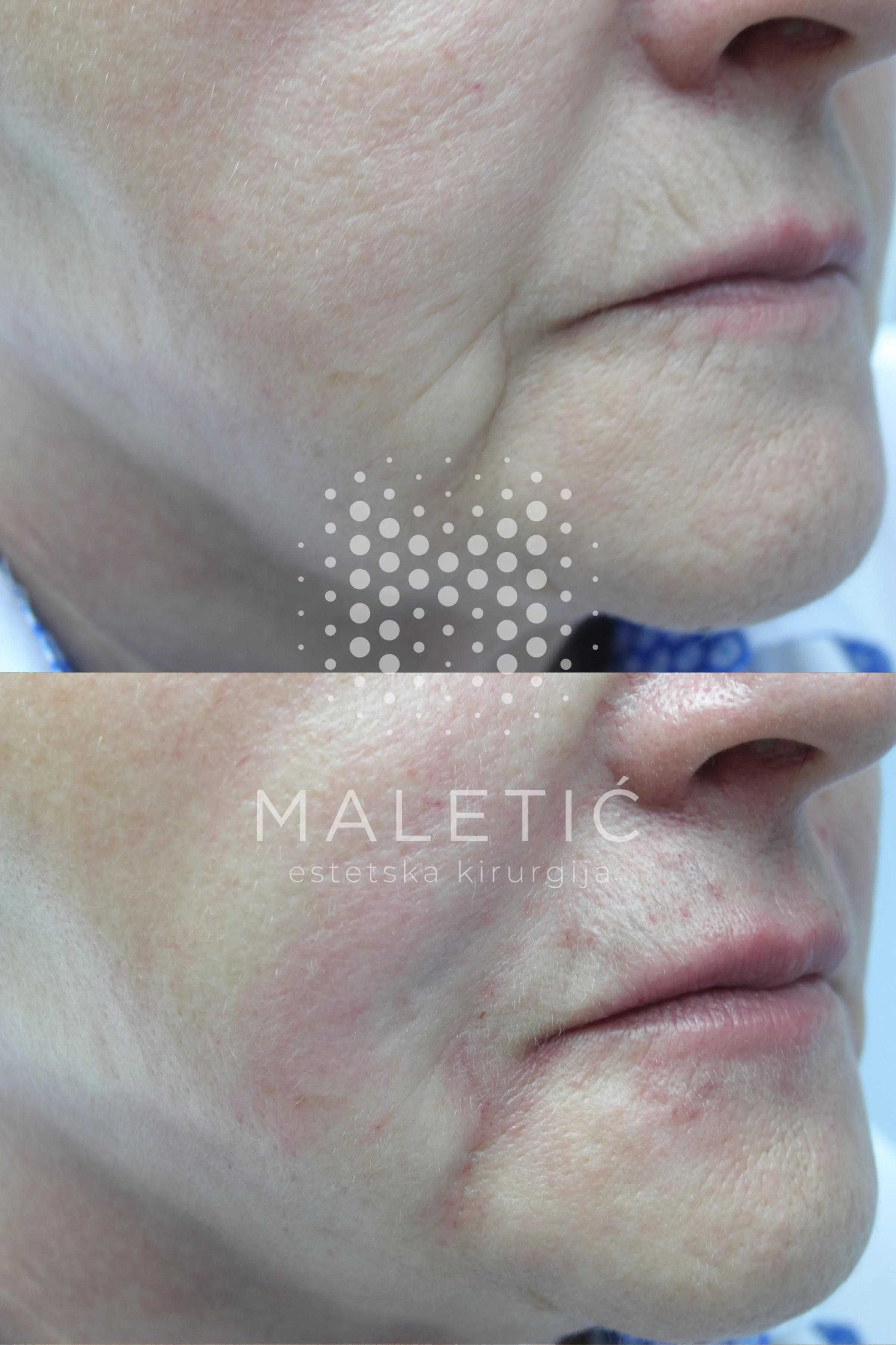
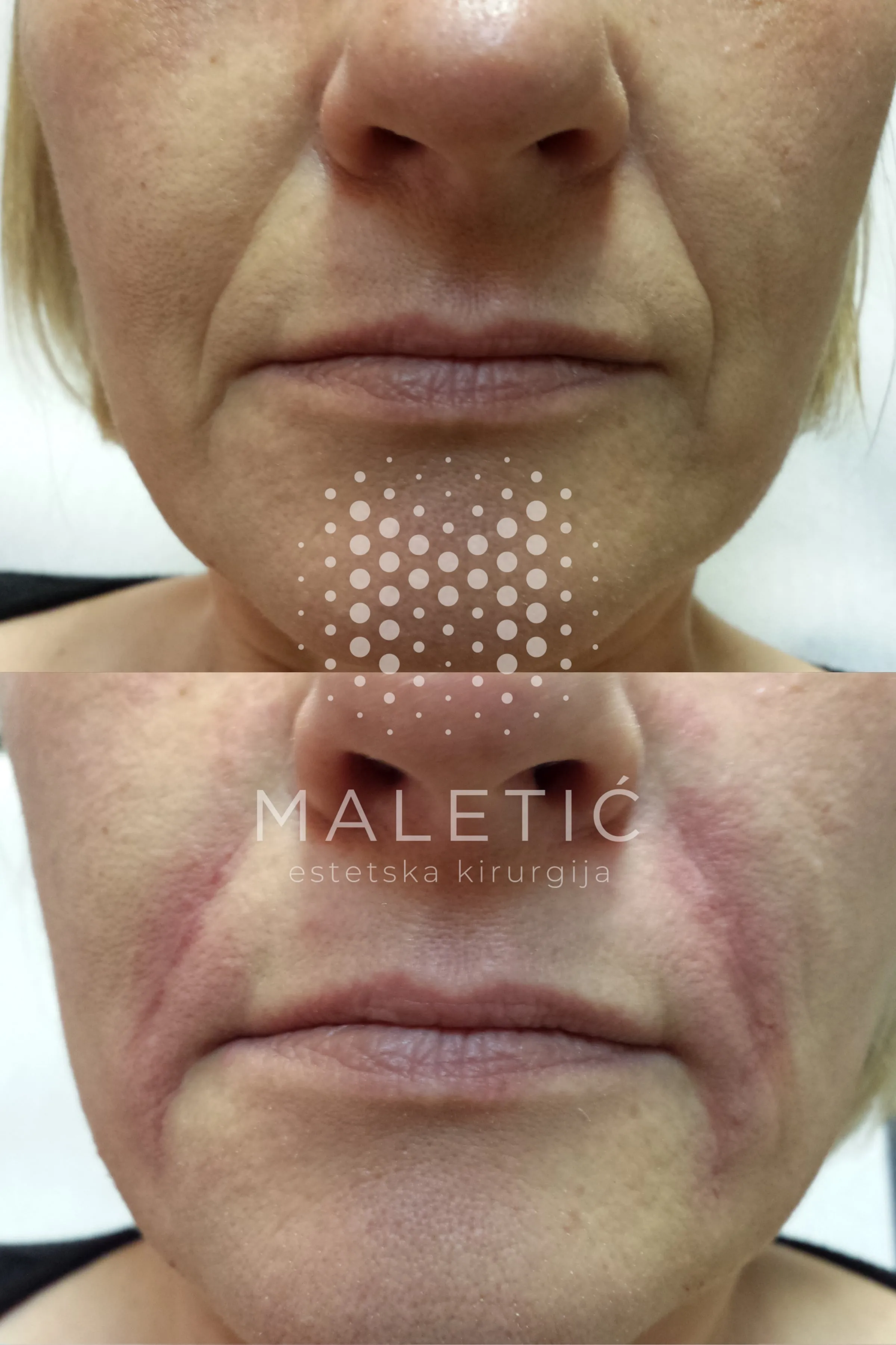
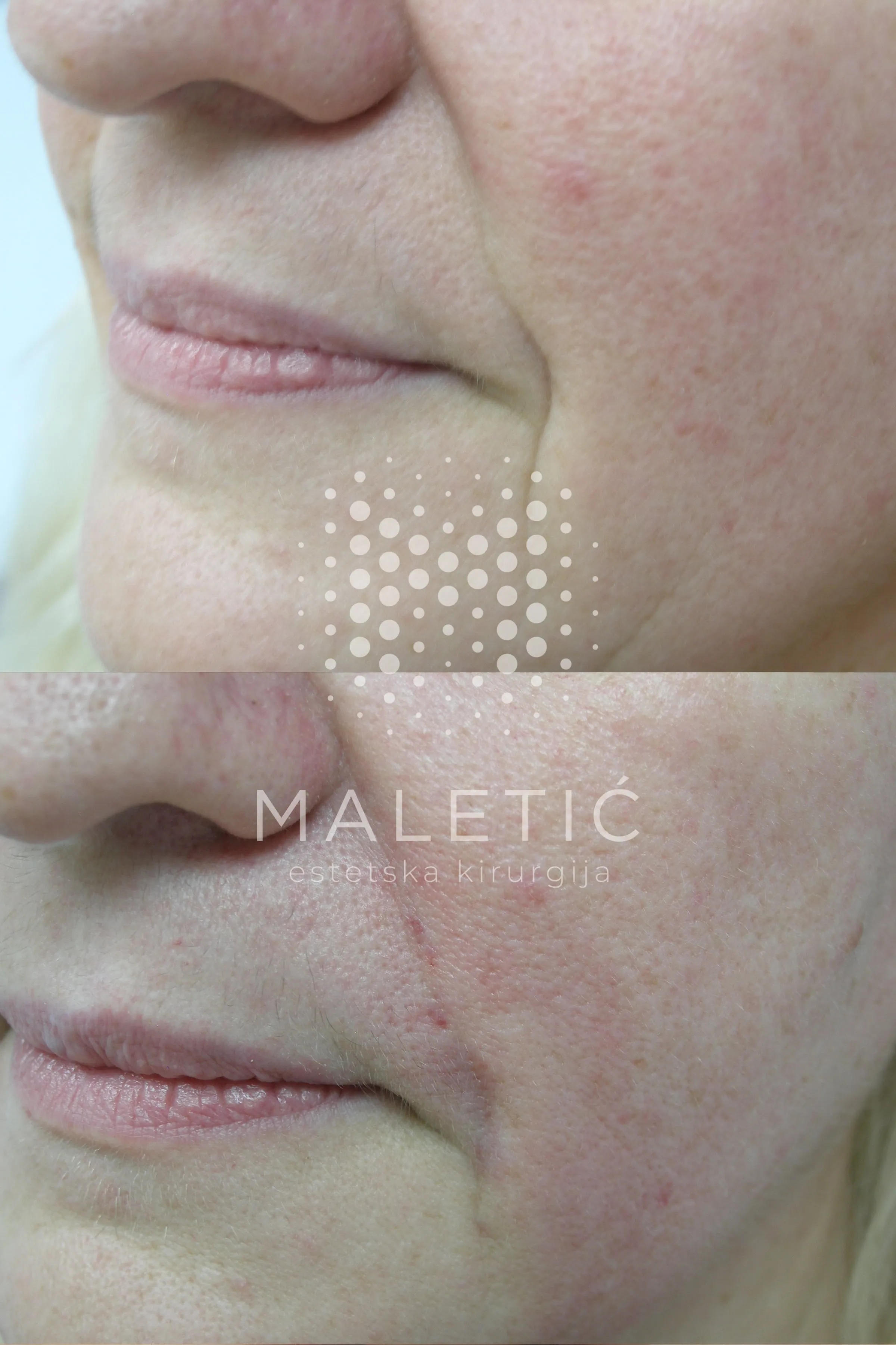
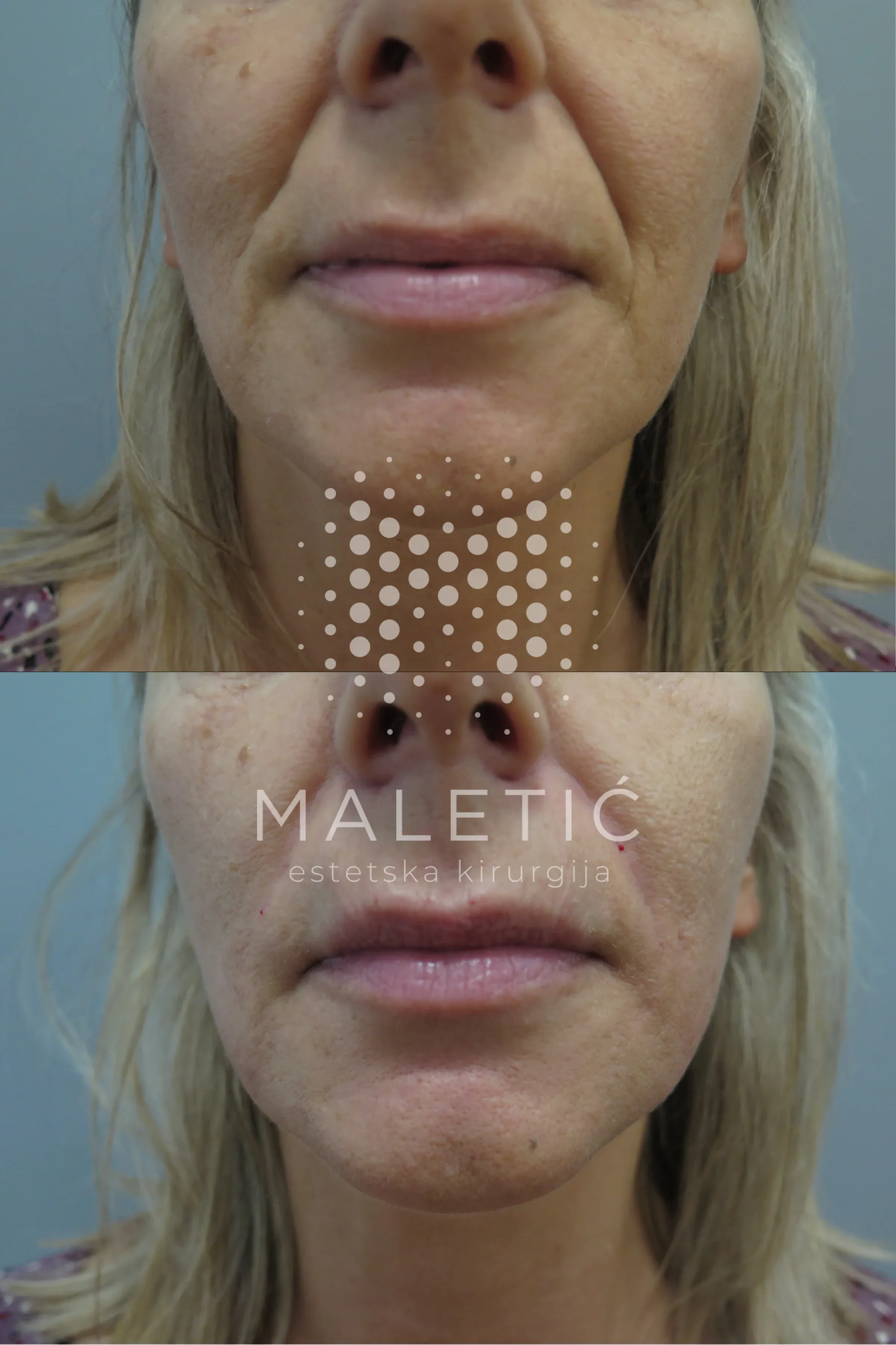
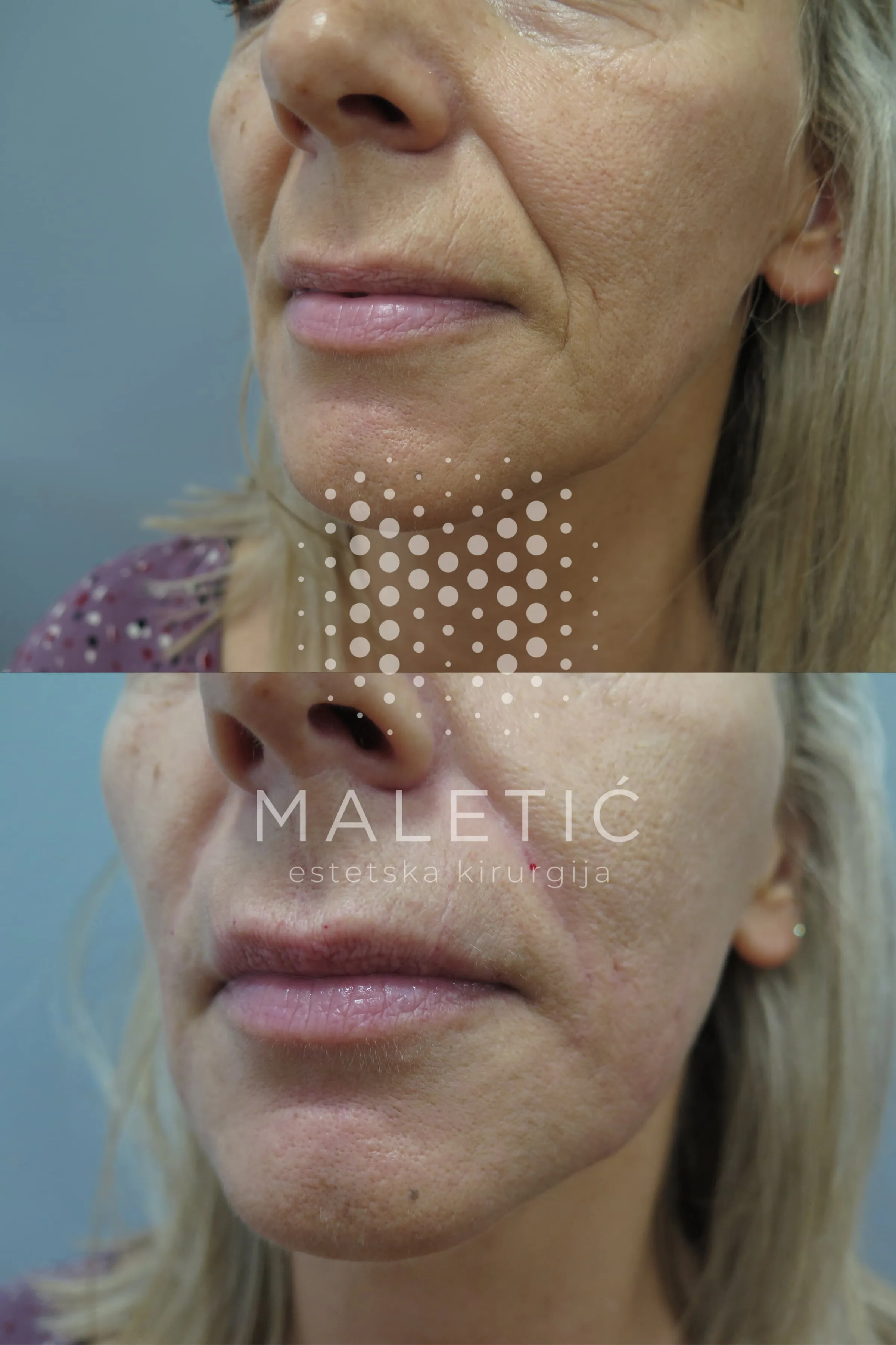
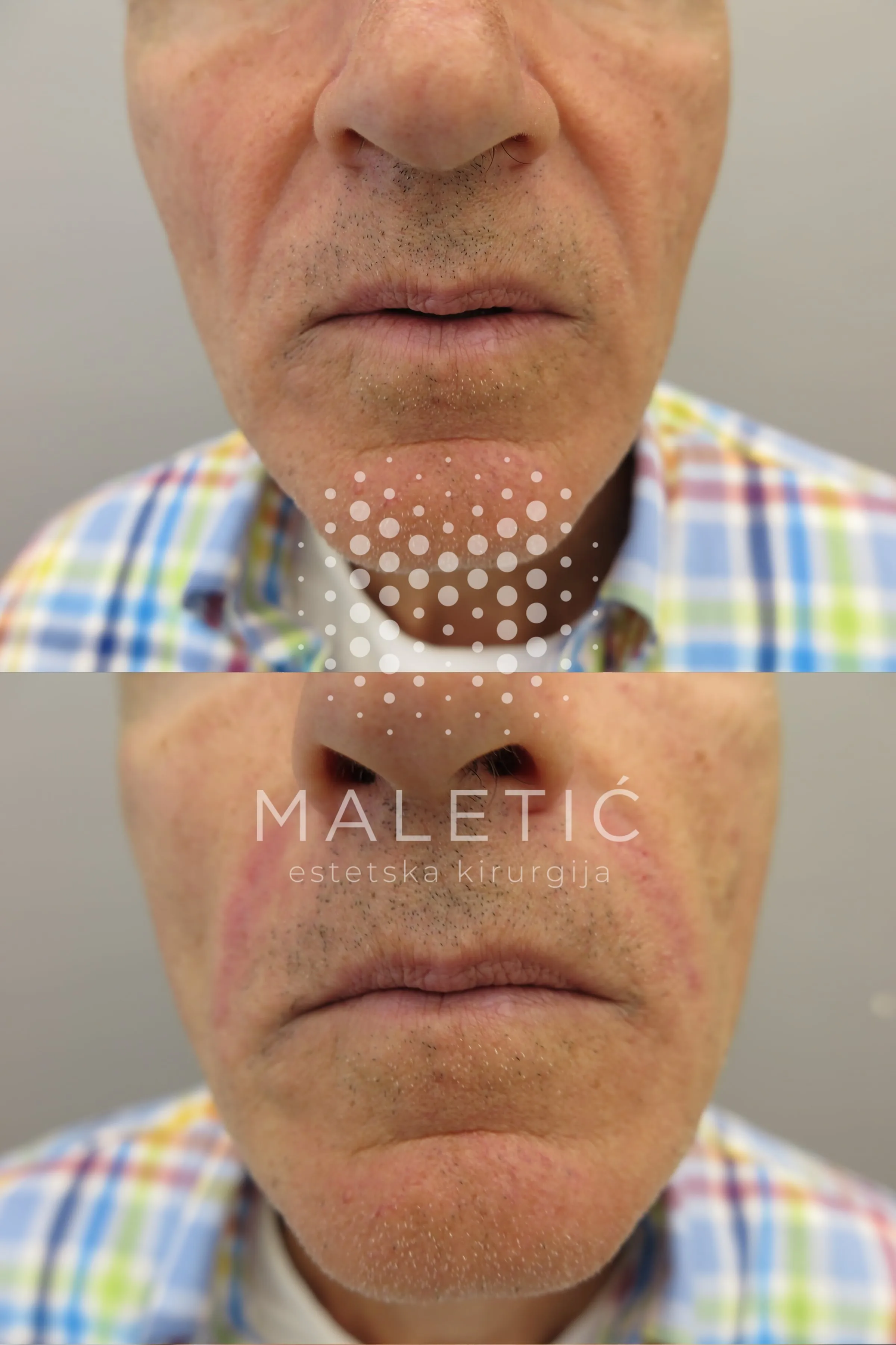
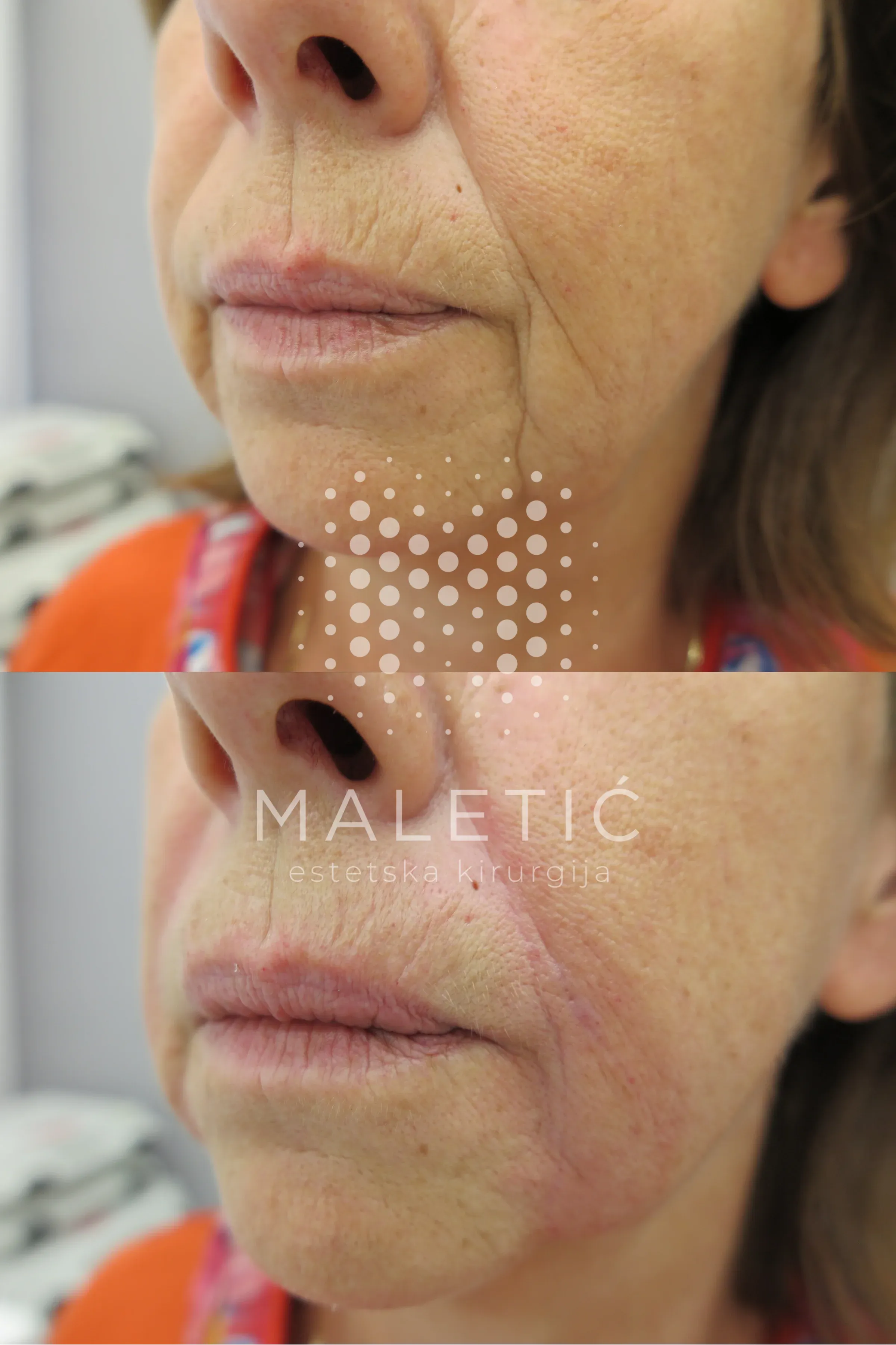
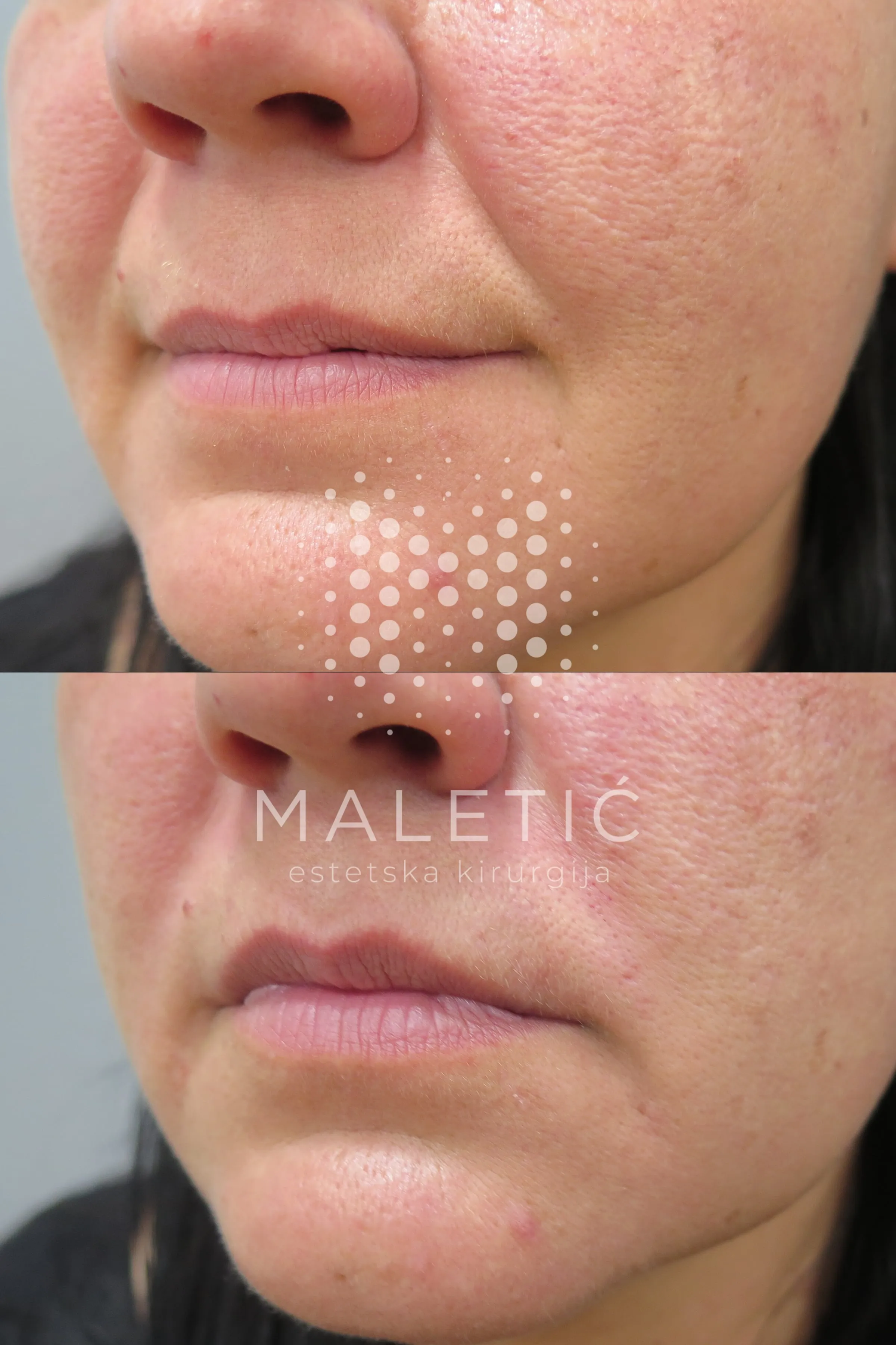
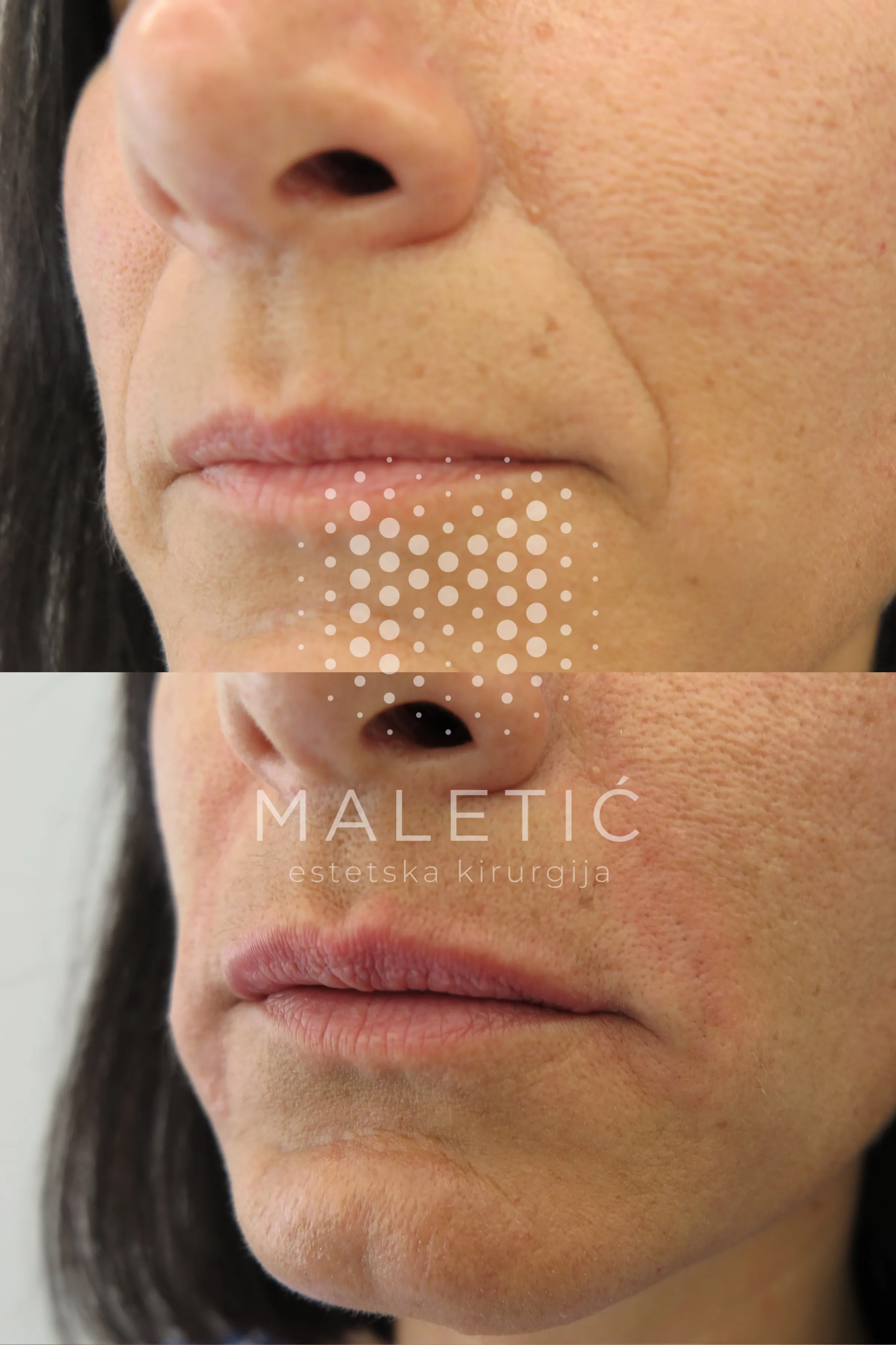
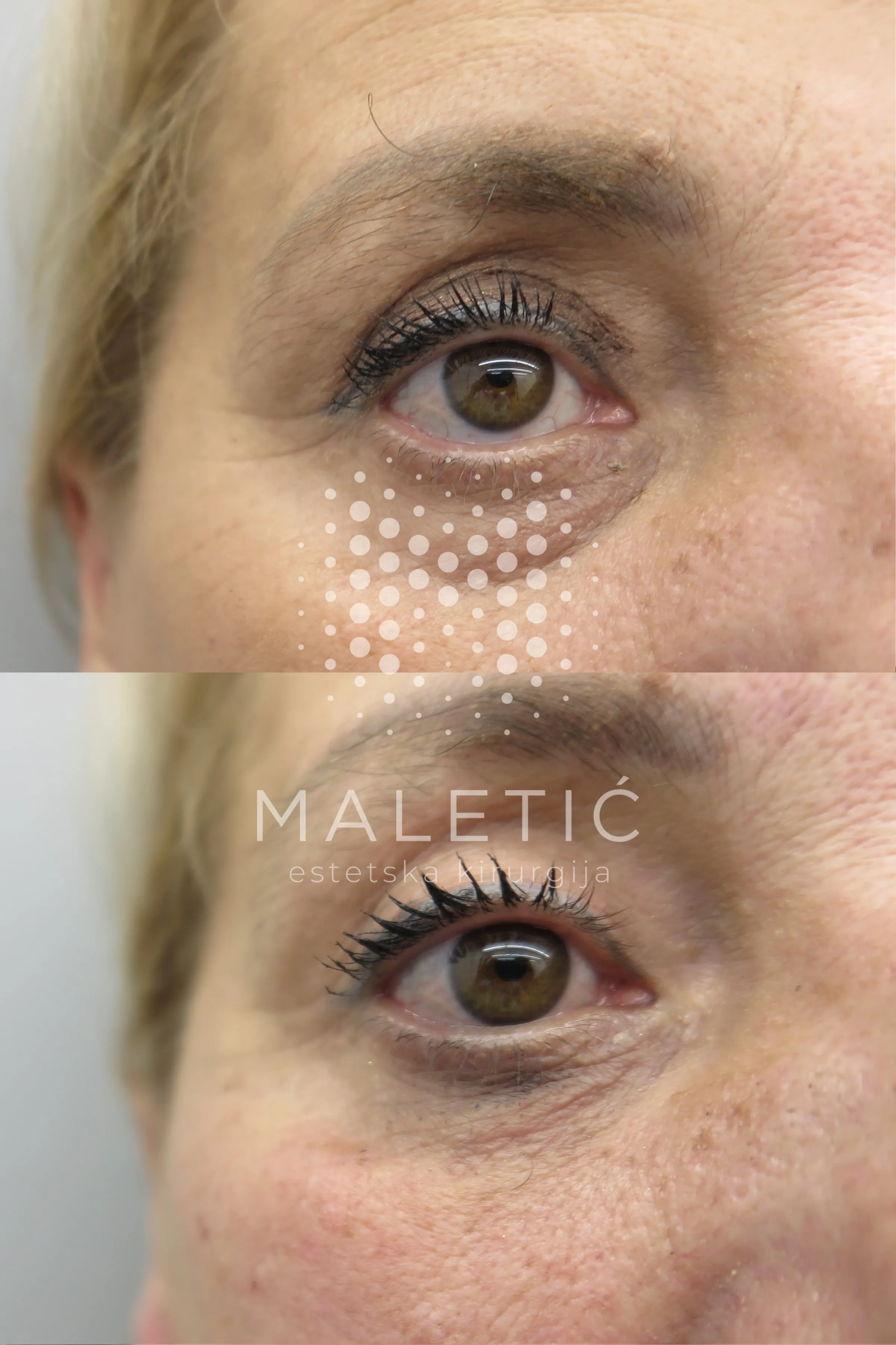
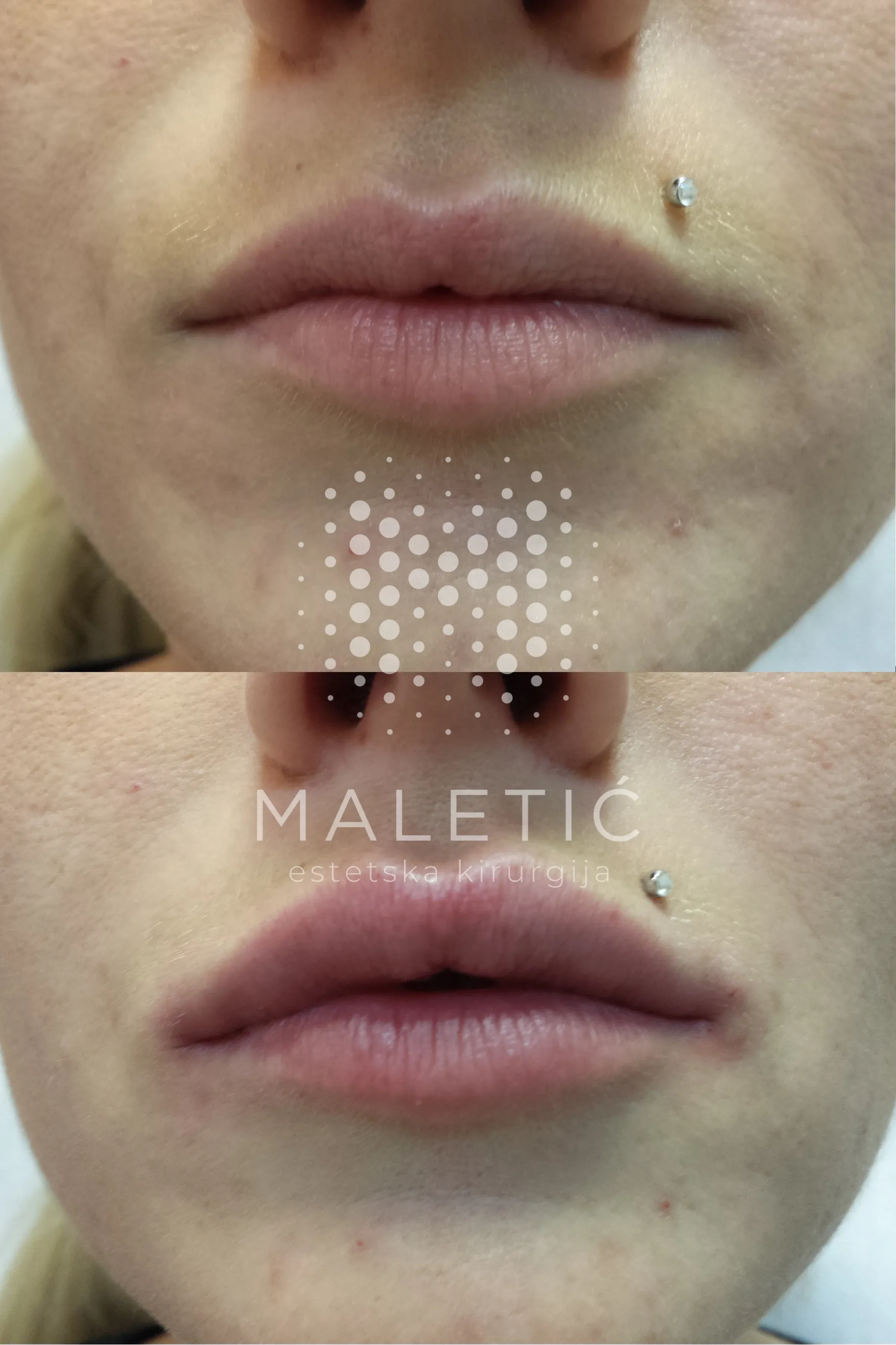
The result is assessed by clinical examination and by comparing standardized photographs taken before and after the treatment. Replacing volume in the midface can change the support of the tissues and soften the lines toward the mouth, even though the filler was not applied directly into them. In published patient series, improvements in the midface, the chin, and along the jawline were recorded even over a year of follow-up, with high patient satisfaction scores.
The degree of change depends on the initial loss of volume, the treated area, the amount of filler, and the individual anatomy of the face.
A filler does not stop the aging process and does not by itself improve the quality of the skin above the treated area.
Real results
Dermal fillers before and after
We show our patients’ results discreetly and only with their consent.
Who we are
Who will be taking care of you
Dermal fillers at Polyclinic Maletić are applied by Mario Bartol, MD, a specialist in surgery and a member of the Polyclinic’s medical team since 2008. Alongside injectable treatments he also performs laser procedures, and he performed the first laser vein operation in Croatia.
Polyclinic Maletić is a family institution founded in 1998, with locations in Zagreb and Daruvar. The same medical team accompanies you through the exam, the treatment, and follow-up visits — and you can turn to them if a question or an unexpected reaction arises after the procedure.
Meet the whole team
Price
The price of dermal fillers
The price is determined by the number of milliliters of filler applied, and the amount needed is assessed at the exam based on the findings. The exam and consultation, at which the indication, the area, and the amount of filler are determined, are included in the price of the treatment.
Dissolving a hyaluronic acid filler with hyaluronidase is listed separately in the price list. To have the indication, the treatment area, and the amount needed assessed, contact us to arrange an exam in Zagreb or Daruvar.
You can find our other procedures and treatments on the Aesthetic Surgery page.
-
Hyaluronic acid filler, 1 ml
-
Filler dissolving with hyaluronidase
The price is per milliliter of filler. The exam and consultation, at which we decide together whether a filler makes sense and how much of it is needed, are included in the price.
See the full price listPatient reviews
What our patients say
Reviews taken from our Google Business profiles, Zagreb and Daruvar, translated from Croatian.
★★★★★
“All praise for Polyclinic Maletić in Daruvar! I had lip augmentation with fillers and I am very satisfied with the result. I would especially like to praise Dr. Mario Bartol, who is extremely kind and professional and has a wonderful approach to patients, which made me feel comfortable and safe throughout the treatment. All the nurses are also very kind, helpful, and professional. I warmly recommend them to anyone considering aesthetic treatments!”
★★★★★
“Since high school I watched the double chin I inherited from my father become more and more pronounced — and 15 years later, the double chin is gone. A big thank you to Dr. Maletić and the whole team for making my wish come true. The procedure was painless, as was the recovery, and the results were visible after just a few days. The whole team was extremely kind and cheerful, and the atmosphere very pleasant. I left the polyclinic satisfied, and when I saw, two days after the swelling went down, that the double chin was gone, my satisfaction knew no bounds. I warmly recommend Polyclinic Maletić.”
★★★★★
“My experience with breast augmentation with Dr. Maletić in Daruvar was excellent. I am extremely satisfied with the result. All the nurses are very kind and professional. I absolutely recommend them.”
★★★★★
“Laser acne treatment is the only treatment that helped me, and I would not choose any other facial treatment over it. Dr. Ines is one of the kindest people I have ever met and always has useful advice. Kind staff and top-level service — I warmly recommend her to everyone!”
★★★★★
“I had a wart on my face removed by laser. A very professional service with excellent results. The wart was quite large, but after just one treatment it was gone. All recommendations!”
★★★★★
“I recently had a varicose vein procedure. All praise to the whole team.”
★★★★★
“Blepharoplasty, 4D laser, and double chin. Perfect. All recommendations!”
★★★★★
“The best team of physicians, extremely professional and kind. I have been loyal to Polyclinic Maletić for more than 10 years and I am always satisfied with the results. Thank you.”
★★★★★
“I came to Dr. Maletić with a big problem and a lot of stress. I was met with such warm empathy and kindness, and patience in answering all my questions. Thank you, Dr. Maletić, for the advice and sincere support. I know I can always turn to her for advice, and that means a lot to me. The staff of the Zagreb polyclinic are also very helpful and kind. My thanks to them as well.”
★★★★★
“Dr. Maletić’s practice, both in Daruvar and in Zagreb — and I have had several procedures — I can only recommend, because I felt very comfortable and in expert hands there!”
Questions and answers
Frequently asked questions
Do dermal fillers hurt?
Before the treatment we use a numbing cream or a local anesthetic. During the injection you may feel short pricks and pressure as the filler is distributed, especially in the lip area, which is more sensitive than the rest of the face. If you feel more pronounced discomfort, tell the physician right away so the treatment can be adjusted or briefly paused.
How many milliliters of filler do I need?
The amount needed cannot be reliably determined in advance or over the phone, because it depends on the treated area and the extent of volume loss. At a first treatment we most often start with a smaller amount, which can be topped up at the follow-up visit if needed. The price is calculated per milliliter of filler applied.
How long does the result last?
A hyaluronic acid filler breaks down over time, and how long the effect lasts depends on the type of filler, the treated area, and your individual metabolism. Most often it is a period of six to twelve months, while in some areas the filler can last longer. The change is visible immediately after the treatment, and the final impression is assessed once the swelling and any bruising subside.
Can the filler be removed if I don’t like it?
Hyaluronic acid fillers can be dissolved with hyaluronidase, an enzyme injected into the treated area. Dissolving is also listed in the Polyclinic’s price list. Permanent fillers cannot be removed with hyaluronidase, so managing an unsatisfactory result or a complication is more complex.
Will people be able to tell I had fillers?
An exaggerated or unnatural result can occur if too much filler is applied or if the filler is placed in an unsuitable area. That is why the plan is adapted to the anatomy of your face and the degree of change you want, and at a first treatment we can start with a smaller amount and assess the result afterwards.
How long do swelling and bruising last?
Redness and tenderness at the injection site usually subside within a few hours to a few days, while swelling and any bruising can last up to two weeks. Swelling of the lips can be more pronounced than in other parts of the face. If you have a wedding, a photo shoot, or an important business event coming up, mention it at the exam so the treatment can be planned early enough.
Do fillers fix under-eye circles?
With the right indication, a filler can soften the hollow under the eye, but the result is not equally suitable for everyone. The skin in that area is among the thinnest on the body, so the filler can show through more easily, give a bluish tint, or retain water, which can make the area look puffy. Before the treatment we assess the anatomy, the quality of the skin, and the actual cause of the under-eye circles.