
Since 1998 · Zagreb & Daruvar
Fat Transfer in Zagreb and Daruvar, Croatia
A fat transfer restores lost volume with your own tissue. Part of the introduced volume is expectedly resorbed, so depending on the final findings, a second session may be needed.
A fat transfer is used when lost volume of the cheeks, temples, lips, or deeper folds needs to be restored. Before the procedure, the examination establishes whether the main problem is volume, laxity, or skin quality, and we explain how much of the introduced tissue is retained on average and when a second session may be needed.
Is this for me?
What a fat transfer is
A fat transfer, also known as lipofilling, is a procedure in which your own fat tissue is harvested by liposuction from one region and introduced into an area that lacks volume.
The volume is restored with your own tissue, without introducing any foreign material, so there is no risk of an allergic reaction or rejection. The cells that take develop their own blood supply and remain living tissue in their new location.
The procedure is most often performed for the face, lips, and deep wrinkles, which is what this page covers. The same method is also used elsewhere on the body, and we have separate pages for that: breast augmentation with your own fat tissue, labia majora correction, penis enlargement, and fat transfer to the scalp.
Areas we treat
Which regions can be treated
Cheeks and the volumetric lift
Fat tissue is most often transferred to the malar region — the cheeks. Restoring volume can increase the fullness of the middle third of the face and support tissue that has descended over time, which can soften the nasolabial fold and irregularities along the jawline. That effect is called a volumetric lift.
Lips
Lip augmentation with your own fat tissue is a common application, above all because no material that needs regular topping up is introduced. The share of retained tissue varies from one facial region to another, so the final fullness of the lips is often achieved only after a second session.
Deep wrinkles and folds
Deep wrinkles, first of all the nasolabial folds, can be filled with fat tissue. For fine lines and for skin quality, fat tissue is not the appropriate method; we cover that below.
The backs of the hands
The backs of the hands can lose subcutaneous fat tissue over time, which makes the tendons and veins more prominent. A fat transfer restores the volume, while radiofrequency and laser treatments can be used for changes in skin quality.
How we work
How a fat transfer is performed
Harvesting the tissue. The fat tissue is harvested by liposuction, most often from the abdominal wall or from the inner or outer thighs. The choice of donor region and the way the tissue is harvested determine how many fat cells remain undamaged and take in their new location.
Preparation. The fat tissue is separated from the local anesthetic and blood. This can be done by centrifugation or by decanting — settling, in which the layers separate without a centrifuge. At the Polyclinic, decanting is used. The professional literature still debates the optimal method of preparation, and no method has been proven superior to the others.
Introducing the tissue. The prepared tissue is transferred into syringes and introduced into the area whose volume is being restored. It is not introduced with needles but with rounded, blunt-tip cannulas with side openings, which greatly reduces the chance of damaging local blood vessels — especially important in the face. The tissue is not left in a single deposit; it is distributed in small amounts and in several layers, so that every part comes into contact with well-perfused tissue and has a better chance of taking.
The procedure can be performed under local tumescent or general anesthesia, depending on the size of the region being treated and the agreement with the surgeon. If the procedure is under local anesthesia, you go home right after it; if under general, after recovering from the anesthesia.
- Duration
- about 1–2 hours, depending on the extent
- Anesthesia
- local tumescent or general, depending on the size of the region
- Recovery
- swelling and bruising for up to two weeks
- Performed by
- Duško Maletić, MD, MSc, and Mario Bartol, MD
Why us
Why choose us for your fat transfer
A family polyclinic since 1998
We have been practicing aesthetic surgery for almost three decades, under the same family.
The surgeons who perform the procedure
The procedure is performed by Duško Maletić, MD, MSc, and Mario Bartol, MD.
Experience from liposuction
A fat transfer begins with harvesting fat tissue — and we have been performing liposuction for decades.
Your own fat tissue
Your own fat tissue is used, with no risk of an allergic reaction or rejection of foreign material.
Blunt-tip cannulas
We introduce the fat tissue with rounded-tip cannulas with side openings, which reduces the risk of injuring blood vessels.
Preparation by decanting
We separate the fat tissue from the local anesthetic and blood by decanting.
Assessment before the procedure
At the examination we distinguish volume loss from laxity and changes in skin quality.
Zagreb and Daruvar
The same team follows you from the consultation to the last follow-up, at both locations.
Honest about the result
How much of the fat actually survives
The share of tissue that is retained is one of the key factors of the final result.
In the first days the transferred cells have no blood supply of their own and are nourished by diffusion from the surrounding tissue. The part that does not connect to the surrounding blood vessels in that period is broken down by the body. That is not a complication — it is the expected course. Pooled analyses of published studies show that on average roughly half of the introduced volume is retained, with a very wide range: in some people about a quarter remains, in others more than three quarters. How much will remain in your case cannot be reliably predicted in advance.
Because of the expected resorption, overcorrection is planned — a larger volume than the planned final result is introduced. The appearance during the first weeks is therefore not final. After three to four months the retained volume can be assessed and, if needed, a second session planned. The final volume stabilizes by the end of the first year, and the share of tissue retained by then remains permanent.
Why a second session is often needed
A second session can be performed when, after stabilization, additional volume needs to be restored. Published data suggest that repeat procedures can have a higher share of retained tissue than the first, because the previously accepted tissue creates more favorable conditions for the new graft.
Recovery
Recovery
Swelling and bruising can appear in both the donor and the treated region. They are most pronounced during the first days and as a rule subside within roughly two weeks. A return to everyday obligations is possible even earlier, with swelling and bruising possibly still visible.
The result is not assessed during the first weeks, because swelling and the initially larger introduced volume are present at the same time. A more reliable assessment is possible after the volume stabilizes — that is, after a few months.
A more significant weight loss after the procedure can jeopardize the result, because the transferred tissue behaves like the rest of the fat tissue in your body. If you are planning to lose weight, it is better to postpone the procedure.
Possible risks and complications
Since your own tissue is used, there is no risk of allergy or rejection. The most common transient effects are swelling and bruising. Possible complications include asymmetry and unevenness, which can arise from uneven take of the tissue or an inappropriate distribution of volume. Depending on the findings, a corrective second session can be considered. Fat necrosis — the breakdown of part of the transferred tissue, which can be felt as a small lump — and infection are rare. Vascular complications, which occur if fat tissue enters a blood vessel of the face, are very rare but serious, and they are precisely the reason blunt-tip cannulas and introduction in small amounts are used.
The risk of complications depends on the individual findings, general health, the extent of the procedure, the surgical technique, and the postoperative recovery.
Fat, fillers, and nanofat
Fat, fillers, and nanofat: three different questions
Dermal fillers, fat transfer, and nanofat have different compositions, goals, and expected effects.
Dermal fillers based on hyaluronic acid restore volume with an immediately visible effect, which diminishes over time, so the treatment is repeated as needed.
Fat transfer restores volume with your own whole fat cells, and what takes remains permanent.
Nanofat is not meant for volume. The fat tissue is mechanically broken down and filtered so that no whole fat cells remain, which is why nanofat does not add volume. What remains acts on the quality of the skin: texture, tone, and glow.
“With fillers, one of the main questions is how long the effect lasts; with a fat transfer, it is what share of the volume will be retained. That is why the expectations of these procedures differ as well.”
When skin quality needs to be addressed alongside volume, both procedures can be performed in the same session, and the price list has a separate line for that. We write more about it on the nanofat page.
A realistic assessment
When a fat transfer is not the right procedure
If the main problem is laxity and excess skin rather than lost volume, a fat transfer cannot remove that excess. Depending on the degree of laxity, a facelift or, in earlier stages, an Aptos thread lift can be considered.
If the main problem is texture, tone, glow, or fine lines, nanofat or laser treatments may be more appropriate.
If the examination shows no indication for the procedure or the changes are mild, monitoring without immediate treatment can be recommended.
Who we are
Who will be taking care of you
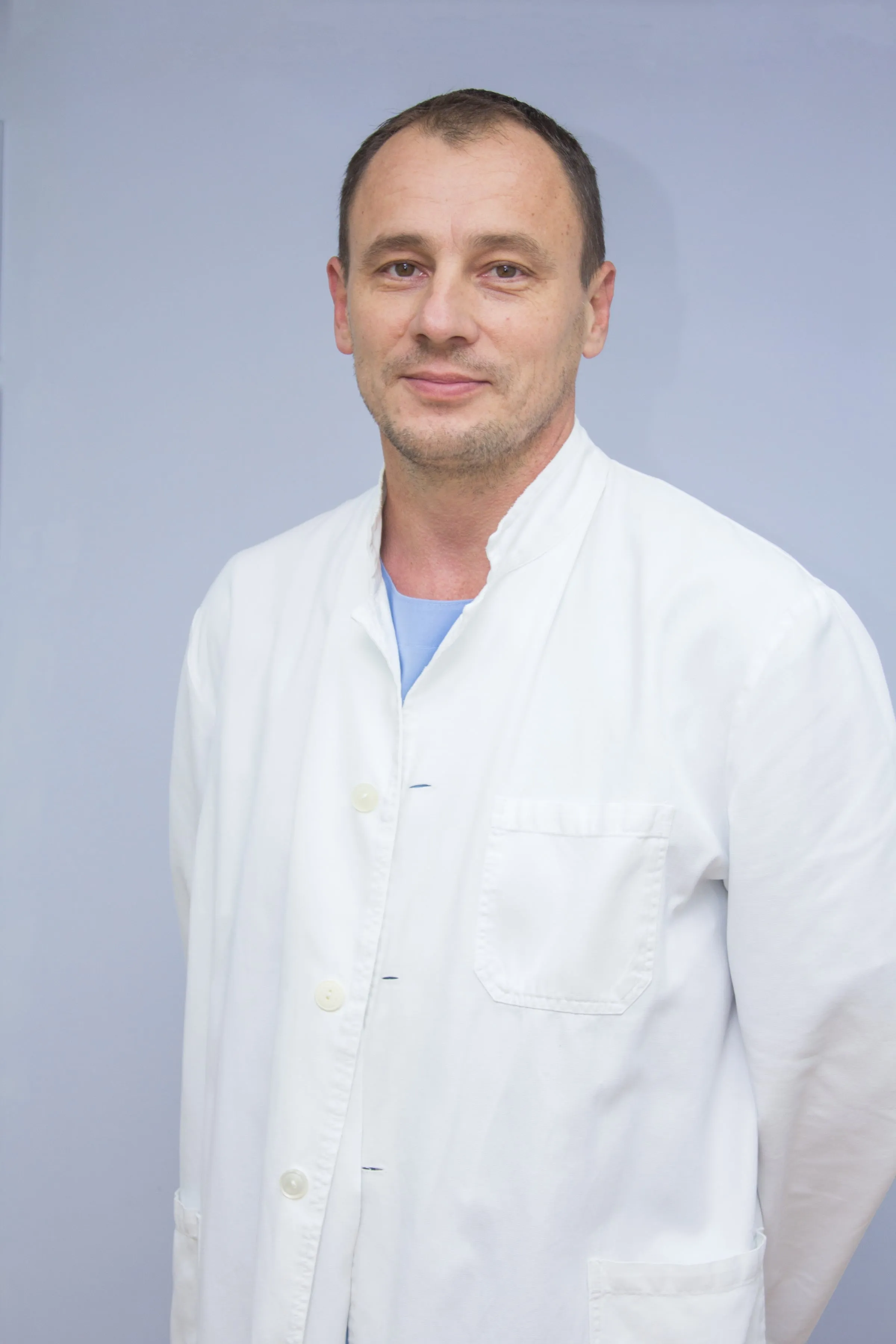
Fat transfers are planned and performed by Duško Maletić, MD, MSc, and Mario Bartol, MD, specialists in surgery. The Polyclinic has operated as a family institution since 1998 and has been performing liposuction and fat transfer for decades. The result depends on the way the tissue is harvested, prepared, and introduced. Alongside the surgeons are the nurses who accompany the patient from preparation to the final follow-ups.
Meet the whole team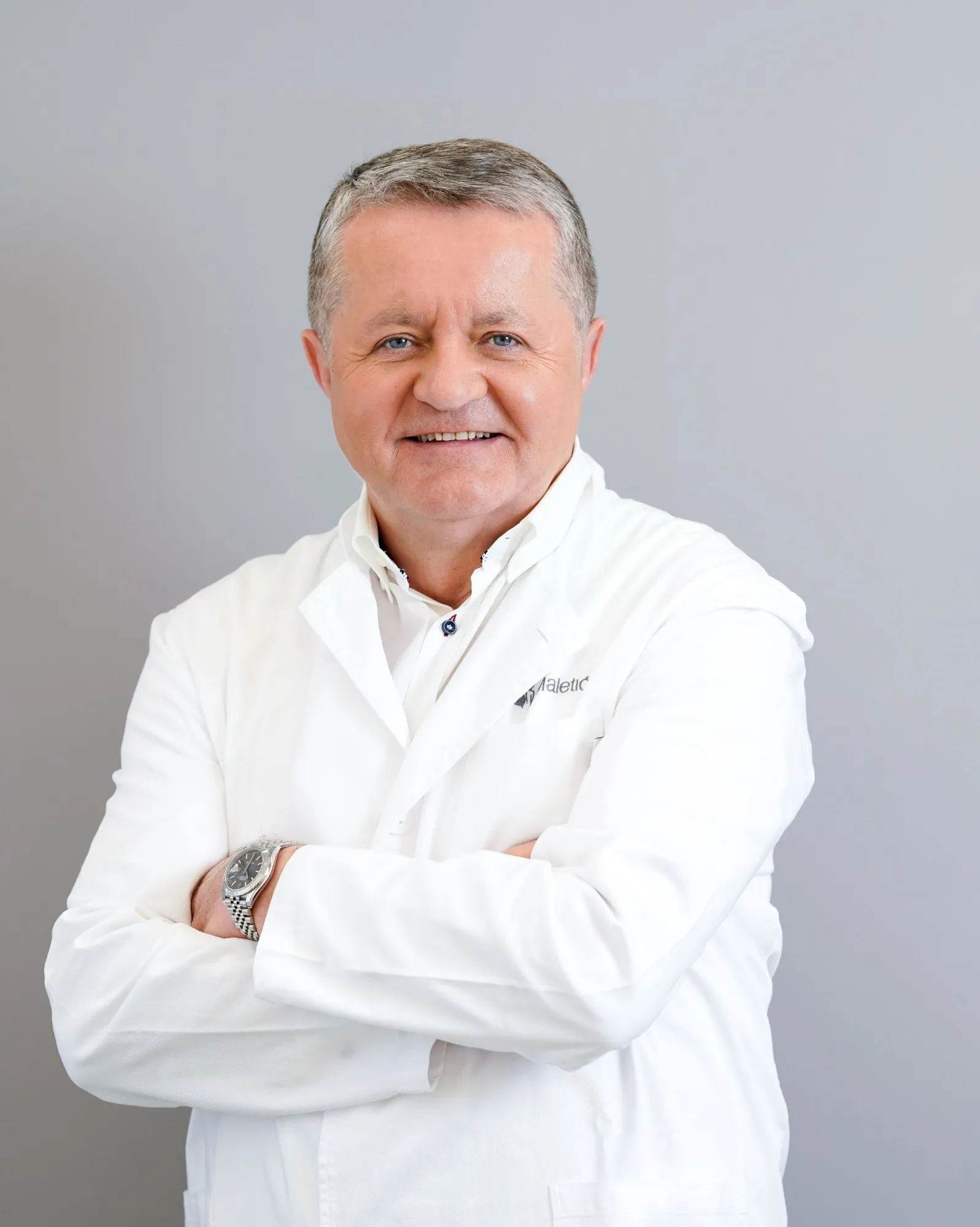
After the procedure
Long-term changes of the transferred tissue
Once the volume settles, the transferred tissue becomes part of the face. It follows changes in body weight and ages together with the surrounding tissue, so the result does not change abruptly in either direction.
The volume is restored, but excess skin is not shortened by it, and aging does not stop.
Price
Price and the first step
The price list contains two items. The first refers to a fat transfer to the face, lips, and wrinkles. The second refers to the combination with nanofat, when skin quality is addressed alongside volume. You can also see the prices of all procedures in the price list.
-
Fat transfer (face, lips, wrinkles)
-
Fat transfer + nanofat
The procedure can be performed under local tumescent or general anesthesia, depending on the size of the region and the agreement with the surgeon.
See the full price listThe first step is an examination at which we assess whether the main problem is volume loss, laxity, or skin quality, which regions can be treated, and what to expect after the first and a possible second session. Get in touch and we will arrange an appointment in Zagreb or in Daruvar.
You can find the other procedures in this area under Face & Neck Surgery.
Patient reviews
What our patients say
Reviews taken from our Google Business profiles, Zagreb and Daruvar, translated from Croatian.
★★★★★
“My experience with breast augmentation with Dr. Maletić in Daruvar was excellent. I am extremely satisfied with the result. All the nurses are very kind and professional. I absolutely recommend them.”
★★★★★
“Since high school I watched the double chin I inherited from my father become more and more pronounced — and 15 years later, the double chin is gone. A big thank-you to Dr. Maletić and the whole team for making my wish come true. The procedure was painless, as was the recovery, and the results were visible within days. The entire team was extremely kind and cheerful, and the atmosphere very pleasant. I left the polyclinic satisfied, and when, two days after the swelling went down, I saw that the double chin was gone, my satisfaction knew no bounds. I warmly recommend Polyclinic Maletić.”
★★★★★
“All praise for Polyclinic Maletić in Daruvar! I had a lip augmentation with fillers and I am very satisfied with the result. I would especially like to praise Dr. Mario Bartol, who is extremely kind, professional, and has a wonderful approach to patients, which made me feel comfortable and safe throughout the treatment. All the nurses are also very kind, helpful, and professional. I warmly recommend them to anyone considering aesthetic treatments!”
★★★★★
“Laser acne treatment is the only treatment that helped me, and I would not choose any other facial treatment over it. Dr. Ines is one of the kindest people I have ever met and always has useful advice. Kind staff and top-level service — I warmly recommend her to everyone!”
★★★★★
“I had a wart on my face removed by laser. Very professional service with excellent results. The wart was quite large, but it disappeared after just one treatment. All recommendations!”
★★★★★
“I recently had a varicose vein procedure. All praise to the whole team.”
★★★★★
“Blepharoplasty, 4D laser, and double chin. Perfect. All recommendations!”
★★★★★
“The best team of doctors, extremely professional and kind. I have been loyal to Polyclinic Maletić for more than 10 years and I am always satisfied with the results. Thank you.”
★★★★★
“I came to Dr. Maletić with a big problem and a lot of stress. I was met with such warm empathy and kindness, and patience in answering all my questions. Thank you, Dr. Maletić, for your advice and sincere support. I know I can always turn to her for advice, and that means a lot to me. The staff of the Zagreb polyclinic are also very helpful and kind. Thanks to them as well.”
★★★★★
“I can only recommend Dr. Maletić’s practice, both in Daruvar and in Zagreb — and I have had several procedures there — because I felt very comfortable and in expert hands!”
Questions and answers
Frequently asked questions
How much of the transferred fat actually survives?
On average, roughly half of the introduced volume is retained, with large individual differences. Pooled analyses of published studies report a range from roughly a quarter to more than three quarters. That is why a larger volume than the planned final result is introduced at the start, and the possibility of a second session is explained at the very first examination.
Is the result permanent?
The share of fat cells that manages to connect to the blood supply at the new location stays there permanently — that is the key difference compared with fillers. Permanent, however, does not mean unchangeable: it is your living tissue, so it responds to a significant change in body weight and continues to age along with you.
Why is a second session needed?
Part of the introduced tissue breaks down during the first months, and the final share of retained volume cannot be reliably predicted in advance. A second session is most often planned three to four months after the first, when the stabilized volume can be assessed. The possibility of repeating the procedure is a normal part of planning it.
Do I have to undergo liposuction to have this procedure?
The fat tissue is harvested by liposuction, most often from the abdominal wall or thighs. Facial procedures require a much smaller amount than body-contouring liposuction, so the goal of the procedure is not to change the contour of the donor area.
What does the face look like immediately after the procedure?
In the first weeks the face looks fuller than the final result, because swelling and the initially larger introduced volume are present at the same time. The final result is assessed after the swelling subsides and the retained tissue stabilizes — that is, after a few months.
What if I lose weight after the procedure?
A more significant weight loss can reduce the volume of the transferred tissue, because it behaves like the rest of the fat tissue in your body. That is why it is better to have the procedure when your weight is stable — and if you are planning to lose weight, tell us at the examination.
What is the difference between fat transfer and nanofat?
Fat transfer restores volume, because the whole fat cells are deliberately preserved. Nanofat does not add volume — it works on the quality of the skin. When both are needed, they can be done in the same procedure, for which the price list has a separate line.