
Since 1998 · Zagreb & Daruvar
Tummy Tuck — Abdominal Skin Tightening in Zagreb and Daruvar, Croatia
Soft, wrinkled abdominal skin is usually not a matter of discipline — it is excess skin that exercise can no longer tighten. A tummy tuck removes that excess, and at the first examination we assess whether the procedure is right for you now or better postponed.
Excess abdominal skin can remain after pregnancy, major weight loss, or prolonged stretching of the skin. Exercise can strengthen the abdominal muscles, but stretched skin cannot be shortened. A tummy tuck removes that excess — yet the procedure is not right for every person, or at every moment. That is why the decision to operate is preceded by an examination assessing the amount and quality of the skin, the condition of the abdominal wall, the stability of your body weight, and any future pregnancy plans.
Is this for me?
What a tummy tuck is and when it is truly the answer
A tummy tuck, also known as abdominoplasty or abdominal skin tightening, is a surgical procedure that removes excess skin and its attached fat tissue from the lower abdominal wall. During the procedure, the abdominal wall itself can also be reinforced with special sutures if it has weakened. The goal is not weight loss but a flatter, firmer abdomen in a person who is already close to the weight they intend to keep.
A tummy tuck is most often chosen by women after one or more pregnancies, and by people who have lost a large amount of weight. In both cases the skin can remain stretched even after body weight has stabilized, because after prolonged stretching it can no longer fully retract on its own.
“Exercise can strengthen the abdominal muscles, but excess stretched skin cannot be shortened. At the examination we therefore assess the skin, the fat tissue, and the abdominal wall separately.”
Why excess skin cannot be tightened by exercise
Exercise strengthens the muscles beneath the skin, but the skin itself cannot be shortened. After prolonged stretching it can recover only partially, depending on age, genetics, and the quality of the connective tissue. Pregnancy can, along with stretching the skin, also cause the straight abdominal muscles to separate — a diastasis — which is assessed separately from the excess skin.
That is why the examination assesses the amount and quality of the excess skin and the firmness of the abdominal wall. Based on the findings, we determine whether a tummy tuck, liposuction, a combination of the two, or neither is the right choice.
Tummy tuck, liposuction, or both
A tummy tuck and liposuction solve different problems. Liposuction removes fat tissue, but it cannot shorten the skin, so with significantly lax skin, liposuction on its own can make the looseness even more visible. A tummy tuck removes the excess skin along with its attached portion of subcutaneous fat tissue.
In practice, the two are often combined in a single procedure — liposuction shapes the waist and hips, while the tummy tuck shortens the skin. If the abdomen is firm and protruding but the skin is thin, the cause is most often fat tissue inside the abdominal cavity, which neither liposuction nor a tummy tuck can address. In that case we do not propose surgery, but reducing visceral fat through diet and physical activity.
How it is performed
How we perform a tummy tuck in Zagreb and Daruvar
The procedure begins with an incision in the lower abdomen, above the pubic bone, whose length depends on the amount of skin being removed. The skin and subcutaneous tissue are lifted, the excess is removed, and the remaining skin is tightened and sutured. In a full tummy tuck, the navel is repositioned to a new, anatomically correct spot, while in a smaller procedure this is usually not necessary. The procedure itself takes one to two hours, depending on its extent.
A smaller tummy tuck with liposuction can be performed at the Polyclinic using the Avelar technique, under local tumescent anesthesia. With this technique, the skin is not widely detached from the abdominal wall, preserving the layer of fat tissue with its blood and lymphatic vessels, while the contour is shaped by liposuction. According to the professional literature, the technique is associated with a lower risk of fluid accumulation and healing difficulties. Larger procedures require spinal or general anesthesia and a complete preoperative workup.
- Duration
- 1–2 hours, depending on the extent of the procedure
- Anesthesia
- included in the price; the type is agreed with the surgeon
- Recovery
- one day in the inpatient ward, a compression garment for several weeks
- Performed by
- Duško Maletić, MD, MSc, and Mario Bartol, MD
The procedure is planned and performed by Duško Maletić, MD, MSc, a specialist in surgery and founder of the Polyclinic, and Mario Bartol, MD. Polyclinic Maletić has practiced aesthetic surgery since 1998, and since 2008 it has also served as an international education center for laser procedures, where physicians from abroad train in body contouring methods.
Diastasis: when the abdominal wall is tightened too
Diastasis is a gap that forms between the straight abdominal muscles, most often during pregnancy, and is felt as weakness and a bulge down the middle of the abdomen. The first line of treatment for diastasis is not surgery. The profession recommends targeted physiotherapy and exercises, which in some people narrow the gap and restore the function of the abdominal wall.
Surgical tightening of the abdominal wall makes sense when the conservative approach does not deliver results, or when significant excess skin is present alongside the diastasis, so both problems can be addressed in the same procedure. If at the examination we conclude that targeted physiotherapy could help, we will recommend trying conservative treatment first.
Preparation and the day of the procedure
Before the procedure, a health assessment, laboratory blood and urine tests, and an ECG are required. You can have the tests and the anesthesiologist’s examination done at the Polyclinic on the day of the procedure, without going to other institutions. If you smoke, you need to stop at least a month before the operation, because smoking measurably increases the risk of impaired healing and tissue damage. Following that instruction is an important part of preparing for a safe procedure.
After the procedure you stay one day in the Polyclinic’s inpatient ward, in a single room with a bathroom, under the supervision of the team that admitted you.
See the full price listWhy us
Why choose us for your tummy tuck
More than 27 years of aesthetic surgery
Polyclinic Maletić has been operating since 1998, and today two generations of the same family work here.
The right moment for the procedure
If your body weight is not yet stable or you are planning a pregnancy, we will recommend postponing the tummy tuck.
Four operating rooms with air-recuperation systems
The operating rooms are equipped with air-recuperation systems to maintain controlled conditions during surgical procedures.
Preparation on the day of the procedure
Laboratory tests, an ECG, and the anesthesiologist’s examination can all be done with us on the day of the procedure, without visiting other institutions.
A single room and 24-hour care
After the procedure you stay one day in the Polyclinic’s inpatient ward, under constant medical supervision.
Our own anesthesiology team
The Polyclinic’s co-founder is an anesthesiologist, and the anesthesia and monitoring during the procedure are led by our own anesthesiology team.
Procedure scope based on your findings
If the assessment shows it is safer to separate procedures, we will recommend performing them in two separate appointments.
Zagreb and Daruvar
The same team follows you from the consultation to the final check-up.
Why trust us
When a tummy tuck is not the right decision
A tummy tuck can be the right procedure — but performed at the wrong moment, it can give a less stable result. So before scheduling the operation, we assess your body weight, pregnancy plans, and the changes that can still be expected.
It is advisable to postpone the procedure if you still plan to lose a significant amount of weight, because further weight loss can create new excess skin. The same applies if you are planning a pregnancy, which can stretch the skin and the previously tightened abdominal wall all over again. After childbirth, we advise waiting at least six months, and most often nine to twelve months, after breastfeeding has ended, because the body is still changing during that period.
“If you are still planning a pregnancy, or you are not at the weight you intend to keep, a tummy tuck is not the wrong procedure — but it may be premature. In that situation it is better to wait for more stable conditions and a longer-lasting result.”
A second opinion is welcome at the Polyclinic. If the examination shows that the procedure is not needed, or that it is better postponed, the recommendation will be based on the current findings and the expected stability of the result.
Why we do not combine everything at once
Whether several procedures can be combined under the same anesthesia is assessed individually. An analysis of nearly 25,000 tummy tucks, published in Plastic and Reconstructive Surgery, showed that abdominoplasty carries a higher risk of serious complications than other aesthetic operations, and that this risk increases further when it is performed together with other body contouring procedures.
We determine the extent of the operation based on the clinical findings, your health, and the assessment of the overall risk. If it is safer to separate the procedures, we will recommend performing them in two separate appointments.
Risks and recovery
Risks, the scar, and recovery, honestly
A tummy tuck is an extensive surgical operation that carries the possibility of complications. The most common is fluid accumulation under the skin — a seroma — which may require aspiration. Hematoma, infection, slower healing or wound separation, altered sensation and numbness around the incision, asymmetry, and, more rarely, damage to or loss of part of the tissue are also possible. As with any larger operation, there are also risks of venous thrombosis and reactions to the anesthesia.
Recovery goes like this:
The first day
You stay in the Polyclinic’s inpatient ward, under supervision.
The first week
We recommend resting from physical activity.
Stitch removal
Roughly ten days after the procedure.
Compression garment
Worn for several weeks so the skin adapts more evenly to the new contour.
Heavier exertion and sport
We postpone these for roughly six weeks.
The final shape
Emerges gradually, over several months, as the swelling subsides.
If you have a small child, you will need to arrange help in advance. During the first several weeks you will not be allowed to lift them, so it is important to have someone with you who can take over the more physically demanding tasks.
The scar: what you can realistically expect
The scar after a tummy tuck is permanent and cannot be completely removed. It is placed low, in the so-called bikini zone, where underwear and a swimsuit generally cover it, and its length depends on the amount of skin being removed.
During the first six weeks the scar may be red and raised, after which it gradually fades and matures for several more months — in some people, up to a year. Its final appearance depends on the extent of the procedure, the position of the incision, and how you individually heal.
“We plan the position and length of the incision according to the amount of skin that needs to be removed. The goal is to place the scar low enough that underwear or a swimsuit can generally cover it.”
Who we are
Who will be taking care of you
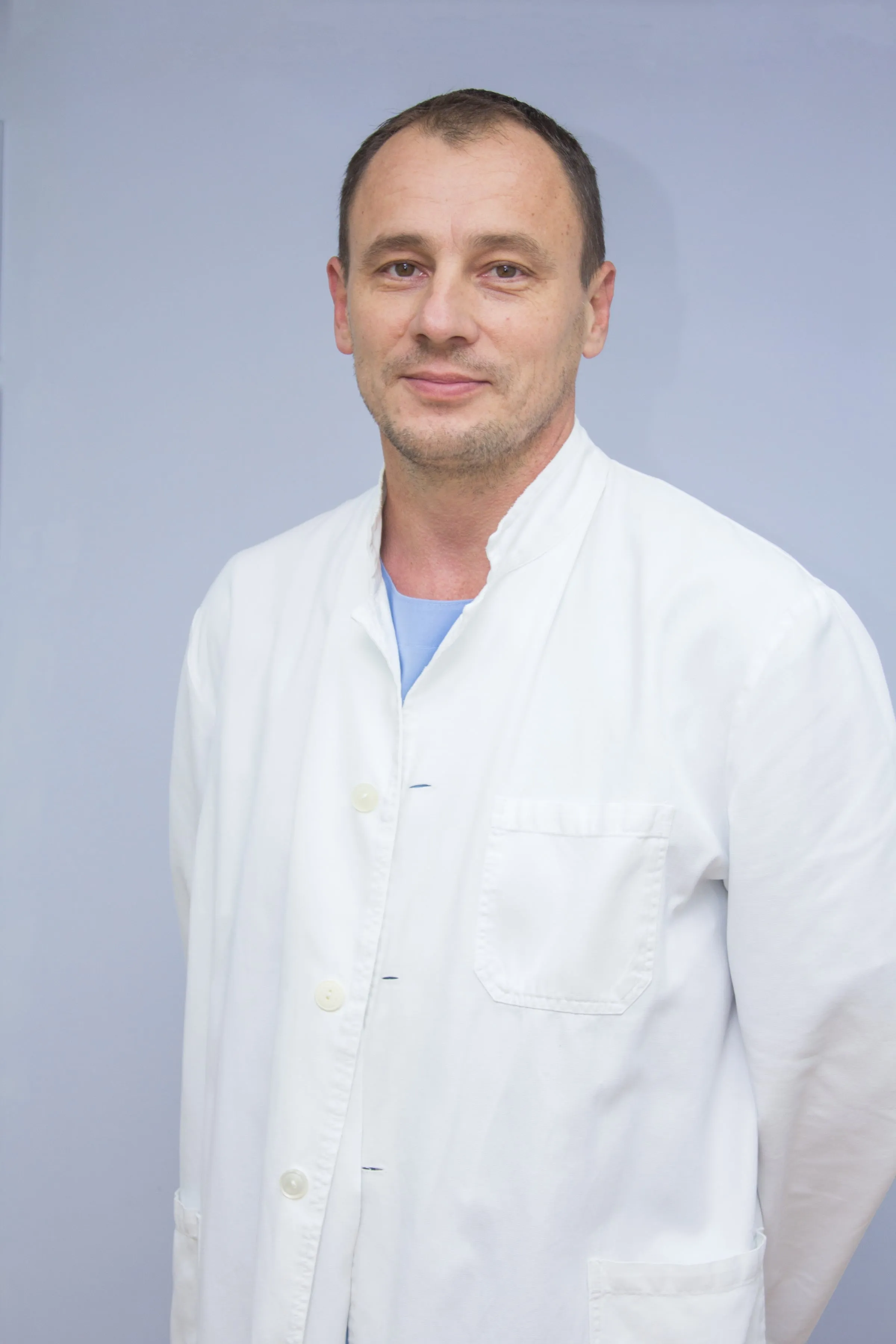
The procedure is planned and performed by Duško Maletić, MD, MSc, a specialist in surgery and urology and founder of the Polyclinic, and Mario Bartol, MD. The anesthesia and monitoring are led by our own anesthesiology team, and the Polyclinic’s co-founder is an anesthesiologist.
The nurses are with you through the preparation, your stay in the inpatient ward, and the follow-up examinations. The procedure and patient follow-up are organized in Zagreb and Daruvar, with continuity of care from the same team.
Meet the whole team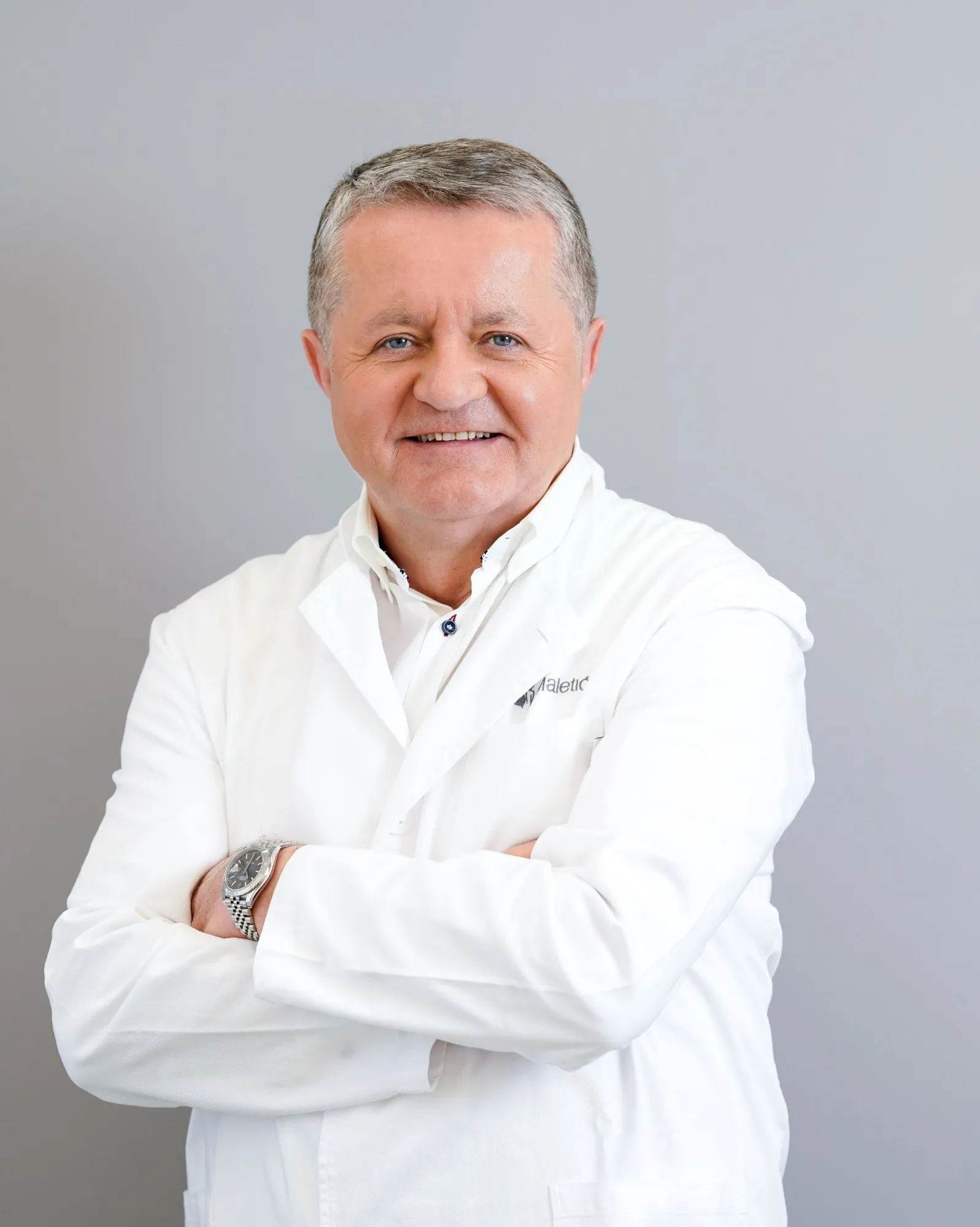
Price
The price of a tummy tuck and the first step
The price of a tummy tuck is listed in the price list, and anesthesia is included in the price. The final amount within the stated range depends on the extent of the procedure, the amount of skin being removed, and whether the abdominal wall needs tightening — and it is determined after the examination.
If you are considering other options as well, read more about liposuction and upper arm and thigh skin tightening, because excess fat tissue and excess skin are addressed with different procedures. At the consultation, the physician will examine you and assess which procedure matches your findings and what it can realistically achieve.
-
Tummy tuck (abdominoplasty)
Anesthesia is included in the price, and the type is agreed with the surgeon before the procedure. The price is the same regardless of the type of anesthesia chosen.
See the full price listPatient reviews
What our patients say
Reviews taken from our Google Business profiles, Zagreb and Daruvar, translated from Croatian.
★★★★★
“I recently had a varicose vein procedure. All praise to the entire team.”
★★★★★
“My experience with breast augmentation with Dr. Maletić in Daruvar was excellent. I am extremely satisfied with the result. All the nurses are very kind and professional. I absolutely recommend them.”
★★★★★
“All praise for Polyclinic Maletić in Daruvar! I had lip augmentation with fillers and I am very satisfied with the result. I would especially like to praise Dr. Mario Bartol, who is exceptionally kind, professional, and has a wonderful approach to patients, which made me feel comfortable and safe throughout the treatment. Also, all the nurses are very kind, helpful, and professional. I warmly recommend them to anyone considering aesthetic treatments!”
★★★★★
“Laser acne treatment is the only treatment that has helped me, and I would not choose any other facial treatment over it. Dr. Ines is one of the kindest people I have ever met and always has useful advice. Kind staff and top-quality service — I warmly recommend her to everyone!”
★★★★★
“I had a wart on my face removed by laser. A very professional service with excellent results. The wart was quite large, but after just one treatment it was gone. All recommendations!”
★★★★★
“Blepharoplasty, 4D laser, and double chin. Perfect. All recommendations!”
★★★★★
“The best team of physicians, extremely professional and kind. I have been loyal to Polyclinic Maletić for more than 10 years and I am always satisfied with the results. Thank you.”
★★★★★
“I came to Dr. Maletić with a big problem and a lot of stress. I was met with such warm empathy and kindness, and patience in answering all my questions. Thank you, Dr. Maletić, for your advice and sincere support. I know I can always turn to her for advice, and that means a lot to me. The staff of the Zagreb polyclinic are also very helpful and kind. My thanks to them as well.”
★★★★★
“Dr. Maletić’s practice, both in Daruvar and in Zagreb — and I have had several procedures — I can only recommend, because I felt very comfortable and in expert hands there!”
★★★★★
“An exceptionally professional, pleasant, and skilled team who know and love their work. It is a fine thing to be in the hands of some of the greatest experts in their field, who provide the kind of service I would wish for and recommend to anyone.”
Questions and answers
Frequently asked questions
Is a tummy tuck the same as liposuction?
No, although they are often combined. Liposuction removes fat tissue but cannot shorten the skin, so where the skin has become very lax, liposuction alone can leave the abdomen looking loose. A tummy tuck removes precisely that excess skin, and, where needed, also tightens the abdominal wall. Which of the two is your problem is something we assess at the examination.
How long is the recovery, and when do I go back to work?
After the procedure you stay one day in the Polyclinic’s inpatient ward, and for the following week we recommend resting from physical activity. The stitches are removed roughly ten days after the procedure, and the compression garment is worn for several weeks. Your return to work depends on how physically demanding your job is, and heavier exertion and sport are postponed for roughly six weeks.
Will the scar show in a swimsuit?
The scar after a tummy tuck is permanent. It is placed low, in the so-called bikini zone, where underwear and a swimsuit generally cover it. For the first six weeks it may be red and raised, after which it gradually fades and matures for several more months — in some people, up to a year.
Can I give birth after a tummy tuck?
Pregnancy after a tummy tuck is possible, but it can stretch the skin and the tightened abdominal wall again and thereby reduce or undo the result of the procedure. That is why a tummy tuck makes the most sense once you are no longer planning a pregnancy. If you are not yet sure, we will recommend postponing the procedure.
How long after childbirth should I wait?
It is recommended to wait at least six months after childbirth, and most often nine to twelve months, after breastfeeding has ended. During that period the body is still changing, hormone levels gradually stabilize, and body weight can still vary. Performing the procedure too early can compromise the quality and durability of the result.
Does a tummy tuck also remove stretch marks?
Only the stretch marks located on the skin that is removed during the procedure — mostly in the lower abdomen — are removed. Stretch marks above the navel and on the sides generally remain. If stretch marks are the main problem and there is no significant excess skin, at the examination we will assess whether a tummy tuck is the right procedure.
What is diastasis, and does it have to be operated on?
Diastasis is a gap between the straight abdominal muscles that most often develops during pregnancy. The first line of treatment is not surgery but targeted physiotherapy and exercises, which in some people narrow the gap and restore the function of the abdominal wall. Surgical tightening of the wall makes sense only when the conservative approach does not help, or when significant excess skin is present alongside the diastasis.