
Laser education center since 2008 · Zagreb & Daruvar
Laser Fibroma & Skin Tag Removal in Croatia
Small, soft growths on the neck, under the arms, or under the breasts become more numerous and more noticeable with the years. At Polyclinic Maletić we remove them with a laser, most often in a single visit — but only after an examination in which we confirm it really is a fibroma.
Most people with fibromas do not come because they hurt. They come because the fibromas keep snagging on clothes or jewelry, get in the way when shaving or showering, or because they once injured one by accident and the bleeding scared them. Fibromas are among the most common benign skin growths in adulthood, and there is no reason to put up with them if they cause you discomfort. Still, the first step is not the laser — it is an examination, where we establish what kind of lesion it is and whether it is advisable to remove it with a laser.
Is this for me?
What a fibroma is, and why there are more of them with age
A fibroma is a benign skin growth, soft to the touch and often attached by a thin stalk. It is usually skin-colored or slightly darker, and its size ranges from a barely visible dot to a lesion the size of a pea. In medicine it is called a soft fibroma or acrochordon, but patients more often describe it in their own words — as a hanging growth, or a skin tag on the neck.
It develops where skin rubs against skin or against clothing, so it appears most often on the neck, in the armpits, in the groin, under the breasts, and on the eyelids. The number of fibromas grows with age, and in adulthood almost every second person has them. Some people stop at one or two lesions; in others, a dozen or more appear over time — and then even a quite small growth starts to bother you, precisely because it is not the only one.
Fibromas have no malignant potential and do not endanger your health in themselves. That means you do not have to remove them — and if you do decide to, you do not have to justify that decision to anyone.
Fibroma, mole, or wart — how to tell them apart
People regularly mix up these three lesions, because at first glance they really can resemble one another. A fibroma is soft, mobile, and usually hangs on a thin stalk. A wart is a viral lesion with a rough surface and a different course. A mole is a pigmented lesion of an entirely different structure, and a stalked form of seborrheic keratosis can also resemble a fibroma.
One of those differences is not cosmetic. A fibroma is not viral and is not contagious — it does not spread to the people you live with, or from one part of your body to another. If the number of growths is increasing, the reason is that the skin is forming new ones in places of friction, not that the existing ones are spreading.
Where fibromas most often appear
- the neck, especially where a collar or necklace sits
- the armpits, where razors and clothing add to the irritation
- the groin and inner thighs
- under the breasts, where skin folds over skin
- the eyelids and the area around the eye, which call for special care and a steady hand
How it is performed
What laser fibroma removal looks like with us
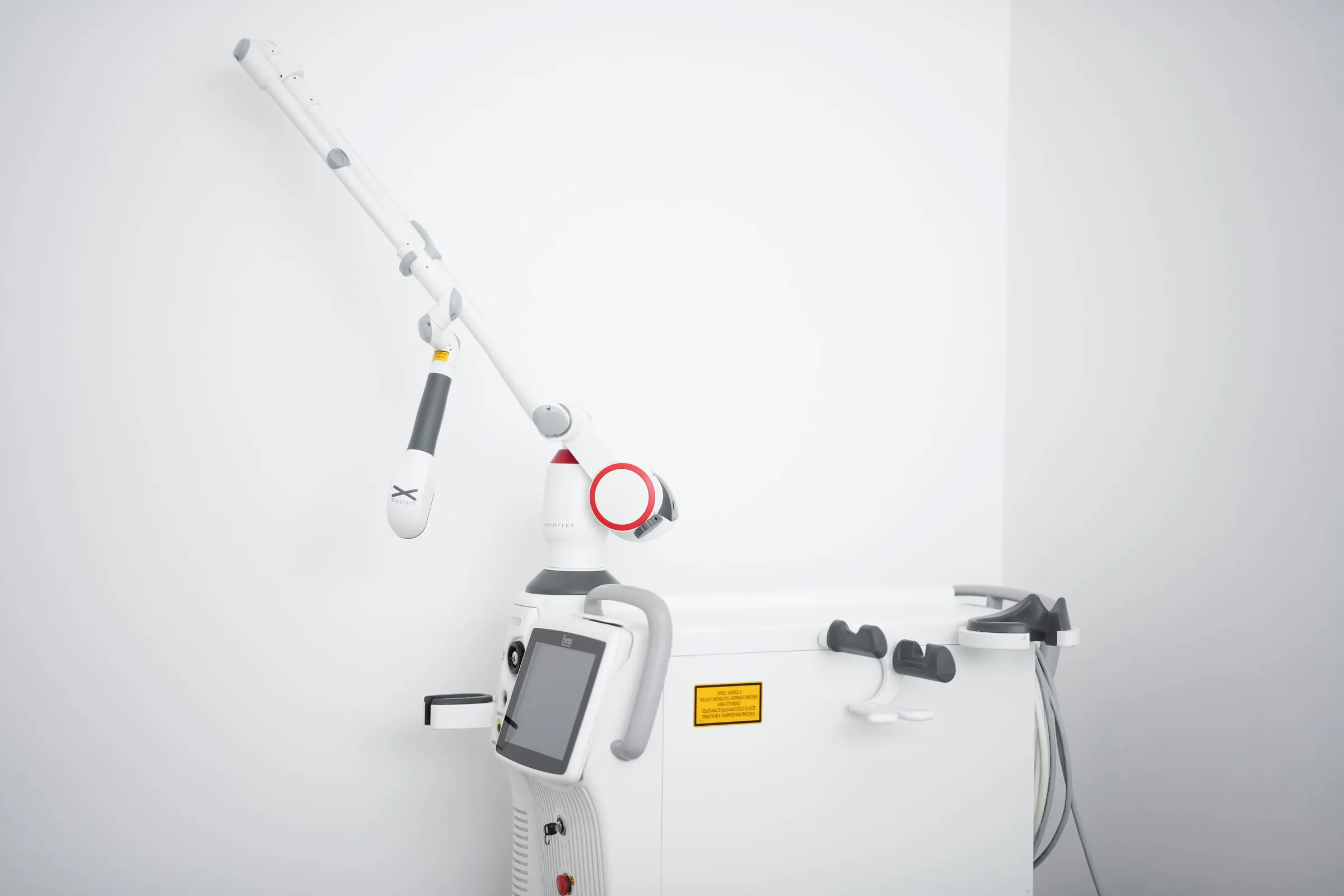
We remove fibromas in outpatient conditions, at both of our locations. Lasers have been part of our work for longer than we have been an education center. Since 2008, Polyclinic Maletić has also been an international education center for laser procedures in cooperation with the Fotona Laser & Health Academy, so physicians from other countries come to us to watch how these techniques are performed.
The fibroma itself is not cut — it is removed in thin layers, until the skin in that spot is left smooth. The surrounding tissue is spared, and since the wound is shallow, no stitches are needed. That is why, for soft fibromas, the laser is usually a calmer choice than the scalpel — especially on the neck and face, where every unnecessary cut leaves a trace.
The course of the procedure, step by step
- Examination. The physician looks at each lesion you want removed and establishes whether it is a fibroma.
- Agreement. We tell you what can be dealt with in one visit and what we would rather split.
- Anesthesia. The area is numbed locally, according to the size and location of the lesion.
- Removal. The laser takes the lesion off layer by layer, with no cutting and no stitches.
- Instructions and follow-up. We explain the care at home and arrange a check-up.
- Number of visits
- most often a single visit
- Anesthesia
- local
- Recovery
- a crust that falls off within 7–14 days
- Performed by
- Mario Bartol, MD, or Ines Maletić, MD
Aftercare and how long recovery takes
A tiny crust forms where the fibroma was removed. That is not a complication — it is an expected part of healing and a sign the skin is doing its job.
The first few days
Keep the area clean and dry, following the instructions you receive.
Up to about 7 to 14 days
The crust falls off on its own. Do not pick or hurry it — that is exactly what decides what kind of trace remains.
The following weeks
Temporary redness or a slight difference in color may remain in that spot and gradually fades.
The whole time
Sun protection, because exposing freshly healed skin increases the risk of a darker spot.
The technology behind the results
The lasers we work with
At Polyclinic Maletić we work exclusively with lasers made by Fotona, a cooperation that dates back to 2008, when we also became its education center. The device, though, is only one part — the outcome of a procedure is decided by the knowledge behind it.
Physicians from the United States, Canada, Australia, Dubai, Russia, Israel, Turkey, and other parts of the world come to our Polyclinic to learn about laser procedures and see how we work. In Daruvar, an education hall carries a live feed from the operating room, so learning happens on real clinical cases.
Our physicians — Ines Maletić, Duško Maletić, MD, MSc, and Mario Bartol — regularly take part in Fotona’s international meetings, which bring together experts in laser medicine. What they learn there, we apply in our work with patients.
We remove fibromas with a medical laser that takes the lesion off layer by layer, with no cutting and no stitches.
- Education center since 2008
- Fotona Laser & Health Academy
- Live feed from the operating room

Why us
Why choose us for laser fibroma removal
A global education center for laser procedures since 2008
physicians from all over the world come to watch how we perform laser treatments
Exclusively Fotona lasers
we work with medical lasers, not cosmetic devices
A medical protocol
fibromas are removed by a physician in the polyclinic’s outpatient clinic, with an examination before the procedure and a check-up after
We do not remove suspicious lesions by laser
anything that calls for histopathological analysis is removed surgically, so the findings stay possible
We will also tell you when you don’t need it
a fibroma that does not bother you does not have to be touched, and we will tell you so openly
Lasers in the hands of physicians who teach them
our physicians teach laser techniques to others, at the academy that has been with us since 2008
Since 1998 — 27+ years
a family polyclinic where many patients stay for decades
Zagreb and Daruvar
the same team and the same standard at both locations
Why trust us
When laser fibroma removal is not the right choice
The laser is a good tool, but it is not the answer to every skin lesion. There are situations in which we would suggest a different procedure — and situations in which we would suggest leaving the growth alone.
“Most fibromas are harmless, but every skin lesion deserves an examination first. Only when we know what we are removing do we decide whether the laser is the right choice.”
When a lesion goes for analysis, not to the laser
The laser removes tissue by vaporizing it, which means that after the procedure there is no sample to send to the pathologist. For a fibroma, that is not a problem, because the diagnosis is clear. The problem arises when a lesion is not typical — when it is irregularly colored, has grown quickly, has changed shape, or bleeds without cause. Such a lesion needs a diagnosis, not vaporization, because behind a growth that looks like a fibroma — however rarely — something else can hide.
“The laser is not for every skin lesion. When there is a reason for histopathological analysis, we choose surgical removal.”
Why a fibroma should not be tied off with thread or dabbed with vinegar
Many patients try on their own before coming in — most often with thread, vinegar, or preparations bought online that promise the growth will simply fall off. The outcome is usually inflammation, bleeding, or a burn of the surrounding skin, with the lesion only partly removed and now looking worse than before.
The biggest risk, though, is not the trace on the skin — it is that at home, nobody has looked at what is actually being removed, so it happens that someone spends weeks treating a lesion that is not a fibroma at all. The procedure in the outpatient clinic is short, and it starts with exactly the thing home methods skip.
“A fibroma does not need to be removed just because it is there. If it does not bother you and causes no trouble, it can also be left alone.”
The long-term effect
What changes in everyday life
The change shows in the small things you had stopped noticing while the growths were there. The collar and the necklace no longer snag, the razor passes over the neck and armpits without detours, and drying off with a towel stops being a reason for caution. For those who once injured a growth by accident and were frightened by the bleeding, that fear disappears as soon as the spot heals. Where a fibroma kept rubbing against clothing or jewelry, removal is not merely an aesthetic decision — repeated irritation and tenderness to the touch are cited in the professional literature as the very reasons patients seek the procedure. Removal, however, deals with the growths we took off — not with the friction in the places where they form.
Real results
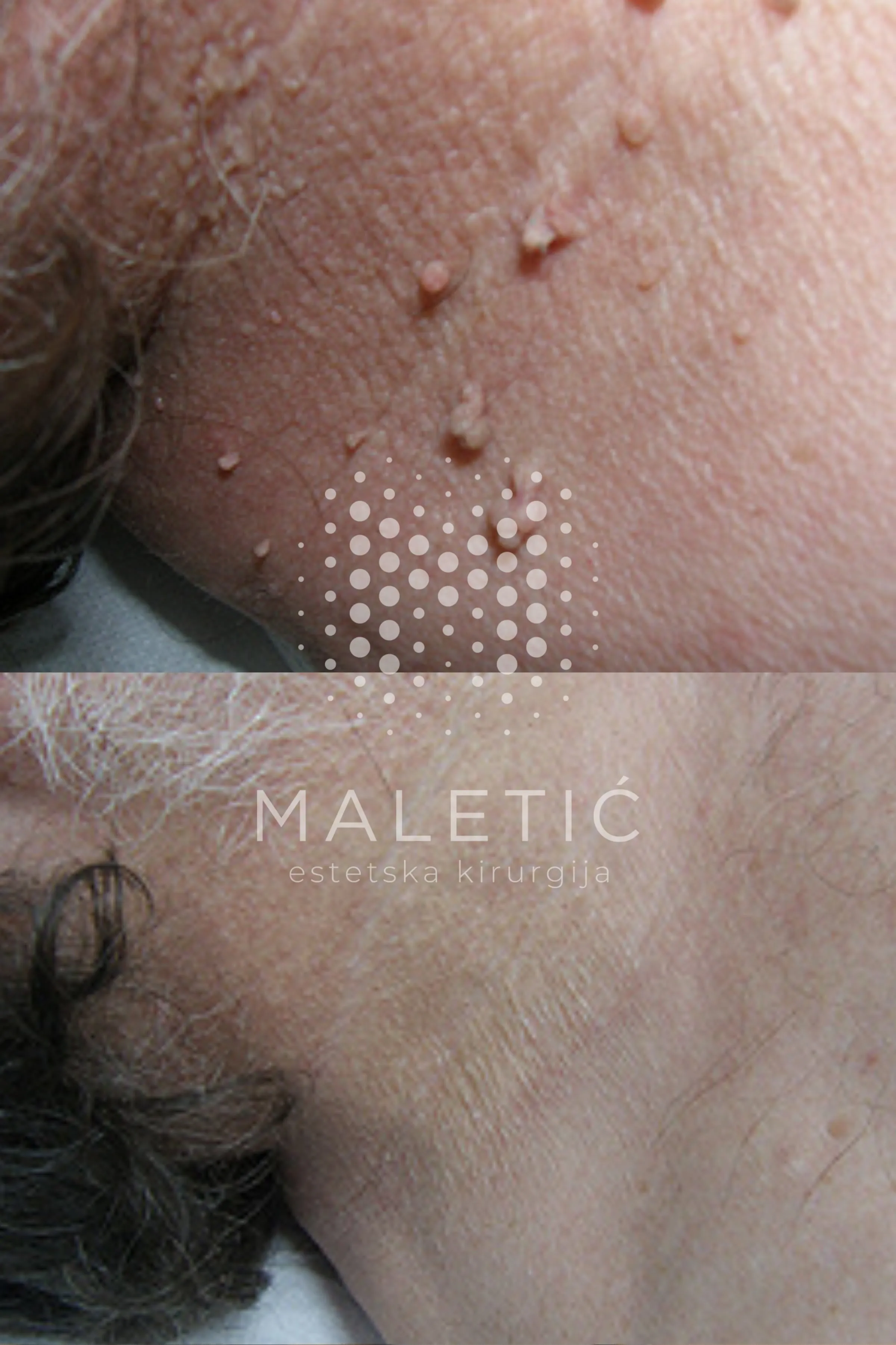
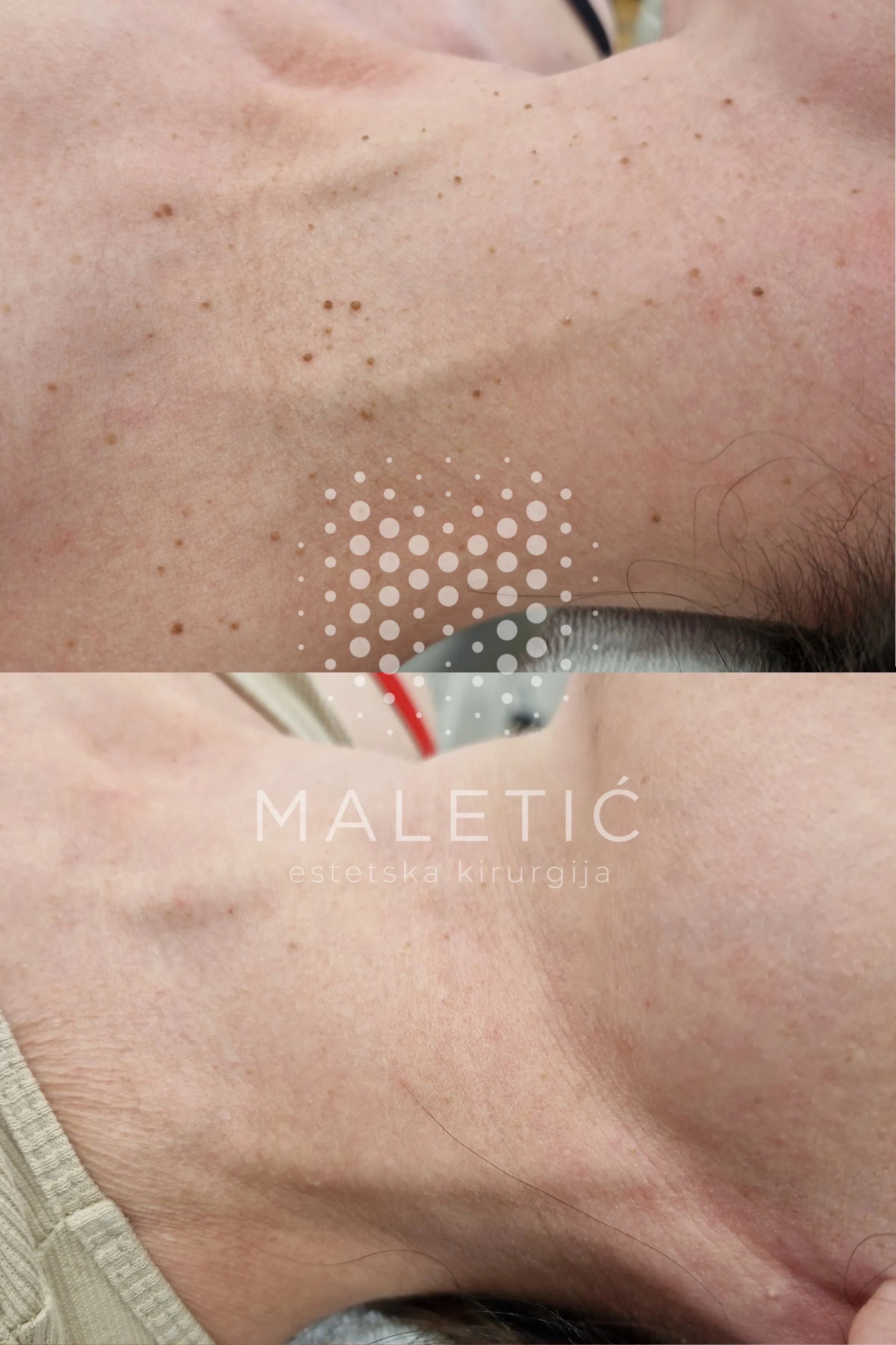
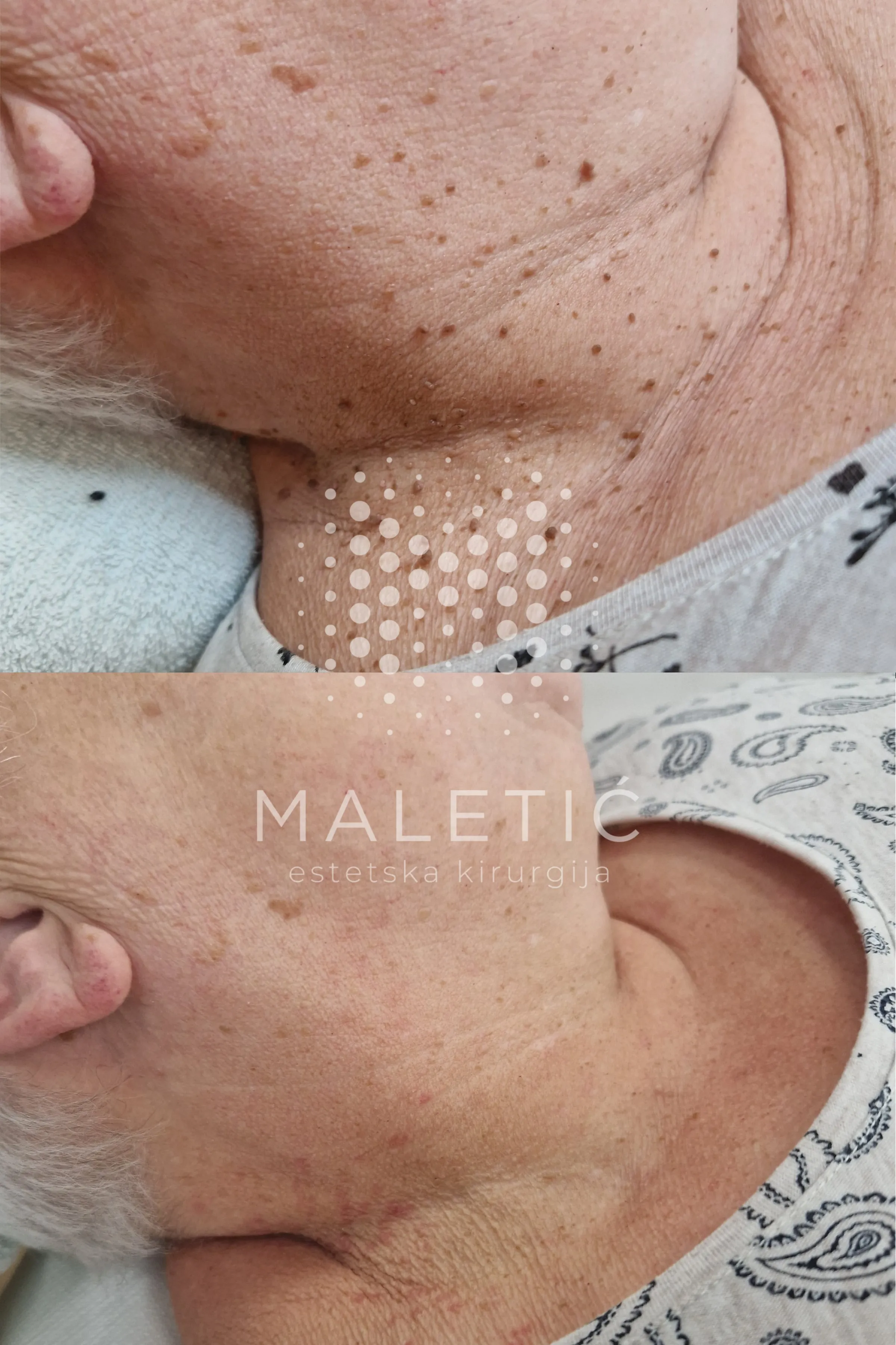
Before and after laser fibroma removal
We show our patients’ results discreetly and only with their consent.
Who we are
Who will be taking care of you
Polyclinic Maletić is a family polyclinic that has been working since 1998, today in Zagreb and Daruvar. In our Laser Center we work with lasers every day, and since 2008 other physicians have been coming to us to learn these techniques.
Laser fibroma removal is performed by Mario Bartol, MD, or Ines Maletić, MD, depending on the location and appointment. Ines Maletić is an Expert Clinical Lecturer at the Laser & Health Academy — meaning she teaches at the academy that sets these procedures as the standard — and she is also a co-founder of the Polyclinic.
Meet the whole team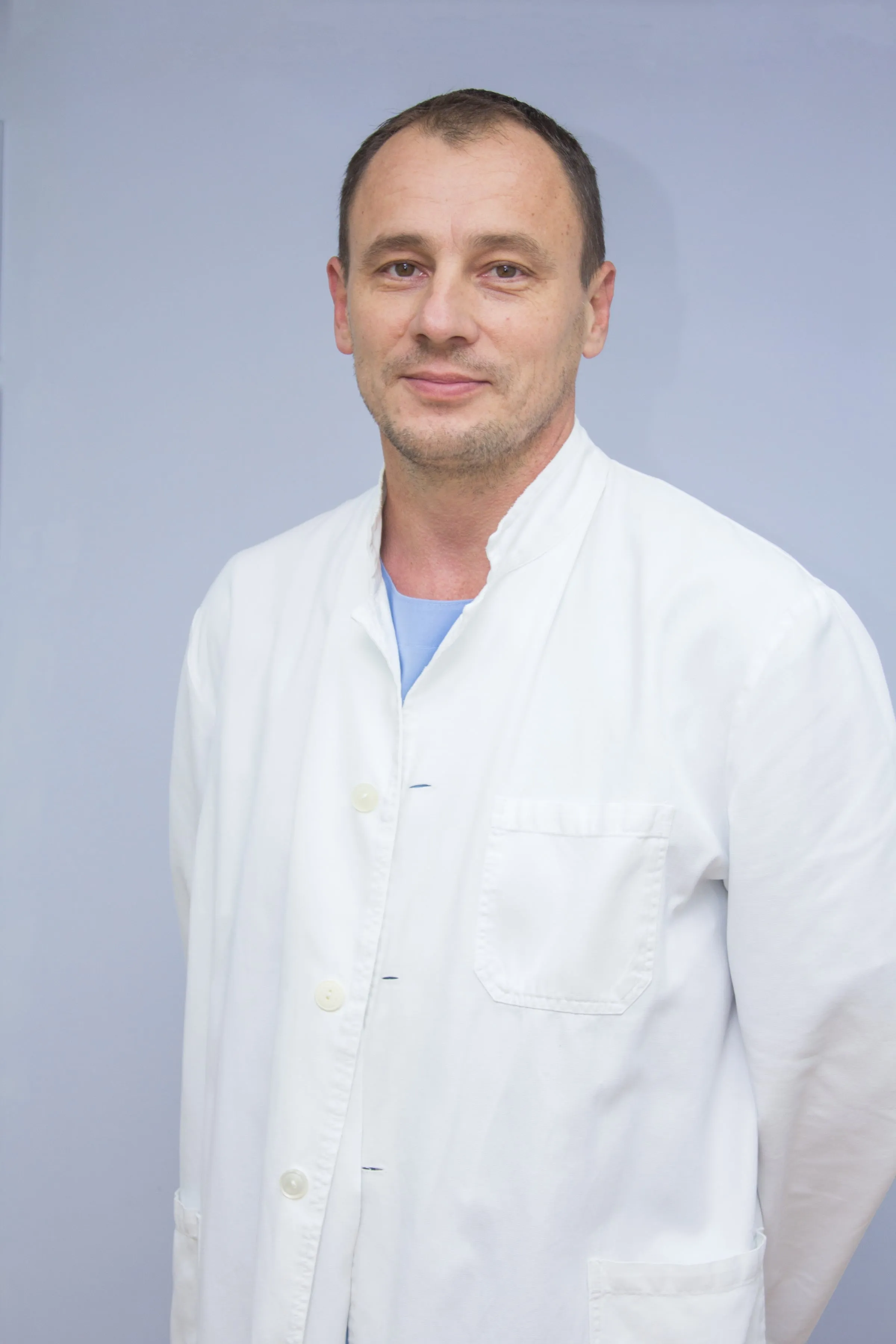

Price
The price of laser fibroma removal
In the price list, this procedure is grouped with related small skin lesions, under the item for laser removal of warts and moles. The final price depends on the number and size of the lesions, so the exact amount can only be given at the examination, once we see what we are working with.
If it turns out the lesion needs to be removed surgically and sent for histopathological analysis, the price changes — which is why we have listed those items right next to the basic one. The full price list is available on the Prices page.
If you are not sure whether what you have is a fibroma, book an examination. We will look at the lesion and tell you what it is, before we remove anything.
-
Laser removal of warts and moles
-
Surgical removal of moles and growths
-
Histopathology analysis (PHD)
Patient reviews
What our patients say
Reviews taken from our Google Business profiles, Zagreb and Daruvar, translated from Croatian.
★★★★★
“I recently had a varicose vein procedure. All praise to the whole team.”
★★★★★
“Since high school I watched the double chin I inherited from my father become more and more pronounced — and 15 years later, the double chin is gone. A big thank you to Dr. Maletić and the whole team for fulfilling my wish. The procedure was painless, as was the recovery, and the results were visible within a few days. The whole team was extremely kind and cheerful, and the atmosphere very pleasant. I left the polyclinic satisfied, and when, two days after the swelling went down, I saw that the double chin was gone, my satisfaction knew no bounds. I warmly recommend Polyclinic Maletić.”
★★★★★
“My experience with breast augmentation with Dr. Maletić in Daruvar was excellent. I am extremely satisfied with the result. All the nurses are very kind and professional. I absolutely recommend them.”
★★★★★
“All praise for Polyclinic Maletić in Daruvar! I had lip augmentation with fillers and I am very satisfied with the result. I would especially like to praise Dr. Mario Bartol, who is extremely kind, professional, and has a wonderful approach to patients, which made me feel comfortable and safe throughout the treatment. All the nurses are also very kind, helpful, and professional. I warmly recommend them to anyone thinking about aesthetic treatments!”
★★★★★
“Laser acne treatment is the only treatment that has helped me, and I would not choose any other facial treatment over it. Dr. Ines is one of the kindest people I have ever met and always has useful advice. Kind staff and top service — I warmly recommend her to everyone!”
★★★★★
“I had a wart on my face removed with a laser. Very professional service with excellent results. The wart was quite large, but after just one treatment it was gone. All recommendations!”
★★★★★
“Blepharoplasty, 4D laser, and double chin. Perfect. All recommendations!”
★★★★★
“The best team of physicians, extremely professional and kind. I have been loyal to Polyclinic Maletić for more than 10 years and I am always satisfied with the results. Thank you.”
★★★★★
“I came to Dr. Maletić with a big problem and a lot of stress. I was met with such warm empathy and kindness, and patience in answering all my questions. Thank you, Dr. Maletić, for your advice and sincere support. I know I can always turn to her for advice, and that means a lot to me. The staff of the Zagreb polyclinic are also very helpful and kind. Thanks to them as well.”
★★★★★
“I can only recommend Dr. Maletić’s practice, both in Daruvar and in Zagreb — and I have had several procedures there — because I felt very comfortable and in expert hands!”
Questions and answers
Frequently asked questions
Does laser fibroma removal hurt?
With local anesthesia, the procedure is practically painless. We choose the anesthesia according to the size and location of the lesion — for tiny fibromas an anesthetic cream or air cooling is enough, while larger ones are numbed with an injection. During the removal itself you usually feel warmth and mild stinging, and the discomfort that remains afterward is usually smaller than the one caused by a growth that kept snagging on clothes.
Will there be a scar?
With correctly performed laser removal, scarring is rare, because the lesion is taken off layer by layer and the surrounding skin is spared. We cannot, however, promise you skin without a single trace, because healing also depends on your skin, and on the location and size of the lesion. Most often, temporary redness or a slight difference in color remains and fades over several weeks, and sun protection during that period considerably reduces the risk of a darker spot.
Do fibromas come back after removal?
A removed fibroma does not grow back in the same spot. The tendency to develop them remains, though, so new ones can appear over time, usually in other places where the skin rubs. That is not a sign that the procedure failed — it is a characteristic of the lesion itself.
How do I know whether it is a fibroma or a mole?
By eye, that cannot always be said reliably — and that is exactly why every procedure with us starts with an examination. A fibroma is soft and usually hangs on a thin stalk, a mole is a pigmented lesion of a different structure, and a stalked form of seborrheic keratosis can also resemble a fibroma. The difference matters because these lesions are not removed by the same procedure.
Can I remove a fibroma myself, at home?
We do not recommend it, and the reason is not only cosmetic. Tying it off with thread, vinegar, and preparations that promise the growth will simply fall off most often end in inflammation, bleeding, or a burn of the skin, with the lesion only partly removed. The biggest risk is a different one, though: at home, nobody has looked at what is actually being removed.
How many fibromas can be removed in one visit?
For most people, all the lesions agreed on at the examination are dealt with in the same appointment. When there are very many of them, or they are spread over several areas, it is sometimes calmer to split them into two visits, so the skin does not heal in too many places at once. We tell you the plan at the examination, before you decide on anything.
What time of year is best for removing fibromas?
The colder part of the year is more practical. After the procedure, the skin on the treated spot is sensitive to the sun for a while, and exposure during that period increases the risk of a darker mark where the lesion was. If a fibroma bothers you or keeps getting injured, there is no need to wait for autumn — just consistently protect that spot from the sun.