
Since 1998 · Zagreb & Daruvar
Eyebrow Transplant in Croatia
Patients often come after years of plucking, with eyebrows that have not grown back, a thinned or completely missing part of an eyebrow, eyebrows that have always been fine or sparse, or a scar caused by injury. Their own follicular units can be transplanted to the eyebrows for long-term hair replacement. Before treatment, we examine the eyebrows and donor region and assess the cause of hair loss, because some conditions require treatment first.
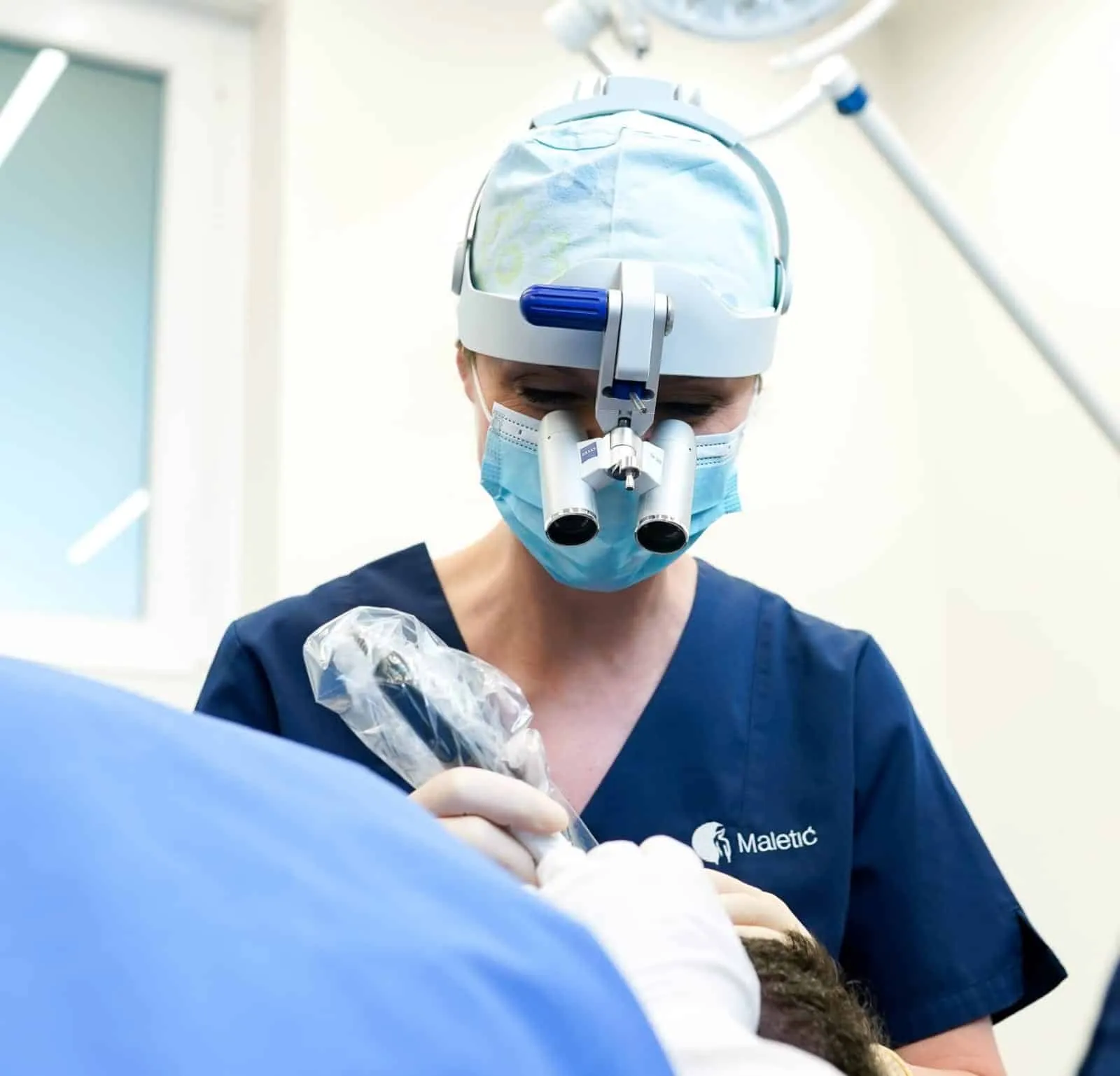
Some patients spend years trying to stimulate growth or visually replace their eyebrows before coming for examination. Some have stopped plucking and waited for recovery, some have always had low density, and others have used microblading or permanent makeup. Before planning the shape, the cause of absent hair growth must be assessed, because active disease or the effects of treatment may require treatment and stabilisation before transplantation is considered.
Is this for me?
What an eyebrow transplant is and who it is for
An eyebrow transplant is the procedure of moving your own follicular units, most often from the back of the scalp or from above the ears, into the eyebrow area. The follicular units are extracted and implanted one by one, at the angle and in the direction in which the eyebrow naturally grows at that spot. The transplanted follicles can produce hairs with the properties of the donor area long-term.
Eyebrows contribute to facial expression and the expression of emotions. They also protect the eyes by keeping out sweat and dust. Losing them can therefore affect facial appearance, expression and self-perception, and may also cause eye-related problems.
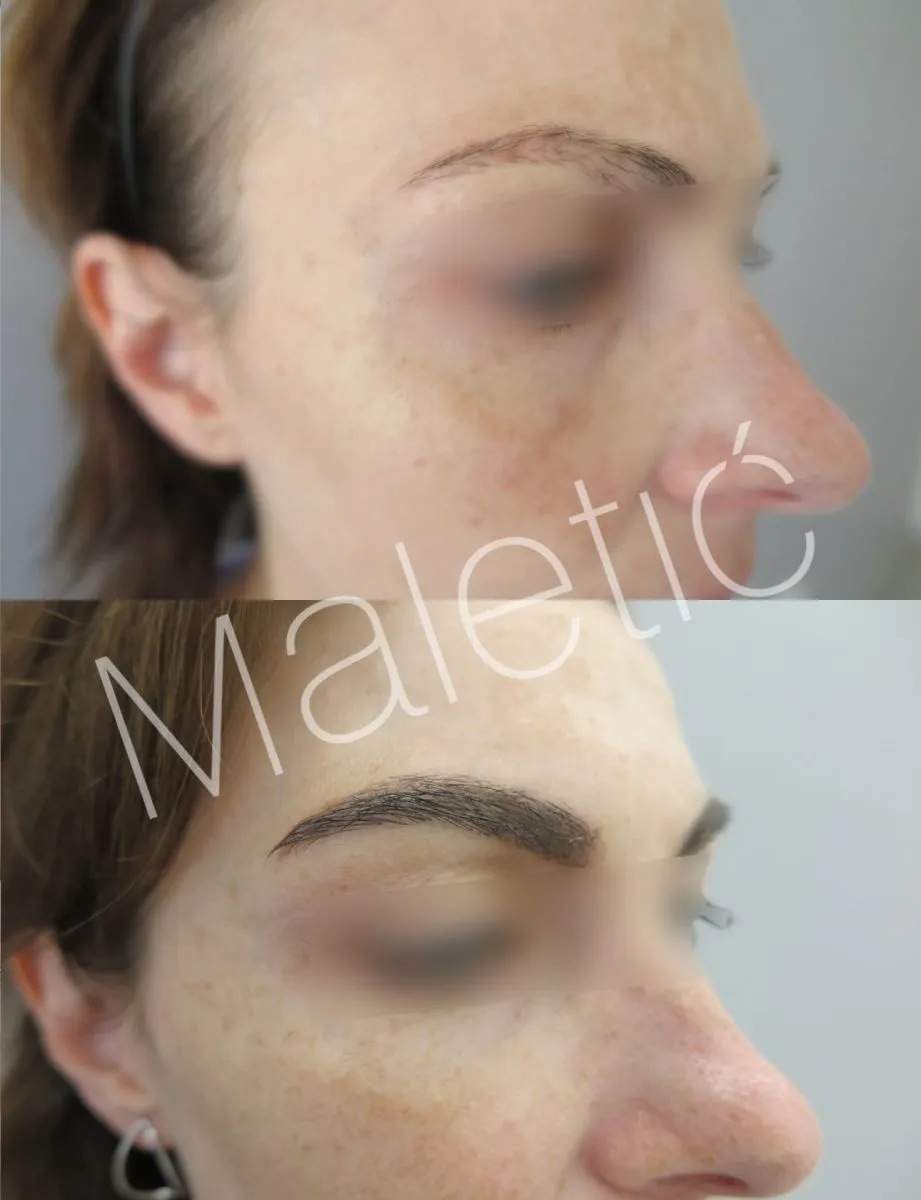
Eyebrows that never recovered after years of plucking
One of the frequent reasons for coming in is the absence of regrowth after long-term plucking, because the follicle can be permanently damaged and the eyebrows no longer grow back even when the plucking stops completely.
Eyebrows that have always been underdeveloped
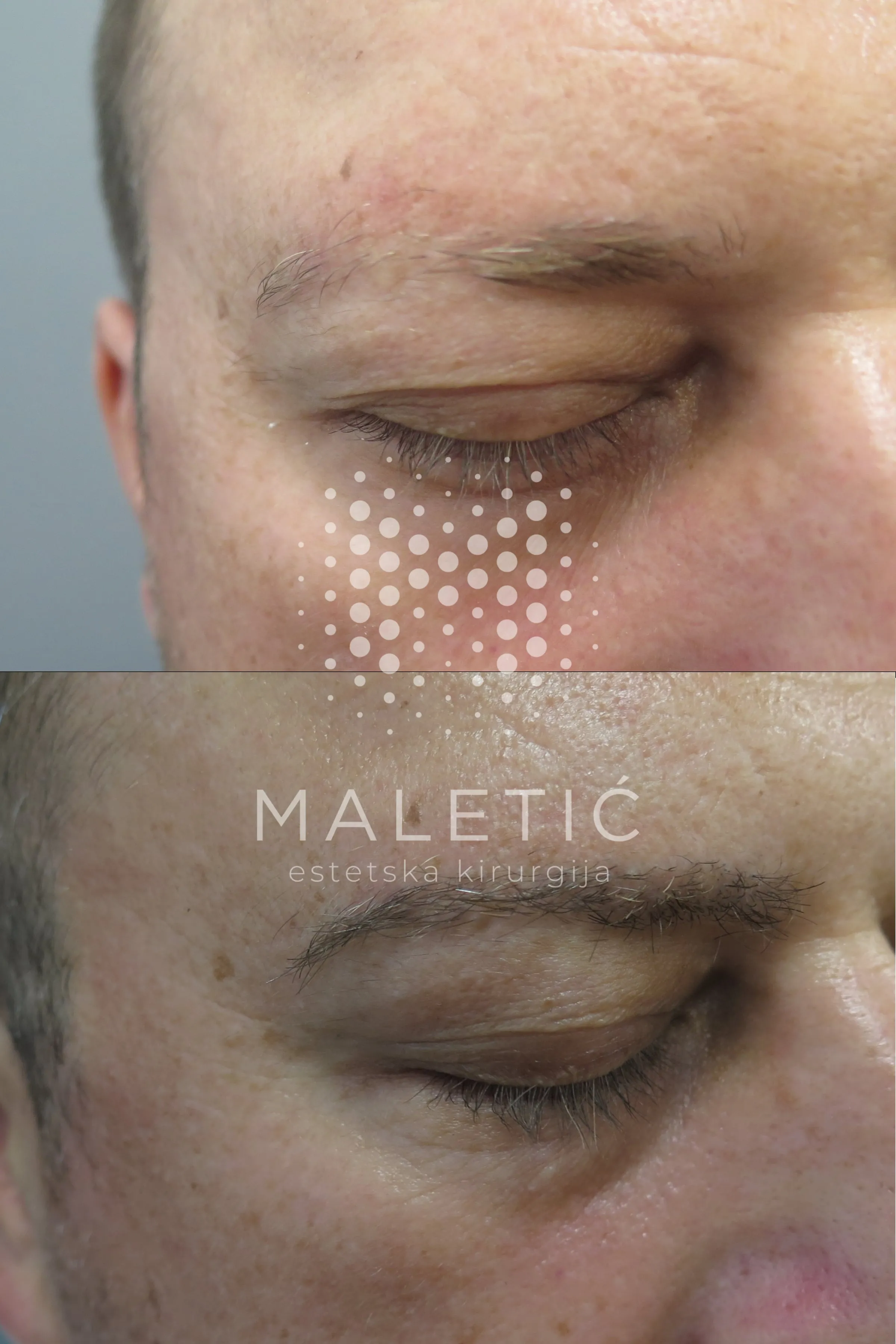
The procedure is also considered by patients with naturally low eyebrow density, whose eyebrows have always been fine or who are missing part of an eyebrow.
Scars, burns, and loss after illness or therapy
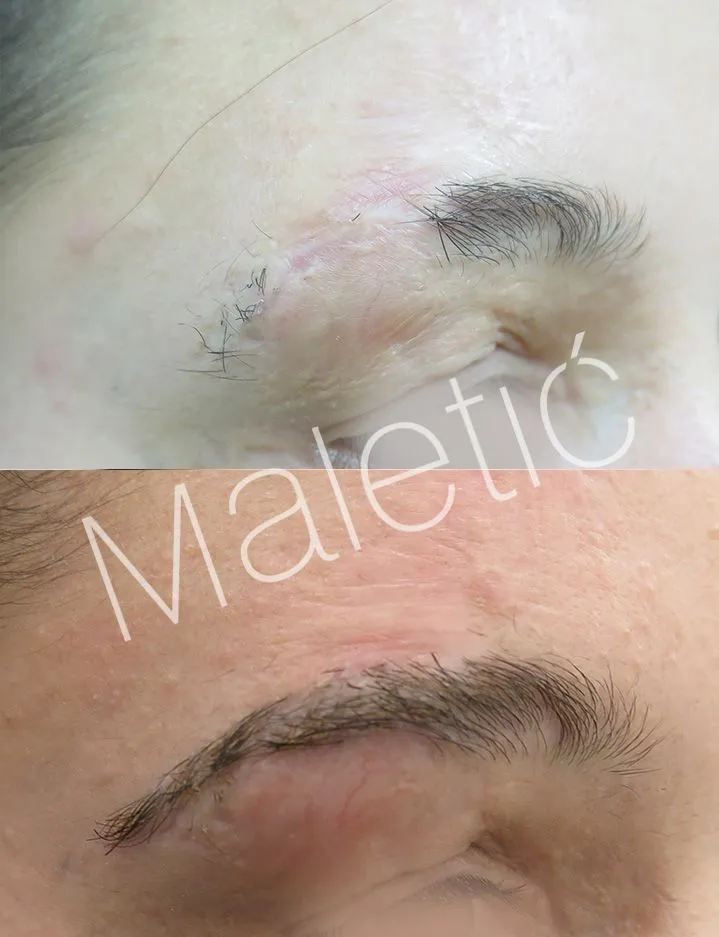
The second group of reasons is medical. Hairs can be missing on areas of skin damaged by injury or burns, and eyebrows can also be lost due to thyroid disease, lupus, dermatitis, certain dermatological and autoimmune diseases, and as a consequence of medication, chemotherapy, or radiation. Aging also brings gradual thinning, just as it does on the scalp. In these cases the procedure can have a reconstructive rather than a purely aesthetic role.
When the right answer is not a procedure
When the procedure should be postponed or the cause treated first
“Before eyebrow transplantation, I try to establish the cause of hair loss. If the cause is active disease or ongoing treatment, it is appropriate to postpone the procedure until the condition stabilises.” — Ana Maletić, MD, PhD
There are situations in which a transplant would not bring the expected benefit, which is why assessing the cause is an important part of the examination.
The thyroid and other conditions treated first
Loss of part of an eyebrow can be associated with thyroid dysfunction. Eyebrows may also thin because of other systemic diseases, scalp conditions or medication side effects. In these cases, the underlying disease is treated first. The same applies to unstable or still-active scars and active alopecia, which require treatment and a period of stabilisation before surgery.
When the plucking is still going on
In some people, repeated eyebrow plucking can be linked to trichotillomania or other forms of compulsive behavior — something some patients find hard to talk about. If the plucking is still ongoing, there is a high risk that the transplanted hairs will be plucked out again, which jeopardizes the result of the procedure. Such behavior is no reason for judgment, but it needs to be recognized and stabilized with appropriate professional help before a transplant. At the examination you can talk about it openly and without any sense of being judged.
At the examination we assess whether the cause of the loss, the condition of the skin, and your expectations are aligned with what the procedure can do, and whether the condition is stable enough for transplantation.
How it is performed
How we perform an eyebrow transplant
- Anesthesia
- local
- Recovery
- home the same day; redness and crusts most often settle within seven to ten days
- Result
- new hairs begin growing at roughly week fifteen to sixteen; final appearance after six to twelve months
- Performed by
- Ana Maletić, MD, PhD
Trichoscopic examination and hair selection
“Before eyebrow transplantation, we examine the eyebrows and donor region in detail with a trichoscopic camera to establish a diagnosis and assess the required number and characteristics of follicular units.” — Ana Maletić, MD, PhD
We also examine the donor area with the camera, because not all hairs from the donor area are equally suitable for eyebrows. We select hairs whose thickness, texture, and color best match the existing eyebrow hairs — these can be hairs from the back of the head, from above the ears, or from other regions of the body. Hair selection is one of the factors that influence how natural the result looks. Before the procedure we take a medical history and assess your general health and the possible causes of the eyebrow loss.
Drawing the shape before the procedure
We agree on and mark the eyebrow shape before the procedure according to facial proportions and existing eyebrows, rather than a template. We show you the planned shape and agree on it before starting. Eyebrow fashions have ranged from very thin to very thick, but the arrangement of hairs we implant today remains permanent.
The angle and direction of implantation
Eyebrow hairs grow at a very shallow angle to the skin and change direction along the eyebrow, so each is implanted at its own angle. We therefore work under optical magnification, count the follicular units, arrange them on special trays and temporarily store them in a suitable solution under controlled temperature conditions while outside the body.
The procedure is performed in an operating room and under local anesthesia. For extracting the follicles, the FUE method is used most often, with instruments less than one millimeter in diameter, which leaves no linear scar — only tiny dot-like marks at the extraction sites. When the STRIP method is more suitable, the incision can be closed with a trichophytic technique, which can allow part of the hair to grow through the scar area, so the scar can be less noticeable when covered by hair. If hairs are taken from other parts of the body, only FUE is used.
What to expect
The day of the procedure and recovery
On the day of the procedure. Photography, health assessment, blood pressure and pulse measurement, and an ECG. The patient changes into clinic clothing. We draw a detailed transplantation plan, then disinfect the donor region and face, apply sterile drapes and local anesthesia, and perform the procedure. You go home the same day afterwards.
The first few days. Tiny crusts are visible on the treated areas, and redness, mild swelling, and bruising are possible.
Days seven to ten. Redness and crusts settle.
Around day ten. Hairs from transplanted follicular units sometimes shed, while the follicles remain.
Weeks fifteen to sixteen. New hairs begin growing from follicles whose hairs have shed.
Months six to twelve. We assess the final result, and depending on the findings and the possibilities of the donor area, an additional procedure to increase density can be considered.
After the procedure, proper hygiene and care of the treated area with a spray you receive at the Polyclinic are important, along with avoiding heavier physical exertion. You receive all instructions in writing.
See the full price listWhy us
Why choose us for your eyebrow transplant
ABHRS Diplomate
Dr. Ana Maletić is the only physician in Croatia with this title, one of 260 physicians worldwide
The only ISHRS Fellow from Croatia
the most distinguished membership level in the international hair transplantation society
One of 6 clinics worldwide
with this level of international certification for transplantation
Since 1996
the start of training in hair transplantation, two years before the Polyclinic opened in 1998
Trichoscopic examination
we examine hairs in the donor and eyebrow regions with a trichoscopic camera
Performed in an operating room
the procedure is performed in an operating room with an air-recuperation system and controlled conditions
Work under magnification
we select hairs most similar to eyebrow hairs for transplantation. Follicular units are implanted under optical magnification; angle and direction matter for a natural result.
A device that eases anesthesia discomfort
we use a vibrating device when injecting local anesthetic to help ease discomfort
A common dilemma
Eyebrow transplant or microblading
Patients often ask what the difference is between an eyebrow transplant and microblading, because these are procedures with a different goal, duration, and way of being maintained.
Microblading is a semi-permanent cosmetic tattoo that provides color and shape, fades over time, and needs refreshing. A transplant moves your own hairs, which, once successfully taken, keep growing long-term.
If the goal is eyebrows with your own hairs, transplantation may be more suitable than a procedure that creates an effect through pigmentation.
Honest about the risks
Risks and what the procedure cannot do
Eyebrow transplantation carries possible risks and side effects. These include pain, swelling, bruising, rare infection, some loss of sensation or weaker growth of some transplanted hairs. Complications associated with surgery under local anesthesia are possible.
The procedure does not change the biological characteristics of donor hair. It usually comes from the scalp and retains its growth rhythm, so it needs occasional trimming.
Who we are
Who welcomes you
The procedure is performed by Ana Maletić, MD, PhD, a specialist in plastic, reconstructive and aesthetic surgery and Head of the Hair Center. She holds the titles FISHRS and ABHRS Diplomate, is the only physician in Croatia with the ABHRS Diplomate title and one of 260 worldwide, and is the only ISHRS Fellow from Croatia. In addition to scalp hair transplantation, she transplants hairs to the eyebrows and beard and moustache.
“From the donor area we choose hairs closest in thickness to those of the eyebrows, because their selection is one of the factors that influence how natural the result looks.” — Ana Maletić, MD, PhD
The Polyclinic has been operating since 1998; it was founded by Dr. Ana’s parents, and today two generations of the family work here. Training in hair transplantation began in 1996, two years before the Polyclinic opened, and we perform the procedure in Zagreb and in Daruvar.
Meet the whole teamWatch
See what it looks like
Eyebrow transplantation at Polyclinic Maletić
Price
Price and the first step
The price of an eyebrow transplant per follicular unit is listed in the table below. The total amount depends on the number of units, and that number is determined at the examination and depends on the agreed shape and on the density your existing eyebrows and the donor area allow. The price of the trichoscopic analysis is listed in the table below.
After the examination you decide for yourself whether to continue planning the procedure. You can also see the prices of all procedures in the price list, and the other hair and scalp procedures in the Hair Center. If, alongside your eyebrows, you are also thinking about your scalp, see hair transplantation as well.
Once transplanted eyebrows have finished growing, they can be washed and groomed, with occasional trimming of hairs that retain donor-region characteristics. The need for daily drawing or pigment renewal may decrease; the aim is eyebrows suited to your current facial proportions and existing hairs.
If you are not sure whether an eyebrow transplant is suitable for you, an examination can clarify the cause of the loss, the indication, and the possibilities and limits of the procedure.
-
Eyebrow transplant (per follicular unit)
-
Trichoscopic scalp analysis (TrichoLAB FotoFinder)
Patient reviews
What our patients say
Reviews taken from our Google Business profiles, Zagreb and Daruvar, translated from Croatian.
★★★★★
“A great experience, team, and final result. In short, I had an eyebrow transplant. Everything went exactly as Dr. Ana Maletić explained. The whole team was very kind and professional from start to finish, and I am now at peace because I finally have eyebrows. They look very natural, and the density is just as it should be. All recommendations!”
★★★★★
“A month ago I had an FUE hair transplant with Dr. Ana Maletić. From the professional side, my hair was done perfectly. I was lucky that my hair did not shed and started growing right away. Dr. Maletić’s expertise is obvious and makes her, without question, the leader in this field in Croatia. But my real satisfaction and gratitude lie in how the Polyclinic treats its patients. They are highly professional, yet approachable and compassionate at the same time. Nurses Matea M. and Valerija left a positive mark on my whole experience and made it more pleasant and calming. To anyone in Croatia looking for a hair transplant, I warmly recommend this Polyclinic. You will get top results and excellent care!”
★★★★★
“I had a hair transplant and I am more than satisfied with this extraordinary, exceptionally professional, life-changing procedure! A big thank you to Dr. Ana, Danijela, Romana, and everyone else who took part in this wonderful experience. My sincerest thanks! Marko S.”
★★★★★
“All praise to the entire staff of the polyclinic. I have already had my second PRP scalp treatment and I can only commend the whole team. I would especially like to praise the doctor for her exceptional expertise, patience, and warm approach. From the first examination to the procedure itself I felt safe and informed. The whole course of treatment was professional and well organized — I received clear and detailed instructions before, during, and after the procedure, which gave me extra confidence. The procedure itself was stress-free, with every step explained along the way, which meant a lot to me. The atmosphere is pleasant and relaxing, and the staff exceptionally kind and helpful. I am very satisfied with the results so far and look forward to further progress. I definitely recommend it to anyone considering a PRP scalp treatment — you are in safe and expert hands!”
★★★★★
“A few years ago I saw Dr. Ana Maletić for a facial hair correction using the FUE method, which made my beard somewhat denser. The results are fantastic — the work was done with such dedication and care. From the first meeting at the polyclinic she radiated confidence and knowledge of her work, along with a readiness and kindness to answer every question I had. All recommendations for Dr. Ana and her entire professional and friendly team.”
★★★★★
“I have been their patient and admirer for years. They have always known how to make my mom and me feel comfortable and welcome. My mom had a neck lift six years ago, and today I came in for PRP for hair growth. I cannot recommend them enough. Thank you, Ana!”
★★★★★
“I am very satisfied with Dr. Maletić’s results, from the beginning to the end of the hair transplant process. Five months after the procedure my hair looks phenomenal. The results I got, considering the number of grafts transplanted, pleasantly surprised me when compared with other clinics outside Croatia. As for the price, there is no big difference compared to clinics abroad, while the quality and expertise are on the level of top clinics. A big plus is that I did not have to travel outside the country, which made the whole process far less stressful for me.”
★★★★★
“I have rarely experienced such a professional, coordinated, and harmonious team. The atmosphere during the hair transplant was so pleasant that they even treated me to the occasional musical number. That relaxed atmosphere made the boredom of the procedure easier to bear. Although I do wonder whether some of you might be better off on a stage than in an operating room. Once again, a big thank you — I am already looking forward to the results in a few months!”
★★★★★
“A more than positive experience at Polyclinic Maletić, both in Zagreb and in Daruvar. I had a hair transplant and I am very satisfied with the approach and the procedure. I recommend it to everyone, especially to women who, like me, lost their hair after an illness. Once again, thank you to the kind team, and especially to Dr. Ana Maletić.”
★★★★★
“I just had a hair transplant. I am satisfied. Well done to Dr. Duško Maletić and the team in Daruvar. They are kind, professional, and do quality work. I recommend them.”
Questions and answers
Frequently asked questions
How many follicular units does an eyebrow transplant take?
It depends on how much eyebrow hair you already have, the agreed shape and the density achievable with the existing eyebrows and donor region. The number is determined after examination, trichoscopic assessment of the donor region and agreement on eyebrow shape. Eyebrows usually require far fewer follicular units than transplantation into the scalp.
Does an eyebrow transplant hurt?
The procedure is performed under local anesthesia, so you should not feel pain during it. Brief discomfort may occur when the local anesthetic is injected; we use a vibrating device to help reduce this. Mild tenderness is possible afterwards, but painkillers are usually unnecessary.
Is it visible right after the procedure, and when can I go back to work?
Tiny crusts are visible on the eyebrows during the first few days, and redness, mild swelling and bruising are possible. Redness and crusts most often settle within seven to ten days. You can return to office work the next day. Avoiding strenuous physical activity for around ten days after the procedure is important.
Why do the transplanted hairs fall out, and when do new ones grow?
Hairs from transplanted follicular units sometimes shed after around ten days, while the follicles remain in place. New hairs begin growing around weeks fifteen to sixteen, and the final appearance is assessed after six to twelve months. In some patients, transplanted hairs continue growing without shedding first.
Do I have to trim transplanted eyebrows?
As a rule, especially at first, they need occasional trimming, because a hair taken from the scalp keeps the growth rhythm of scalp hair and grows longer than a natural eyebrow hair. In some patients the growth rhythm may adapt somewhat to the new area over time, but we cannot promise that in advance.
Is the result permanent, and can I change the eyebrow shape later?
Transplanted follicles are intended to grow long term, but final growth and density cannot be fully guaranteed in advance. Eyebrows can subsequently be groomed and trimmed, but substantial changes to the transplanted shape are limited and may require additional corrective procedures. Shape and its long-term implications are therefore discussed in detail when planning the procedure.
Which is better, an eyebrow transplant or microblading?
They are two different things. Microblading is a semi-permanent cosmetic tattoo that fades over time and needs refreshing, while a transplant moves your own hairs, which, once successfully taken, keep growing long-term. Microblading provides color and a visual shape, while a transplant adds your own hairs. If the goal is eyebrows made of your own hairs, a transplant may be the more suitable choice over a procedure that creates its effect through pigmentation.