
Since 1998 · Zagreb & Daruvar
Hair Transplant in Croatia
Planning does not start with a graft count. It starts with a scalp analysis. Only once the type and stage of hair loss are established can we assess whether a transplant is indicated — and when it makes sense to perform it.
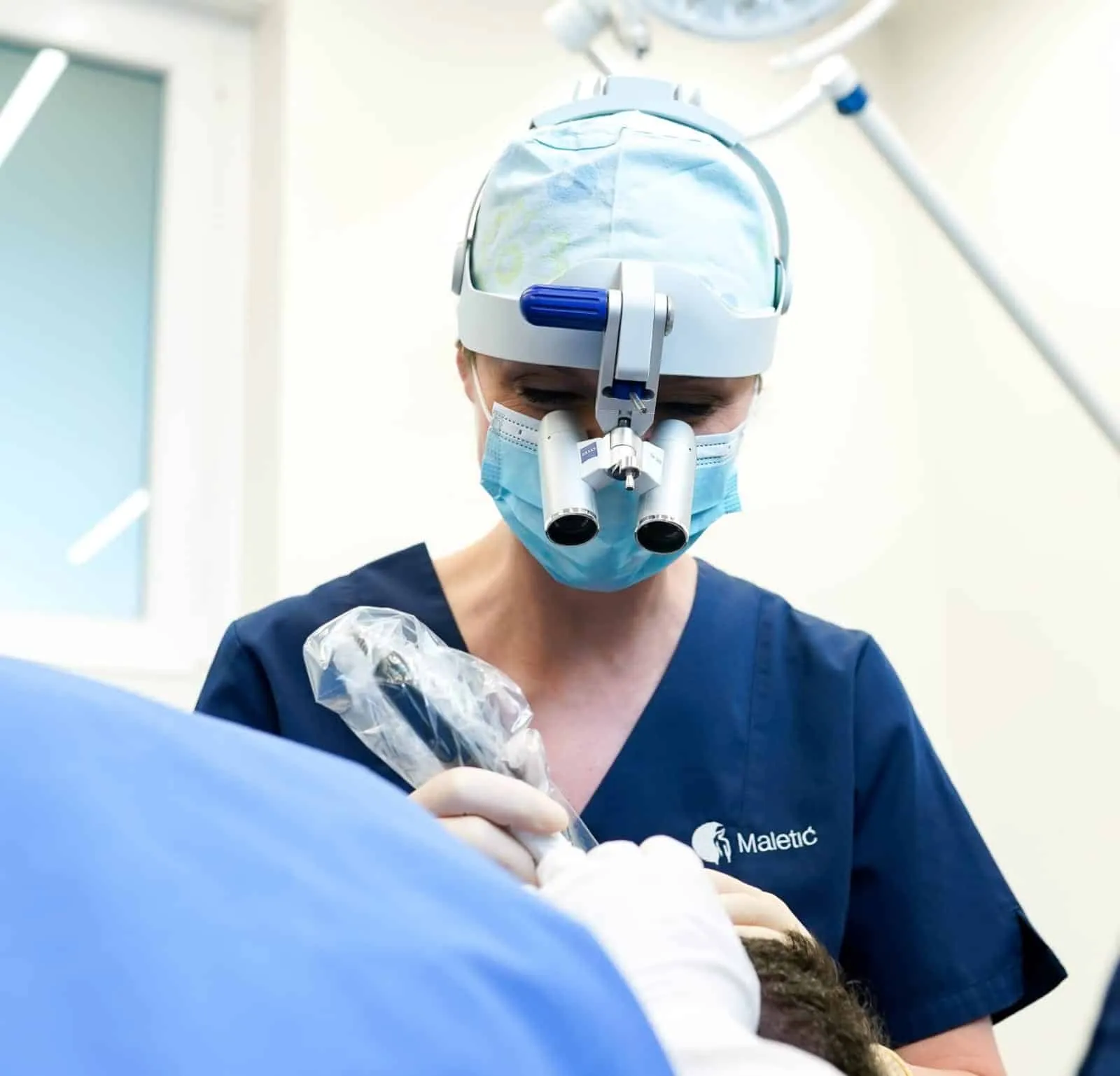
Patients often ask whether the result will look natural and how it will develop as non-transplanted hair continues to be lost. Both questions require long-term planning beyond the first year. The plan begins with scalp analysis to establish the type and stability of hair loss and the total number of follicular units that can be transplanted from the donor region. The number is determined after completing analysis of the scalp, donor region and planned recipient area.
Is this for me?
What a hair transplant is and who it is for
Hair transplantation moves your own follicular units from the back of the scalp and the sides above the ears, where follicles are resistant to androgen-related hair loss, to areas of thinning or absent hair. If needed, hair can also be transplanted from other body areas, such as the beard, chest or pubic region. Only your own follicles can be used. Afterwards, follicles continue producing hair with donor-region characteristics, so it can later be washed, cut and styled normally.
The procedure is most often performed in suitable candidates with androgenetic alopecia, hereditary hair loss beginning at the temples and crown in men and most often appearing as thinning along the parting and frontal scalp in women. It may also be performed for other scalp conditions, to correct a high forehead or naturally high hairline, and for scalp scars following injury or surgery.
When a transplant is indicated
The most suitable candidates are people whose hair loss pattern is stable or can be assessed with enough certainty, whose donor area is dense enough, and who have realistic expectations of the possible result. In practice, that third condition matters just as much as the first two: a transplant can improve scalp coverage and shape the hairline, but it cannot create more density than the donor area allows.
Women who are candidates most often have stable, limited thinning, a high forehead or hair loss due to scarring. For some women with diffuse thinning across the scalp, transplantation is not a solution because there is no safe donor region. We first investigate the cause and consider therapies to preserve and improve existing hair.
When the procedure is not indicated or should be postponed
Some conditions mean transplantation would not provide the expected benefit or could worsen the local condition. Active alopecia areata and unstable scarring alopecia require treatment rather than immediate transplantation. Very rapid hair loss in the early twenties may indicate an unstable pattern whose course cannot yet be reliably predicted. If hair loss is linked to a hormonal disorder, thyroid dysfunction, iron deficiency or another health condition, that condition is diagnosed and treated first; transplantation remains an option once it settles. We begin with diagnostics and, when indicated, therapy monitored over several months. Once the condition permits hair transplantation, we can also proceed with it.
In some cases, we assess that hair transplantation is not indicated. We then discuss other treatment or monitoring options.
The first step
Diagnostics and scalp analysis before the procedure
Before determining how many follicular units need to be transplanted, we examine and analyse the scalp with a trichoscopic camera.
What the scalp analysis shows
We analyse hair thickness and density in several scalp regions to assess whether the loss is androgenetic, how advanced it is, donor density and quality, and stability. We use a trichoscopic camera and, when needed, TrichoLab Studio, whose camera and software provide more detailed data on exact hair thickness, hair counts by region and hairs per follicular unit. It also helps plan transplantation by calculating the number of follicles needed to achieve a given density in each region and analysing how many can be extracted from the donor area. When needed, diagnostics also include a scalp biopsy.
“Under the trichoscope, the scalp reveals hair thickness, density and the number of hairs per follicular unit. From these measurements I assess whether hair loss is androgenetic and whether the condition has stabilised. Sometimes the findings show that a procedure would not achieve the expected result at that time.” — Ana Maletić, MD, PhD
The same analysis is later used for monitoring. With PRP scalp treatment, mesotherapy, laser hair growth treatment or another hair growth treatment, we analyse the same scalp after several months and compare it with the initial findings.
Why the donor area is central to the plan
The number of donor follicular units is limited and determines everything else: how many can be harvested without visible donor thinning later, where the hairline can be placed and whether reserves remain for a future procedure.
“The donor region is limited and does not regenerate. Where follicles are extracted, hair no longer grows from those follicles, while non-transplanted hair loss may continue. A long-term transplantation plan is therefore important so that the result remains consistent with possible future hair loss.” — Ana Maletić, MD, PhD
At the first consultation, patients often ask how many follicular units they need — but that number cannot be determined separately from the overall plan. With us, the number of follicular units is the result of the plan, set only after all the relevant factors have been assessed.
How it is performed
How we perform a hair transplant
Polyclinic Maletić was among the first to introduce hair transplantation in Croatia, performing procedures since it opened in 1998. Training in this field began earlier, in 1996. We perform all four transplant methods: FUE, DHI, Sapphire, and STRIP. The method is chosen based on your scalp findings and the state of the donor area.
The procedure uses local anesthesia in operating rooms with heat recovery ventilation and controlled conditions. Survival of transplanted follicular units depends on handling during surgery, instrument quality, time outside the body, the patient’s health, scalp condition and aftercare behaviour.
- Duration
- usually 4–8 hours, depending on the number of follicular units transplanted
- Anesthesia
- local
- Recovery
- Back to everyday routines within days; crusts fall off in 7–10 days
- Performed by
- Ana Maletić, MD, PhD
FUE
Follicular units are extracted individually with an instrument less than one millimetre in diameter. There is no linear incision or suturing, and tiny visible dots remain in the donor region. FUE is the most commonly used method today; suitability is assessed according to donor findings and the goal of the procedure.
DHI
With DHI, a follicle is implanted using an implanter that opens the channel and places the follicular unit in the same step.
Sapphire
Sapphire is a variant of FUE in which implantation channels are opened with sapphire blades of different sizes. Blade size is selected according to the size of the follicles to be implanted.
STRIP, also known as FUT
A narrow strip of scalp is removed from the donor region, which is then sutured, and follicular units are separated under a microscope. A linear donor scar remains. We now close the incision with a special suturing technique, trichophytic closure, which allows hair to grow through the scar later, making it less visible.
A natural hairline
A natural look is the result of a series of planning and technical decisions made before and during the procedure. We adapt the hairline to the shape of your face, the degree of alopecia, and the density of the donor area — no single template is applied to every patient. Single-hair follicular units go into the hairline, while denser units are reserved for the mid-scalp and crown. The angle and direction of growth differ from region to region and between patients, so each unit is placed in the direction the hair naturally grows at that spot.
Trimming before the procedure is not mandatory. We discuss the need for trimming beforehand and match it to the planned number of follicular units and the chosen technique.
See the full price listWhy us
Why choose us for your hair transplant
One of 6 clinics worldwide
with this level of international certification for hair transplantation
ABHRS Diplomate
Dr. Ana Maletić is the only physician in Croatia with this title, one of 260 physicians worldwide
The only ISHRS Fellow from Croatia
the most distinguished membership level in the international hair transplantation society
The only clinic in Croatia offering all four methods
FUE, DHI, Sapphire, and STRIP; the method is chosen based on your scalp findings and the state of the donor area
Since 1996
the start of training in hair transplantation, two years before the Polyclinic opened in 1998
TrichoLab scalp analysis
measuring hair thickness, density and hairs per follicular unit before planning transplantation
Four operating rooms
operating rooms with air-recuperation systems and controlled conditions for performing the procedure
Her own transplant method
Dr. Ana Maletić presented it at the ISHRS World Congress in Berlin, 2025
Recovery
The day of the procedure and recovery
Before the procedure. At examination, we analyse the scalp and agree on a plan.
On the day of the procedure. We photograph the scalp so that follow-up images can be compared to assess the result. Preparation includes health assessment, blood pressure and pulse measurement, and an ECG; the patient changes into clinic clothing. We draw the transplantation plan in detail on the scalp. The procedure usually lasts four to eight hours, depending on the number of follicles transplanted. It uses local anesthesia, includes breaks, and you go home the same day.
The first two to three days. The scalp may be mildly tender, with redness and crusts.
By day ten. Crusts fall off, and the scalp is washed and cared for according to your written instructions.
Weeks two to six. Transplanted hairs may shed, although at our clinic they very often continue growing without shedding. The follicle remains in place.
Months three to four. New hairs begin growing from follicles whose hairs have shed.
Month six. In most patients the change becomes more visible.
Month twelve. We assess the final result, which in some patients continues developing up to eighteen months.
Avoid strenuous activity and intense sun exposure for the first two weeks. Most patients return to office work the day after the procedure.
Honest about the limits
Limitations, risks, and long-term planning
“Hair transplantation is elective surgery, so the decision should be informed and made without haste. At the first examination, the patient receives the information needed to decide independently whether to proceed with planning.” — Ana Maletić, MD, PhD
At examination, we assess whether expectations match donor capacity and the long-term development of hair loss.
What a transplant does not solve
Transplantation does not stop balding. Transplanted follicles remain, but surrounding non-transplanted hair is still affected by androgenetic alopecia. When needed, we therefore also plan preservation of non-transplanted hair through medication or scalp-strengthening treatments. Without this plan, results may become uneven over time and another procedure may be needed.
The procedure also does not change the quality of the hair you already have.
Risks of the procedure
Hair transplantation carries possible risks and side effects: forehead swelling in the first days, temporarily reduced sensation in donor and recipient areas, follicular inflammation, rare infection and complications associated with surgery under local anesthesia. Donor marks remain: tiny dots with FUE and a linear scar with STRIP.
How to choose a clinic and a surgeon
Patients considering treatment abroad often compare clinics across several countries. When comparing, what matters is verifying the qualifications of the person performing the procedure, the way the clinic works, and the availability of follow-up care after the procedure.
“A low price may attract attention, but it is not a criterion for choosing a clinic. In some institutions, this procedure is performed by people without the appropriate medical licence, in inadequate conditions, and fewer follicular units are transplanted than agreed with the patient. Quality depends on the team’s expertise, technique, instrument quality and patient follow-up, rather than the country. Patients should know who performs the key steps and whom to contact if difficulties arise during recovery or hair growth.” — Ana Maletić, MD, PhD
The International Society of Hair Restoration Surgery, ISHRS, maintains a public directory of its physician members. Whichever country you choose, check that your intended doctor belongs to this professional society. Only doctors proficient in performing this procedure can be members. Ana Maletić, MD, PhD, is a full member from Croatia. The list is available here: Find a Doctor
Real results
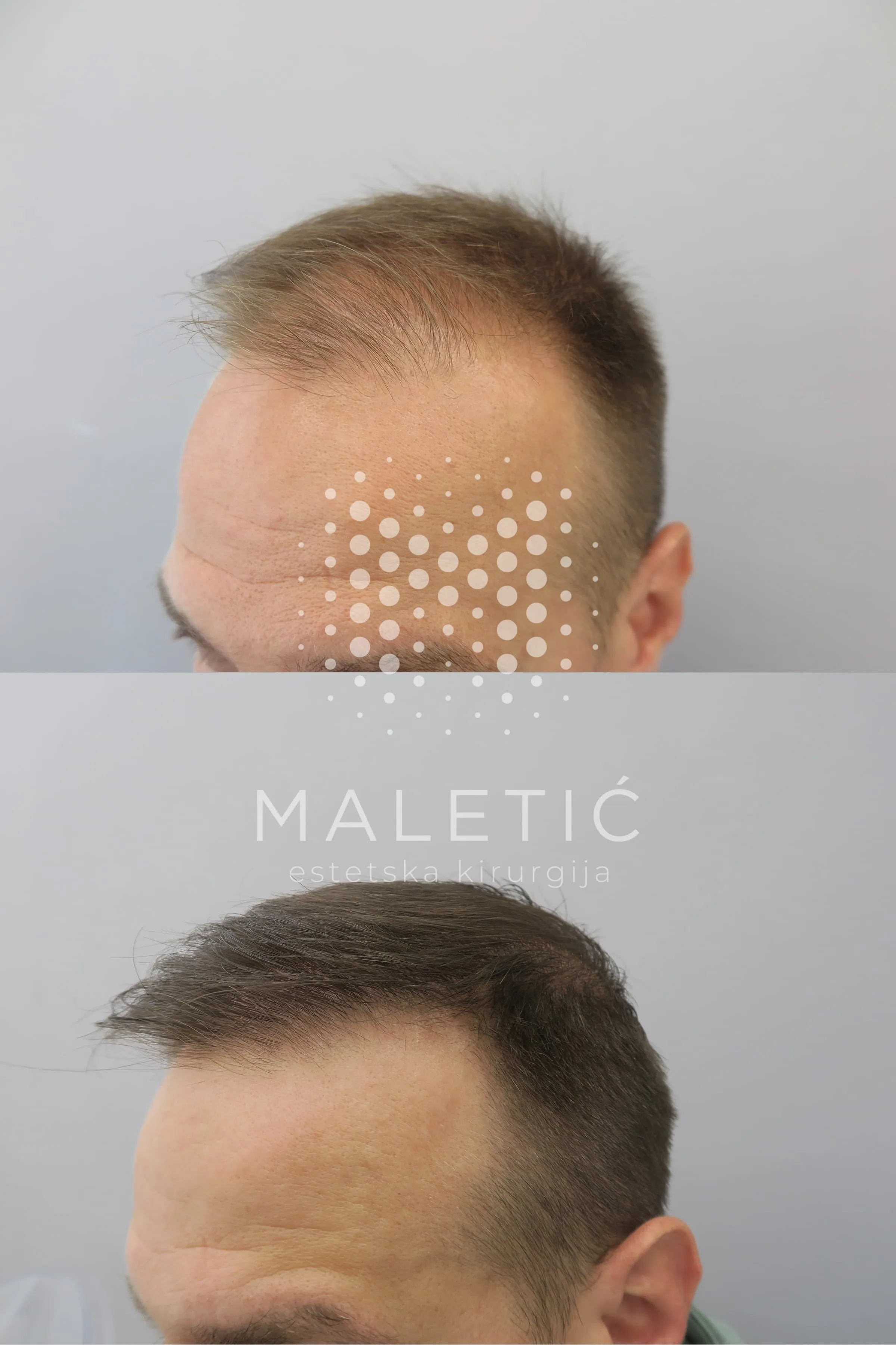
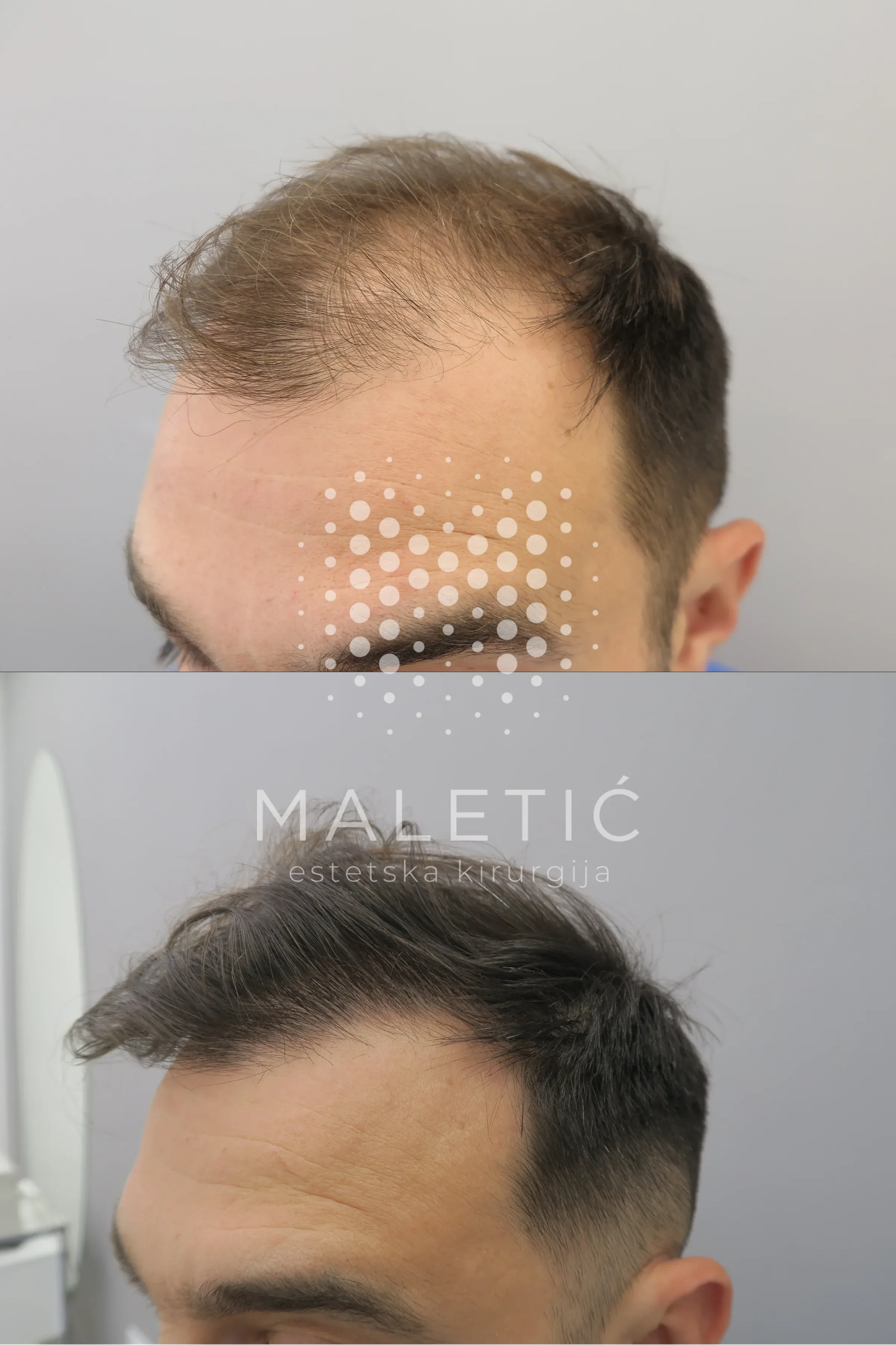
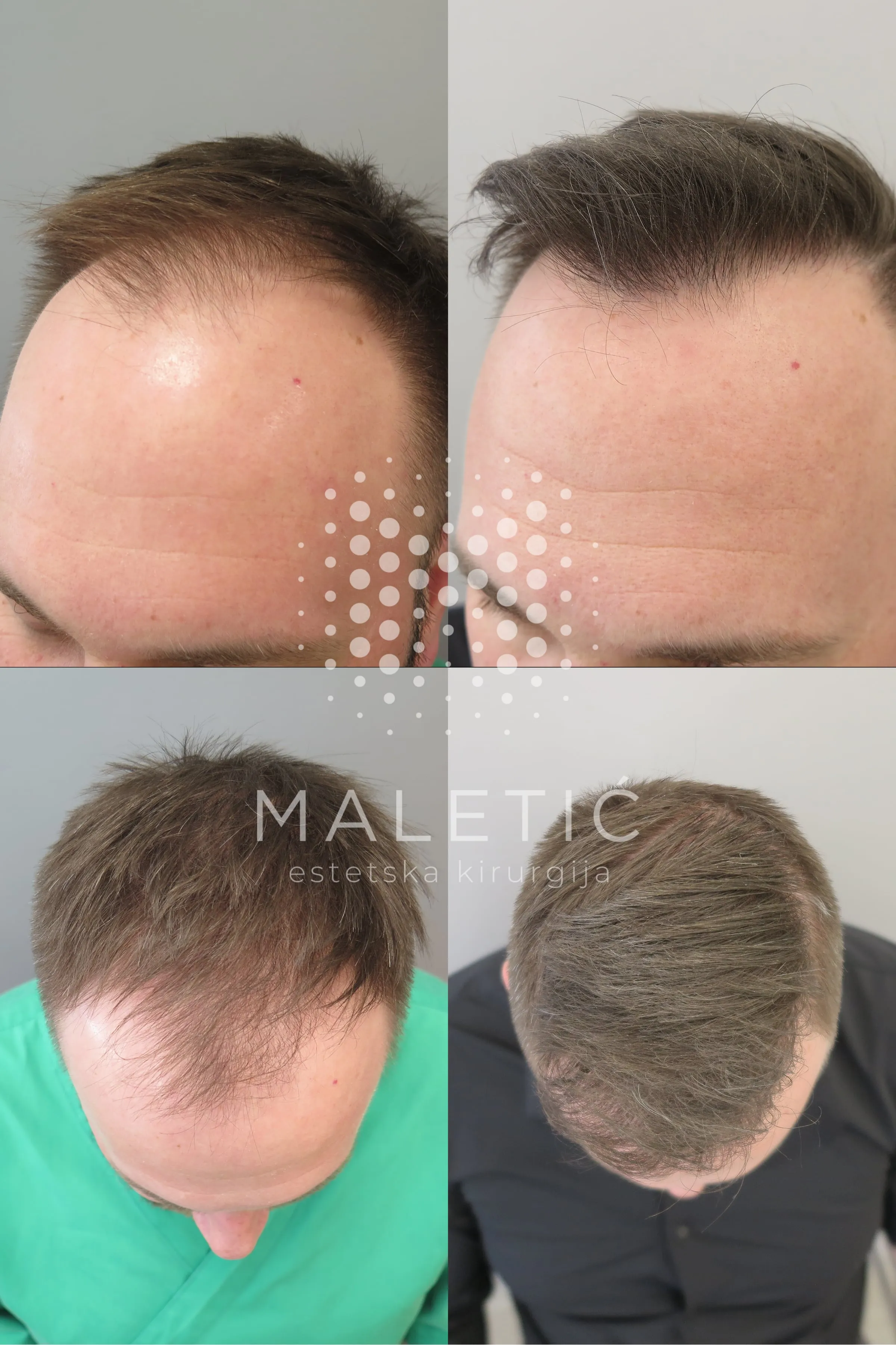
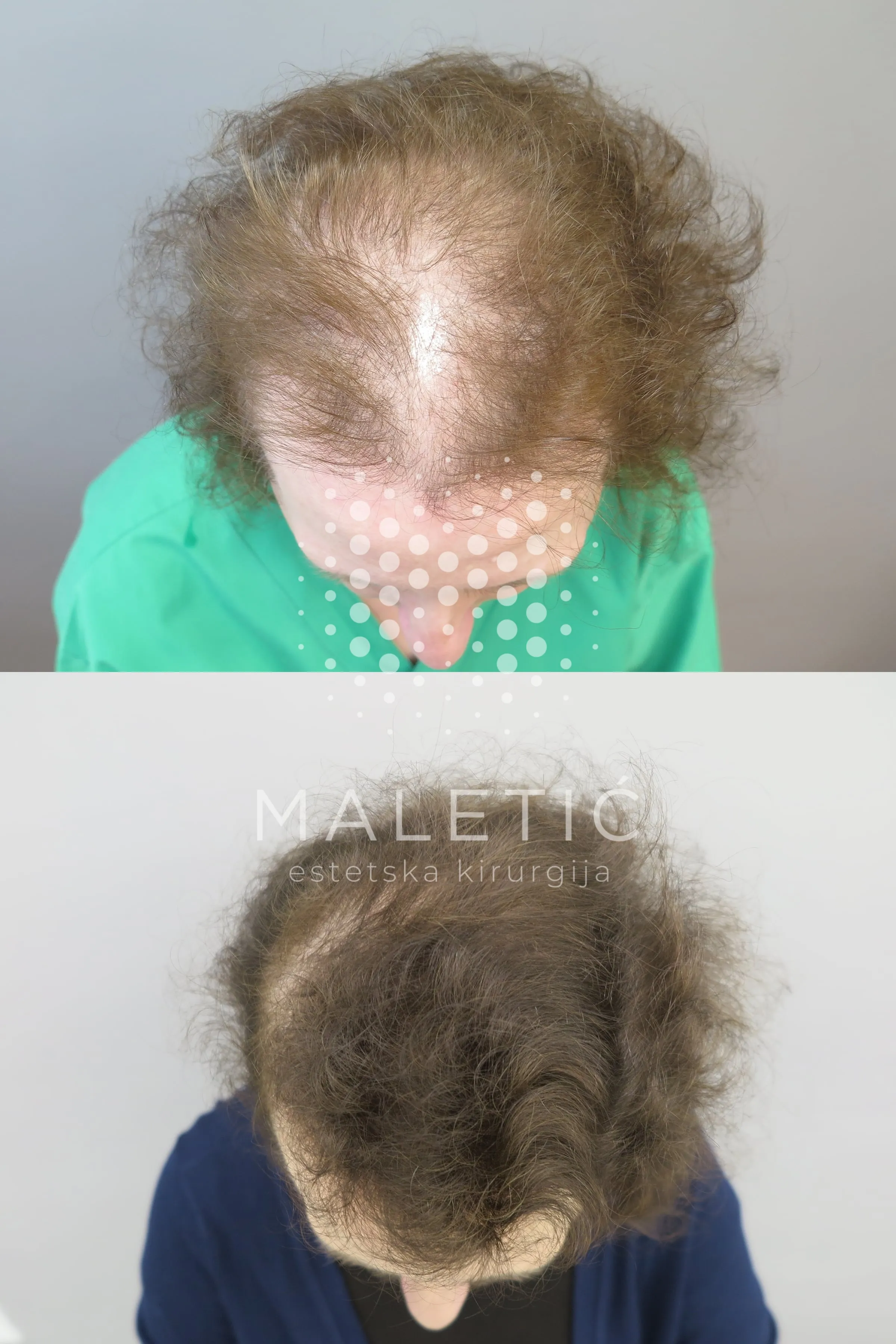
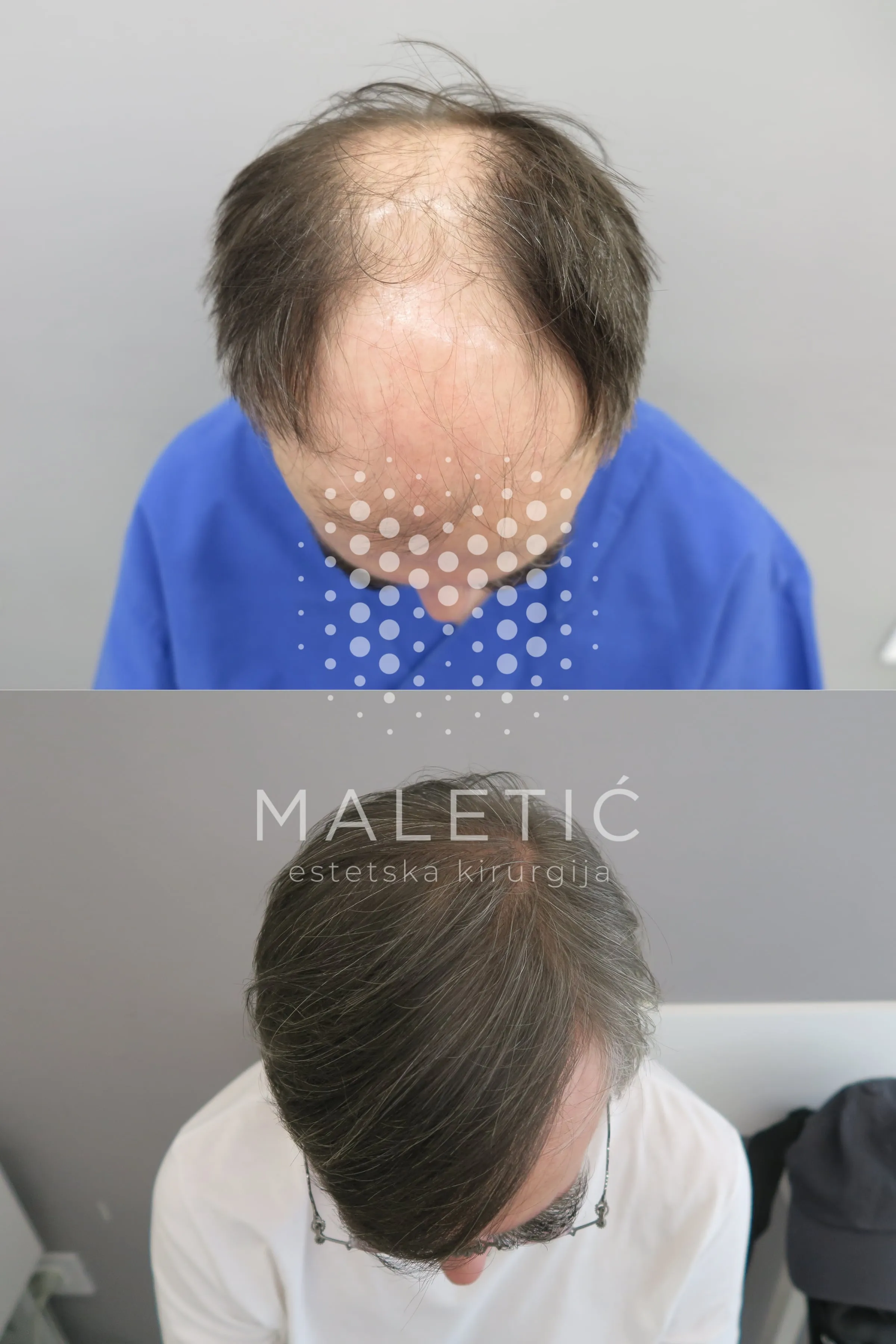
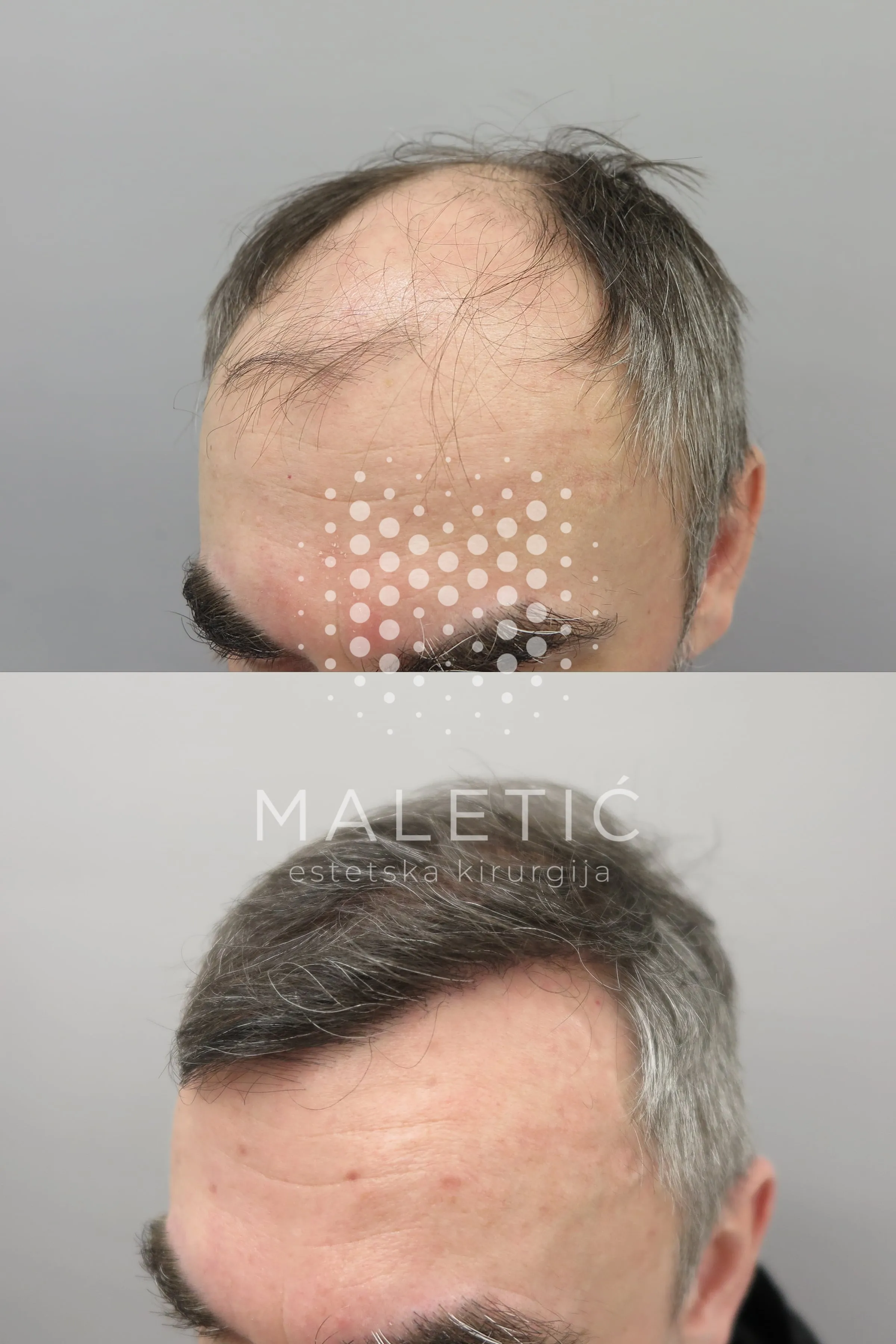
Before and after hair transplantation
We show results only with documented patient consent.
Who we are
Who will be taking care of you
The Hair Center is led by Ana Maletić, MD, PhD, a specialist in plastic, reconstructive and aesthetic surgery. She holds FISHRS and ABHRS Diplomate titles. She is the only physician in Croatia with the ABHRS Diplomate title and one of 260 worldwide. This title is held by doctors who have passed the only internationally recognised hair transplantation examination, administered by the American Board of Hair Restoration Surgery. She is the only full ISHRS member from Croatia and holds Fellow status, recognising the society’s most distinguished members. In March 2026, she defended her doctorate examining the relationship between hair transplantation and biopsychosocial factors of health.
“This procedure attracted me because it requires exceptional precision, patience and perfectionism.” — Ana Maletić, MD, PhD
Dr. Ana Maletić singles out follow-up visits as one of her favorite parts of the work, because that is when she follows how the result develops and how the patient is doing after the procedure.
A medical team supports you during preparation, the procedure and immediate recovery. The polyclinic has operated since 1998, founded by Dr. Ana’s parents, and two generations of the family work here today. We perform the procedure in Zagreb and Daruvar.
Meet the whole teamWatch
See more about hair transplantation
One year later
How the result develops over the first year
Transplanted follicles from your scalp continue producing hair with donor-region characteristics, so it can be washed, cut, coloured and styled without special rules.
A natural result depends on a hairline suited to your face and degree of alopecia, implantation following the angle and direction of hair naturally growing in those regions, and the use of single-hair follicular units at the hairline.
Studies following hair transplantation record improved satisfaction with appearance and quality of life in a share of patients.
The procedure does not increase the total number of follicles — it moves them from the donor area into the area of hair loss.
Price
Price and the first step
The total price of a hair transplant is determined individually, based on the number of follicular units and the chosen method. Prices for the FUE method per follicular unit, the STRIP-FUT method and transplanting hair from other parts of the body to the scalp per follicle are listed in the table below.
After the examination you decide for yourself whether to continue planning the procedure. The price of the trichoscopic scalp analysis is listed in the table below.
After examination and scalp analysis, you receive an individual procedure plan, an estimate of the follicular unit count and total price. Prices for all procedures are available in the price list.
If you are not sure whether a transplant is right for you, an examination can clarify the indication, the possibilities, and the limits of the procedure.
-
FUE hair transplant (per follicular unit)
-
STRIP-FUT hair transplant
-
Body hair transplant to the scalp (per follicle)
-
Trichoscopic scalp analysis (TrichoLAB FotoFinder)
-
Trichotest
-
Scalp biopsy with histopathology
Which method for whom
Patients most often ask us which hair therapy is best. There is no universally best therapy: each person’s hair loss has its own cause, stage, scalp condition and degree of follicle preservation. The same method may therefore work well for one person but not another.
We therefore build the treatment plan around a detailed scalp examination and, when needed, a health assessment. After trichoscopic analysis, we know the type and stage of hair loss and whether follicles with regenerative potential remain. The findings lead to one therapy or a combination of complementary methods. Sometimes they show that treatment makes no sense in your case; we then discuss transplantation or monitoring, depending on the findings. You will hear this at the first examination, not after several paid treatments.
Below is an overview of the methods we perform, how they differ, and when each one comes into consideration.
| Method | How it works | When it comes into consideration |
|---|---|---|
| Scalp mesotherapy | Delivers a preparation of vitamins, minerals and amino acids, composed according to the findings, into the scalp skin. | For weakened, thinning hair, early-stage thinning, and increased shedding after childbirth, illness, or a longer period of stress. |
| PRP treatment | Uses plasma from your own blood and the growth factors it contains, so the treatment involves drawing your blood and preparing it. | For increased shedding and thinning, when the follicles still exist but produce a thinner, weaker hair. |
| Polynucleotides | Purified DNA fragments that reduce inflammation in the scalp and stimulate the formation of new blood vessels, improving the scalp’s blood supply. | For diffuse thinning and a sensitive scalp, and when you prefer a solution that does not involve drawing blood. |
| Scalp filler | Delivers a complex of peptides and hyaluronic acid into the scalp skin that acts on the follicle itself. Unlike facial fillers, the goal is not added volume but strengthening the existing hair. | For weakened, thin hair and in the earlier phase of thinning, while the follicles are still active. |
| Laser hair growth treatment | Uses a medical Er:YAG laser to improve the scalp’s blood supply and encourage follicles to shift from resting into the growth phase, with no needles and no downtime. | For increased shedding and for strengthening existing hair, on its own or alongside other therapies. |
| Hair transplant | Your own follicles are moved from the donor region to areas where hair is absent or thinning. | When certain regions no longer have active follicles, because no treatment can bring back hair that is gone there. |
How it works
Delivers a preparation of vitamins, minerals and amino acids, composed according to the findings, into the scalp skin.
When it comes into consideration
For weakened, thinning hair, early-stage thinning, and increased shedding after childbirth, illness, or a longer period of stress.
How it works
Uses plasma from your own blood and the growth factors it contains, so the treatment involves drawing your blood and preparing it.
When it comes into consideration
For increased shedding and thinning, when the follicles still exist but produce a thinner, weaker hair.
How it works
Purified DNA fragments that reduce inflammation in the scalp and stimulate the formation of new blood vessels, improving the scalp’s blood supply.
When it comes into consideration
For diffuse thinning and a sensitive scalp, and when you prefer a solution that does not involve drawing blood.
How it works
Delivers a complex of peptides and hyaluronic acid into the scalp skin that acts on the follicle itself. Unlike facial fillers, the goal is not added volume but strengthening the existing hair.
When it comes into consideration
For weakened, thin hair and in the earlier phase of thinning, while the follicles are still active.
How it works
Uses a medical Er:YAG laser to improve the scalp’s blood supply and encourage follicles to shift from resting into the growth phase, with no needles and no downtime.
When it comes into consideration
For increased shedding and for strengthening existing hair, on its own or alongside other therapies.
Hair transplant
How it works
Your own follicles are moved from the donor region to areas where hair is absent or thinning.
When it comes into consideration
When certain regions no longer have active follicles, because no treatment can bring back hair that is gone there.
The methods are often combined, because the same scalp can simultaneously hold weakened follicles and areas where hair no longer grows. Then one method preserves and strengthens what is left, while the other replaces what has been permanently lost.
It is equally important to know what these methods cannot do. No therapy creates new follicles, so where a follicle has been permanently lost, no number of treatments can change the situation; transplantation is indicated. If hair loss is linked to thyroid disease, nutrient deficiency or a hormonal change, that condition is treated separately, with scalp therapy alongside it rather than instead of it.
The right method is the one that suits your scalp condition. Every plan therefore begins with analysis and discussion, followed by treatment selection.
Patient reviews
What our patients say
Reviews taken from our Google Business profiles, Zagreb and Daruvar, translated from Croatian.
★★★★★
“A month ago I had an FUE hair transplant with Dr. Ana Maletić. From the professional side, my hair was done perfectly. I was lucky that my hair did not shed and started growing right away. Dr. Maletić’s expertise is obvious and makes her, without question, the leader in this field in Croatia. But my real satisfaction and gratitude lie in how the Polyclinic treats its patients. They are highly professional, yet approachable and compassionate at the same time. Nurses Matea M. and Valerija left a positive mark on my whole experience and made it more pleasant and calming. To anyone in Croatia looking for a hair transplant, I warmly recommend this Polyclinic. You will get top results and excellent care!”
★★★★★
“I had a hair transplant and I am more than satisfied with this extraordinary, exceptionally professional, life-changing procedure! A big thank you to Dr. Ana, Danijela, Romana, and everyone else who took part in this wonderful experience. My sincerest thanks! Marko S.”
★★★★★
“I am very satisfied with Dr. Maletić’s results, from the beginning to the end of the hair transplant process. Five months after the procedure my hair looks phenomenal. The results I got, considering the number of grafts transplanted, pleasantly surprised me when compared with other clinics outside Croatia. As for the price, there is no big difference compared to clinics abroad, while the quality and expertise are on the level of top clinics. A big plus is that I did not have to travel outside the country, which made the whole process far less stressful for me.”
★★★★★
“I have rarely experienced such a professional, coordinated, and harmonious team. The atmosphere during the hair transplant was so pleasant that they even treated me to the occasional musical number. That relaxed atmosphere made the boredom of the procedure easier to bear. Although I do wonder whether some of you might be better off on a stage than in an operating room. Once again, a big thank you — I am already looking forward to the results in a few months!”
★★★★★
“A more than positive experience at Polyclinic Maletić, both in Zagreb and in Daruvar. I had a hair transplant and I am very satisfied with the approach and the procedure. I recommend it to everyone, especially to women who, like me, lost their hair after an illness. Once again, thank you to the kind team, and especially to Dr. Ana Maletić.”
★★★★★
“I just had a hair transplant. I am satisfied. Well done to Dr. Duško Maletić and the team in Daruvar. They are kind, professional, and do quality work. I recommend them.”
★★★★★
“All praise to the entire staff of the polyclinic. I have already had my second PRP scalp treatment and I can only commend the whole team. I would especially like to praise the doctor for her exceptional expertise, patience, and warm approach. From the first examination to the procedure itself I felt safe and informed. The whole course of treatment was professional and well organized — I received clear and detailed instructions before, during, and after the procedure, which gave me extra confidence. The procedure itself was stress-free, with every step explained along the way, which meant a lot to me. The atmosphere is pleasant and relaxing, and the staff exceptionally kind and helpful. I am very satisfied with the results so far and look forward to further progress. I definitely recommend it to anyone considering a PRP scalp treatment — you are in safe and expert hands!”
★★★★★
“I have been their patient and admirer for years. They have always known how to make my mom and me feel comfortable and welcome. My mom had a neck lift six years ago, and today I came in for PRP for hair growth. I cannot recommend them enough. Thank you, Ana!”
★★★★★
“A few years ago I saw Dr. Ana Maletić for a facial hair correction using the FUE method, which made my beard somewhat denser. The results are fantastic — the work was done with such dedication and care. From the first meeting at the polyclinic she radiated confidence and knowledge of her work, along with a readiness and kindness to answer every question I had. All recommendations for Dr. Ana and her entire professional and friendly team.”
★★★★★
“A great experience, team, and final result. In short, I had an eyebrow transplant. Everything went exactly as Dr. Ana Maletić explained. The whole team was very kind and professional from start to finish, and I am now at peace because I finally have eyebrows. They look very natural, and the density is just as it should be. All recommendations!”
Questions and answers
Frequently asked questions
Does a hair transplant hurt?
The procedure uses local anesthesia, so you should not feel pain during it. Brief discomfort when the anesthetic is injected lasts a few minutes. We use vibration at the injection site to minimise this discomfort. Afterwards, tightness and tenderness are possible, but painkillers are usually unnecessary.
Do I have to shave my head?
Not necessarily. We discuss the need for a haircut with the patient at the consultation.
How long does the procedure take, and do I stay overnight?
Depending on the number of follicular units, the procedure usually lasts four to eight hours, including breaks. It uses local anesthesia and you can go home the same day.
Why does transplanted hair shed around ten days after the procedure?
This is a possible phase called temporary shedding of transplanted hair. The hair sheds while the follicle remains in place. New hair usually begins growing after three to four months. At our clinic, transplanted hair very often continues growing without shedding, thanks to our exceptionally gentle and precise technique.
When will I see the final result?
Initial growth is visible around months three to four, a more noticeable change around month six, and the final appearance is assessed after twelve months. In some patients, the final appearance continues developing up to eighteen months.
Will people be able to tell I had a transplant?
The aim is a natural result, so we pay particular attention to planning the hairline, distribution and growth direction. The hairline is adapted to facial shape, degree of alopecia and donor density. Single-hair follicular units are placed at the front, with denser units reserved for the middle and crown.
Will the rest of my hair keep falling out after the procedure?
Follicles transplanted from the safe donor region are resistant to androgenetic alopecia, but your existing surrounding hair remains susceptible. We therefore also plan how to preserve existing hair. Preservation methods cannot completely stop hair loss, but most often reduce and slow it.