
Since 1998 · Zagreb & Daruvar
Beard and Mustache Transplant in Croatia
Patchy cheeks, a beard that does not connect to the mustache, or areas where hairs have never grown are the reasons men come in for an examination. Transplanting your own follicles can permanently fill in the beard, and the procedure is preceded by an assessment of the indication, the state of the donor area, and the right time to perform it.
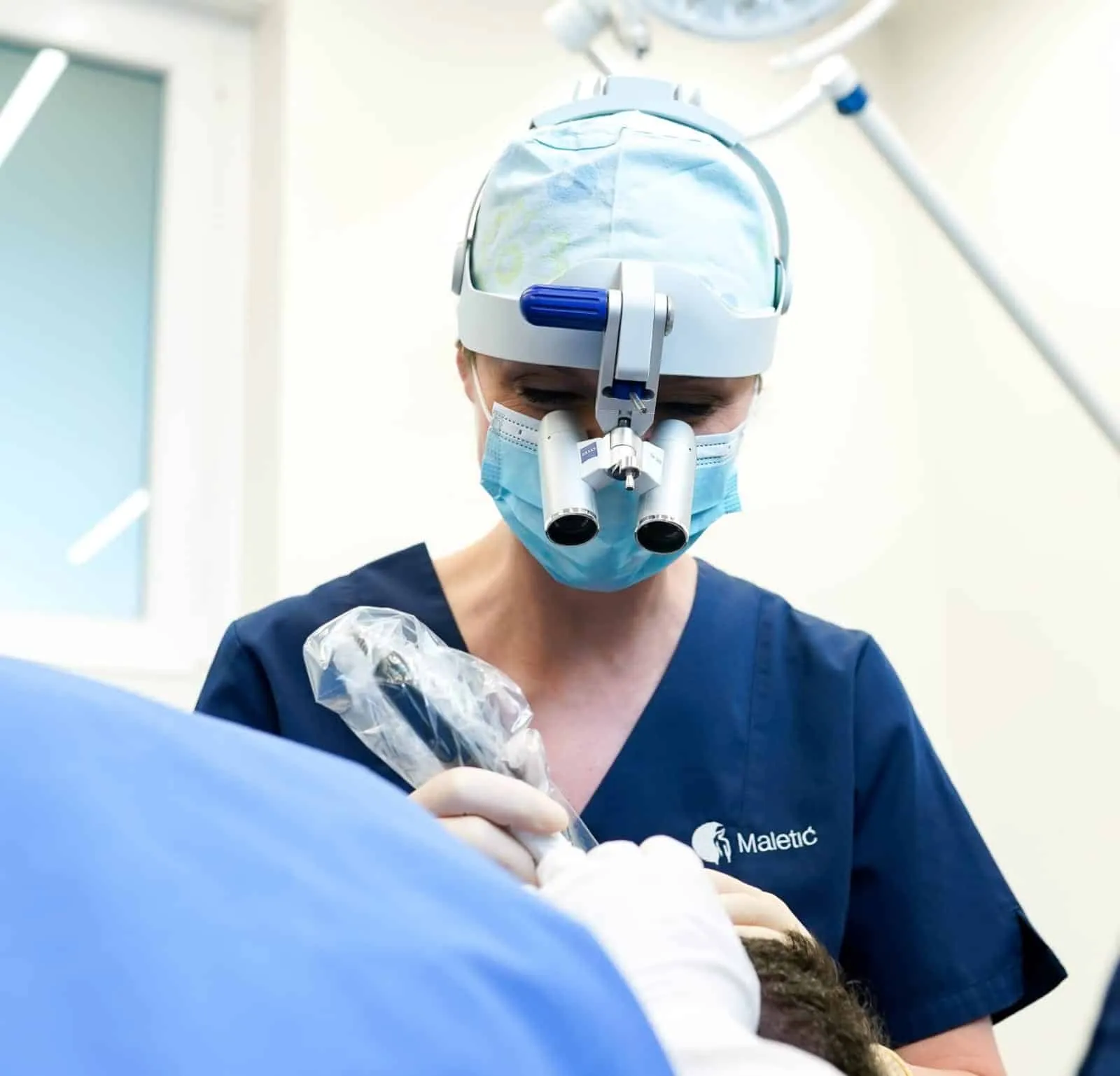
Many men rarely talk about being unhappy with the density or shape of their beard. Before the examination, some have tried various ways of covering the gaps or stimulating growth, without the results they expected. At the examination you can talk about it openly and without any sense of being judged. We first assess the cause of the missing growth, the condition of the skin, and the donor area, because those factors determine whether the procedure is indicated and feasible.
Is this for me?
What a beard and mustache transplant is and who it is for
Beard and moustache transplantation moves your own follicular units from a safe donor region — usually the back and sides of the scalp or the beard area on the neck — to facial areas where hair is absent or too sparse. Only your own follicles can be used. After transplantation, follicles continue producing hairs with the characteristics of the donor region, so the beard can later be shaved, trimmed and cared for normally.
We plan density, direction and implantation angle separately for each beard area, because a natural result depends not only on hair count but also on distribution, angle, direction and facial proportions.
Patchy cheeks and moustache
The most common reasons for visiting are naturally low hair density, gaps on the cheeks and a beard that does not connect with the moustache. This pattern is usually a natural anatomical characteristic: the distribution and density of follicles are genetically determined.
Scars, burns, and the after-effects of earlier procedures
Other causes are acquired. Hair may be absent from skin damaged by burns, injury, severe acne, surgery or cleft lip repair. In scars, the procedure has a reconstructive role, aiming to restore hair growth in damaged skin. Depending on the scar location, hairs are sometimes taken from the other side of the neck to match the colour and thickness of existing hairs as closely as possible.
Assessing the indication
When the procedure is not needed or should be postponed
“We make every recommendation according to what is in the patient’s best interest. If the examination shows the procedure is not needed or is not the right choice, we will not recommend it.” — Ana Maletić, MD, PhD
In two situations, we first postpone the procedure or recommend further diagnostics.
In some men the beard keeps filling in after twenty
Beard growth increases during puberty, but density can continue changing afterwards. In some men it increases for years into adulthood, as fine, light hairs gradually develop into thicker, more pigmented terminal hairs. A beard pattern in the early twenties is therefore not necessarily final. For very young patients, we sometimes recommend monitoring beard development and reassessing after a period of time.
When the gaps appeared later
There is a difference between a beard that has never been dense and gaps that appear suddenly as round, sharply defined patches. These can indicate beard alopecia areata, an autoimmune condition in which the immune system attacks its own follicles and whose course is unpredictable. Diagnosis and treatment come before transplantation in this case. The same applies to active acne and other inflammatory skin conditions in the planned treatment area.
Hair loss affects the planning of the donor area
The hairs at the back of the head are not an unlimited reserve and do not renew themselves. In a man who is already losing hair, follicular units used for the beard are no longer available for a possible future scalp procedure, which is why we assess the state of the scalp and the donor area before planning the procedure.
The doctor explains the limitations of the donor region, especially when a large number of follicular units is planned. The supply is limited and does not regenerate after extraction. Harvesting scalp follicles also leaves tiny pale dots, usually covered by hair, which may become more visible if the hair is shaved very short.
Before a permanent procedure, it is important to gather all the information needed for a decision, including a professional opinion.
How it is performed
How we perform a beard and mustache transplant
- Follicular units
- the required number depends on the design, size of the areas to fill, desired density and donor supply
- Anesthesia
- local
- Recovery
- home the same day; about ten days without sport or heavier exertion
- Performed by
- Ana Maletić, MD, PhD
Design before the first hair
Before harvesting follicular units, we mark the planned beard shape on the face: the areas to fill, the border, density and the natural direction of growth. We show you the design and agree on it before starting. Hairs are implanted at an angle close to the skin, matching surrounding hairs, because angle and direction determine whether the result looks natural and consistent with existing hair.
“I plan the beard shape according to facial proportions and the number of follicles available from the donor region.” — Ana Maletić, MD, PhD
We design the beard to look natural whether you wear it longer or shorter.
FUE, STRIP
We most often use FUE, extracting follicular units individually with an instrument less than one millimetre in diameter, without a linear incision or sutures. The donor region — usually the back of the scalp, the sides above the ears or the neck — retains tiny dots that fade over time. We select units whose hairs most closely resemble beard hair. Only FUE is used when harvesting from the beard area on the neck. For the back of the scalp or the sides above the ears, STRIP is also possible: a strip of scalp is removed and individual follicular units are separated under a microscope. This leaves a linear donor scar.
The procedure is performed under local anesthesia.
Where we take the hairs from
The main donor regions are the back and sides of the scalp, where suitable candidates have more stable follicles at sufficient density for harvesting. If there is enough hair in another beard area, hairs can also be taken from the neck, where colour, thickness and growth pattern may more closely match the existing beard. Darker, thicker hairs can create a greater impression of density with the same number of follicular units.
See the full price listWhy us
Why choose us for your beard and mustache transplant
ABHRS Diplomate
Dr. Ana Maletić is the only physician in Croatia with this title, one of 260 physicians worldwide
The only ISHRS Fellow from Croatia
the most distinguished membership level in the international hair transplantation society
One of 6 clinics worldwide
with this level of international certification for transplantation
Since 1996
the start of training in hair transplantation, two years before the Polyclinic opened in 1998
The procedure is performed by a physician
beard and moustache transplantation is surgery and should be performed by a doctor, preferably a surgeon
All transplantation methods
we can use all hair transplantation methods, choosing the best one for each patient and the region from which follicles are harvested
Beard design before the procedure
before surgery, we agree on the regions receiving follicles and those providing them
Performed in an operating room
operating rooms have the most advanced equipment for this procedure, including heat recovery ventilation
Preparation and recovery
Preparation, the day of the procedure, and recovery
Two weeks before. Medicines and supplements that can affect bleeding need to be discussed with your physician beforehand; prescribed therapy should not be stopped on your own. You receive exact instructions about alcohol, caffeine, medicines, and dietary supplements during the preparation for the procedure.
On the day of the procedure. The procedure uses local anesthesia and you go home the same day. Beforehand, we photograph the donor regions and beard, assess your health, measure blood pressure and pulse, and perform an ECG. You change into clinic clothing.
The first seven days. You care for the donor and transplanted areas with a spray you receive at the Polyclinic, following the written instructions.
The first ten days or so. Tiny crusts and redness are visible, and sport and strenuous activity are avoided. Transplanted hairs may shed while follicles remain in place. At our clinic, hairs very often continue growing without shedding, thanks to our particularly meticulous technique.
Months three to four. New hairs begin growing from follicles whose hairs have shed.
Months ten to fourteen. The final result is assessed.
For the first few weeks, protect the transplanted area from direct, intense sun exposure. You receive written instructions on washing and when you may shave.
Real results
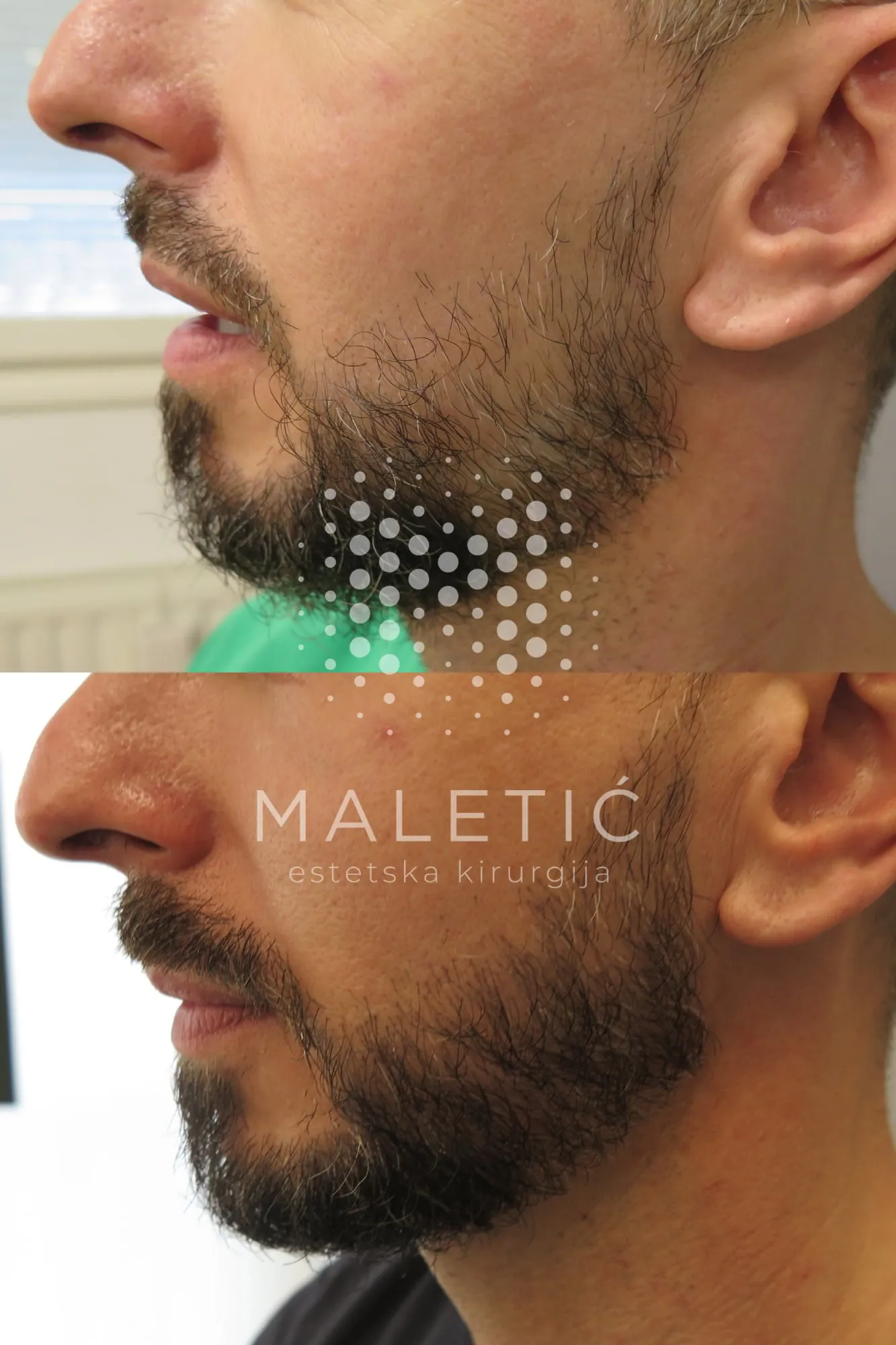
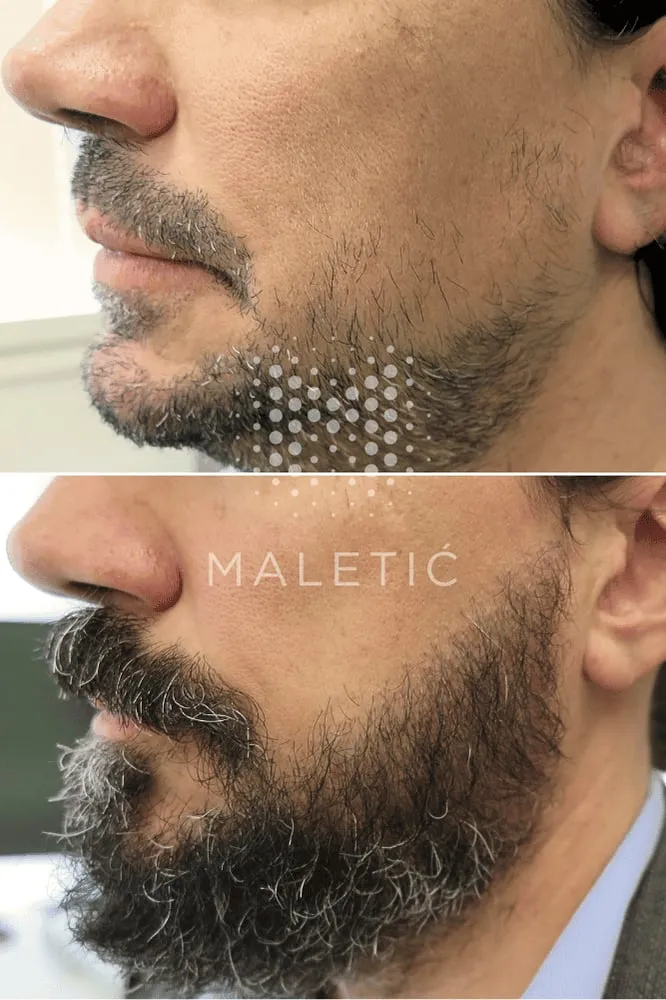
Before and after a beard and mustache transplant
We show results only with documented patient consent.
Honest about the risks
Risks and what the procedure cannot do
Like any surgery, beard and moustache transplantation carries possible risks and side effects. Follicular inflammation and tiny bumps around implanted hairs may occur. Hyperpigmentation may develop in the transplanted area and hypopigmentation at extraction sites, both more pronounced in darker skin. Infection or ingrown hairs may occur rarely.
The aesthetic result is particularly affected by the angle and direction of implantation. If the hairs are implanted at the wrong angle or in the wrong direction, the beard grows unnaturally, and correcting it is difficult and sometimes requires removing some of the implanted hairs. That is why the physician’s experience and precise planning matter especially for a natural result.
A second procedure is sometimes needed if greater density is desired.
For people considering non-surgical options, medication is sometimes considered.
Where to decide
How to choose the place and the physician for the procedure
When choosing a clinic, find out who performs the procedure, how follow-up is organised and whom you can contact during recovery. Quality depends on team expertise, technique and follow-up availability, rather than the country. Know who performs the key steps and whom to contact if difficulties arise during recovery or hair growth.
The International Society of Hair Restoration Surgery, ISHRS, maintains a public directory of its physician members. Whichever country you choose for the procedure, check whether your intended doctor is verified and listed among ISHRS-recommended physicians. The directory is available here: Find a Doctor
Who we are
Who performs the procedure
The procedure is performed by Ana Maletić, MD, PhD, a specialist in plastic, reconstructive and aesthetic surgery and Head of the Hair Center. She holds FISHRS and ABHRS Diplomate titles. She is the only physician in Croatia with the ABHRS Diplomate title and one of 260 worldwide. This title indicates passing the only internationally recognised hair transplantation examination, administered by the American Board of Hair Restoration Surgery. She is the only ISHRS Fellow from Croatia, a status recognising the society’s most distinguished members. Alongside scalp hair transplantation, she transplants hairs to the beard, moustache and eyebrows.
A medical team supports you during preparation, the procedure and immediate recovery. The polyclinic has operated since 1998, founded by Dr. Ana’s parents, and two generations of the family work here today. We began training in hair transplantation in 1996, two years before the Polyclinic opened, and perform the procedure in Zagreb and Daruvar.
We are aware that talking about the look and density of a beard can be sensitive for some men. The conversation is held without judgment and with full respect for medical confidentiality.
Meet the whole team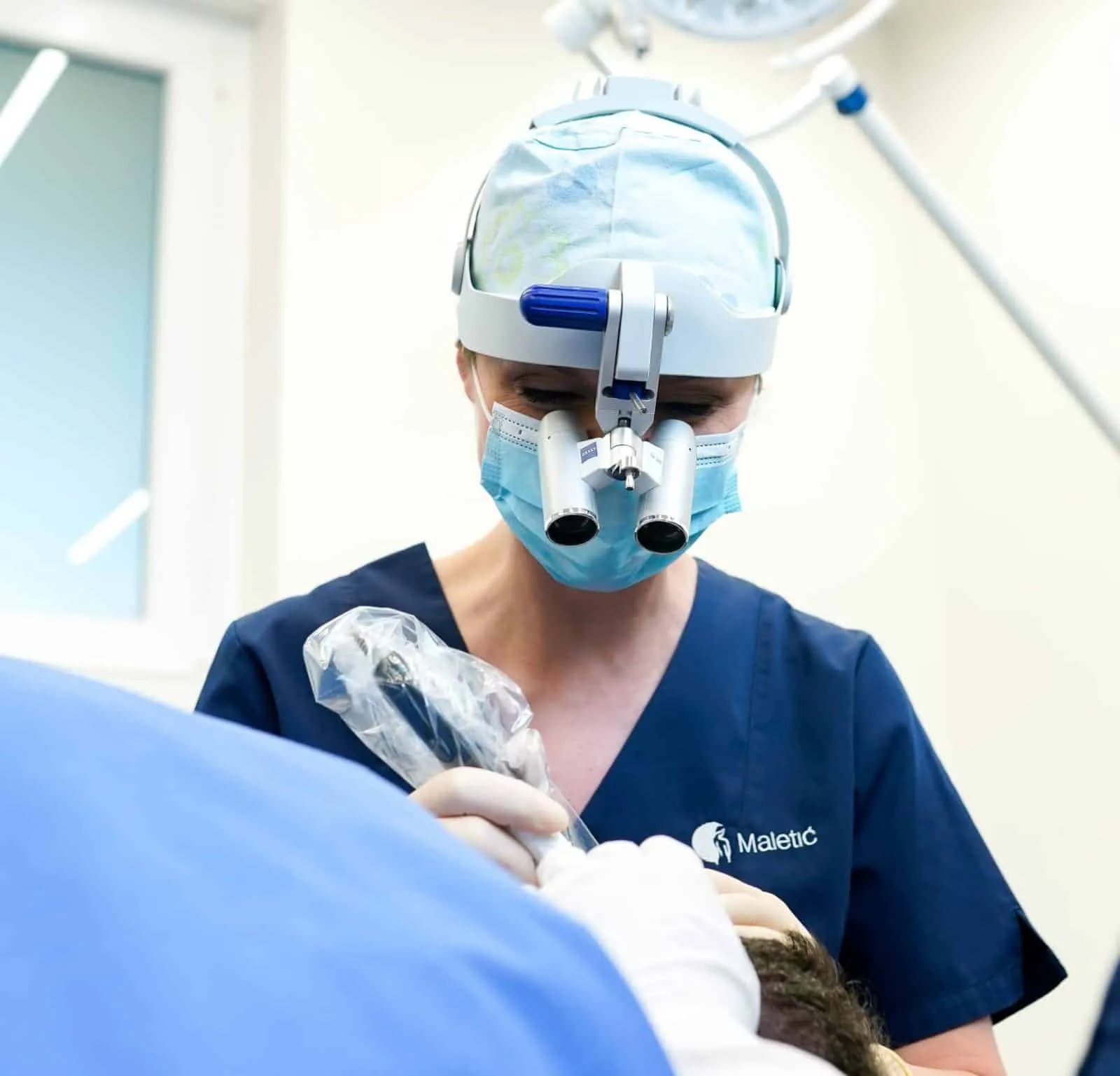
After the procedure
What the result looks like once growth is complete
Transplanted hairs grow from your skin and retain their donor-region characteristics, so they can be shaved, trimmed and styled like the rest of the beard. Final growth is assessed after ten to fourteen months. The final shape depends on the agreed design, facial proportions and transplanted hair characteristics.
Once growth is complete, the beard may look more even, and transplanted hairs can be shaved, trimmed and styled like the others.
The procedure does not change the natural properties of the transplanted hair — color, thickness, and curl stay as they were in the donor area, so a natural impression depends on the harmony of the number, distribution, direction, and angle of implantation.
Price
Price and the first step
The price of a beard and mustache transplant per follicular unit is listed in the table below. The total amount depends on the number of units, and that number is determined only after the examination and the agreement on the beard design, because it depends on the size of the area, the existing density, the state of the donor area, and the agreed plan for the procedure.
After examination, you decide whether to proceed with planning. We determine the required number of follicular units according to the findings, donor capacity and planned design. Prices for all procedures are available in the price list, and other hair and scalp procedures in the Hair Center.
If you are not sure whether the procedure is suitable for you, an examination can clarify the indication, the possibilities, and the limits. At the examination you receive an assessment of the indication, the state of the donor area, and the possibilities of the procedure.
-
Beard and mustache transplant (per follicular unit)
Patient reviews
What our patients say
Reviews taken from our Google Business profiles, Zagreb and Daruvar, translated from Croatian.
★★★★★
“A few years ago I saw Dr. Ana Maletić for a facial hair correction using the FUE method, which made my beard somewhat denser. The results are fantastic — the work was done with such dedication and care. From the first meeting at the polyclinic she radiated confidence and knowledge of her work, along with a readiness and kindness to answer every question I had. All recommendations for Dr. Ana and her entire professional and friendly team.”
★★★★★
“A month ago I had an FUE hair transplant with Dr. Ana Maletić. From the professional side, my hair was done perfectly. I was lucky that my hair did not shed and started growing right away. Dr. Maletić’s expertise is obvious and makes her, without question, the leader in this field in Croatia. But my real satisfaction and gratitude lie in how the Polyclinic treats its patients. They are highly professional, yet approachable and compassionate at the same time. Nurses Matea M. and Valerija left a positive mark on my whole experience and made it more pleasant and calming. To anyone in Croatia looking for a hair transplant, I warmly recommend this Polyclinic. You will get top results and excellent care!”
★★★★★
“I had a hair transplant and I am more than satisfied with this extraordinary, exceptionally professional, life-changing procedure! A big thank you to Dr. Ana, Danijela, Romana, and everyone else who took part in this wonderful experience. My sincerest thanks! Marko S.”
★★★★★
“All praise to the entire staff of the polyclinic. I have already had my second PRP scalp treatment and I can only commend the whole team. I would especially like to praise the doctor for her exceptional expertise, patience, and warm approach. From the first examination to the procedure itself I felt safe and informed. The whole course of treatment was professional and well organized — I received clear and detailed instructions before, during, and after the procedure, which gave me extra confidence. The procedure itself was stress-free, with every step explained along the way, which meant a lot to me. The atmosphere is pleasant and relaxing, and the staff exceptionally kind and helpful. I am very satisfied with the results so far and look forward to further progress. I definitely recommend it to anyone considering a PRP scalp treatment — you are in safe and expert hands!”
★★★★★
“I have been their patient and admirer for years. They have always known how to make my mom and me feel comfortable and welcome. My mom had a neck lift six years ago, and today I came in for PRP for hair growth. I cannot recommend them enough. Thank you, Ana!”
★★★★★
“I am very satisfied with Dr. Maletić’s results, from the beginning to the end of the hair transplant process. Five months after the procedure my hair looks phenomenal. The results I got, considering the number of grafts transplanted, pleasantly surprised me when compared with other clinics outside Croatia. As for the price, there is no big difference compared to clinics abroad, while the quality and expertise are on the level of top clinics. A big plus is that I did not have to travel outside the country, which made the whole process far less stressful for me.”
★★★★★
“I have rarely experienced such a professional, coordinated, and harmonious team. The atmosphere during the hair transplant was so pleasant that they even treated me to the occasional musical number. That relaxed atmosphere made the boredom of the procedure easier to bear. Although I do wonder whether some of you might be better off on a stage than in an operating room. Once again, a big thank you — I am already looking forward to the results in a few months!”
★★★★★
“A great experience, team, and final result. In short, I had an eyebrow transplant. Everything went exactly as Dr. Ana Maletić explained. The whole team was very kind and professional from start to finish, and I am now at peace because I finally have eyebrows. They look very natural, and the density is just as it should be. All recommendations!”
★★★★★
“A more than positive experience at Polyclinic Maletić, both in Zagreb and in Daruvar. I had a hair transplant and I am very satisfied with the approach and the procedure. I recommend it to everyone, especially to women who, like me, lost their hair after an illness. Once again, thank you to the kind team, and especially to Dr. Ana Maletić.”
★★★★★
“I just had a hair transplant. I am satisfied. Well done to Dr. Duško Maletić and the team in Daruvar. They are kind, professional, and do quality work. I recommend them.”
Questions and answers
Frequently asked questions
How many follicular units does a beard take?
It depends on the size of the area to be filled, how much hair already grows there and your desired density. The exact number cannot reliably be determined without examination, as it depends on existing density, donor condition and the agreed beard shape.
Does a beard transplant hurt?
The procedure uses local anesthesia, so you should not feel pain during it. Brief discomfort may occur when the anesthetic is injected; we use vibration at the injection site to reduce it. Mild tenderness and tightness are usual afterwards and can be relieved with standard painkillers if needed.
Why do the transplanted hairs fall out after a few weeks?
This is an expected recovery phase for many patients. The transplanted hair sheds while the follicle remains in place. Growth usually begins after three to four months. At our clinic, hairs often continue growing without shedding, thanks to our very meticulous technique.
When can I go back to work, and when may I shave?
The procedure uses local anesthesia and you go home the same day. Avoid sport and strenuous activity for around ten days. Tiny crusts and redness are visible in the transplanted area during that time, so it is useful to plan your return to work and social activities in advance.
Is the result permanent, and can I shave the beard normally afterwards?
Transplanted follicles are permanent. Once the hairs grow, they can be shaved, trimmed and cared for like the others, because follicles retain their donor-region characteristics.
Can I have a beard transplant if the hair on my head is already thinning?
Yes, but especially careful donor assessment is needed. Follicles at the back of the scalp are a limited, non-renewable supply: units used for the beard are no longer available for possible future scalp transplantation, while hair loss may continue.
Will people be able to tell the beard is transplanted?
The aim is a natural result, with particular attention to shape, distribution, growth direction and angle. Hairs are implanted close to the skin at the natural growth direction for that area. An incorrect angle or direction is the most common reason a transplanted beard looks unnatural, and such irregularities are difficult to correct later.