
Since 1998 · Zagreb & Daruvar
Scalp Filler in Croatia
When hair starts losing density and getting thinner, the first step is to establish the state of the follicles and the cause of the change before choosing a therapy. A scalp filler with peptides and hyaluronic acid can help strengthen weakened hair and reduce its shedding. Before any treatment, we examine the scalp in detail and assess whether the filler is a suitable therapy for you.

A scalp filler is an injectable therapy that delivers a complex of peptides and hyaluronic acid into the scalp skin to strengthen weakened follicles and reduce hair shedding. It can be most useful for thin, weakened hair and in the earlier phase of thinning, while the follicles are still active. With advanced hair loss, the expected effect is smaller.
Is this for me?
What a scalp filler is and what it contains
Scalp filler is an injectable therapy for weak, fine hair. It introduces a complex of seven peptides and hyaluronic acid into the scalp — substances that strengthen follicles and improve scalp condition. It is used in both women and men, most often for increased shedding and thinning hair.
This is a medical treatment, not cosmetic care. That is why an examination comes first, and the therapy is recommended only when the findings show that the follicles are still active and the therapy can have an effect.
Why it is called a “filler” when it adds no volume
The name can be confusing, as most people associate fillers with lips and the face. There, a filler does add volume beneath the skin. Scalp filler does something entirely different. It neither shapes nor fills tissue, but delivers active substances into a specific skin layer to strengthen existing hair and improve its density. They share a name and a method of administration, but not the purpose of treatment.
What it acts on
Peptides and hyaluronic acid act on several processes in the scalp at once. They may support follicle activity, have antioxidant effects and stimulate angiogenesis — the formation of new blood vessels — improving scalp circulation. Better circulation may help supply follicles with the oxygen and nutrients needed for normal function.
The filler, then, does not create new hair and does not add volume. Its goal is to improve the conditions in which the existing follicles function.
Who it makes sense for
Who a scalp filler helps the most
The people who can benefit most are those whose thinning is still in an earlier phase. When the hair has thinned but the follicles are still active, the therapy can act on the existing hair. The more advanced the hair loss, the more limited the expectations from the therapy.
Situations in which we suggest it
- Weakened, thin hair — a hair shaft that has lost thickness and strength.
- Increased shedding and early thinning, when density is dropping and the part line is slowly widening.
- Diffuse thinning in women — an even loss of density across the entire scalp.
- Hair loss after childbirth, illness, or a longer period of stress, when the condition has settled but recovery is not happening.
- As a complement to other scalp therapies, PRP for example, when the findings show they complement each other well.
Filler, PRP, or mesotherapy: how the therapy is chosen
This is the most common question at the consultation, and understandably so, because all three therapies deliver active substances into the scalp — they differ in what is applied. A PRP treatment uses your own plasma, mesotherapy uses nutrients composed according to your findings, and the filler uses a complex of peptides and hyaluronic acid.
Therapy is selected according to the scalp analysis findings, rather than the popularity of a treatment. Individual methods can be combined when the findings show this is needed.
“A scalp filler has nothing to do with a lip filler, even though the name is confusing. Here nothing is volumized — peptides and hyaluronic acid are delivered into the scalp with the goal of improving the conditions in which the follicle functions. Whether the therapy makes sense in your case is something we assess with an examination and a scalp analysis.” — Ana Maletić, MD, PhD
How it is performed
What a filler treatment with us looks like
The entire procedure takes about half an hour and belongs to the minimally invasive medical procedures.
- Duration
- about 30 minutes
- Anesthesia
- usually not needed; local anesthesia by agreement
- Protocol
- 4 treatments over 8 weeks, two weeks apart
- Performed by
- Ana Maletić, MD, PhD
1 · Examination and trichoscopic scalp analysis. We examine the scalp with trichoscopy and, when a more precise picture is needed, use the TrichoLAB system to measure hair thickness, density and hair counts by region. The examination helps us identify the type of hair loss and whether filler could have an effect.
2 · Preparation. We photograph the scalp and disinfect the treatment area with an antiseptic. If you are more sensitive, local anesthesia can be used by arrangement. Vibration at the filler injection sites is usually sufficient.
3 · Application. We inject the filler with fine needles into the areas selected according to the findings, then massage the scalp to distribute the preparation evenly.
4 · After the treatment. You return to your routine right away, with no downtime. You receive instructions for the following days in writing.
Treatment is usually given as a series of four sessions over eight weeks, approximately two weeks apart. After the series, we analyse and photograph the scalp again to assess the changes.
See the full price listHonest about the limits
What the filler cannot do and when we do not recommend it
This part of the conversation happens at the first examination, before a single treatment is agreed.
It does not create new follicles. Where follicles are no longer present, injectable therapies cannot restore lost hair, so filler is not a solution for a bald crown or areas without hair and living follicles. In that situation, considering hair transplantation is more appropriate than providing therapy unlikely to help. See hair transplantation.
It does not remove the cause of hair loss. If hair loss is associated with thyroid dysfunction, iron deficiency or a hormonal change, the underlying cause also needs treatment.
If the findings do not point to an expected benefit from the filler, we will not recommend the therapy. We suggest a series of treatments only when there is a clear professional indication for it.
A realistic expectation
What actually changes after the series
The scalp does not change quickly because treatment acts on the slow hair growth cycle. The effect is assessed several months after therapy. Changes that may be confirmed during this period include thicker hair, greater density and less shedding.
In everyday life, the change most often means less hair on the brush and better scalp coverage.
Why us
Why choose us for a scalp filler
ABHRS Diplomate
Dr. Ana Maletić is the only physician in Croatia with this title, one of 260 physicians worldwide
The only ISHRS Fellow from Croatia
the most distinguished membership level in the international hair transplantation society
One of 6 clinics worldwide
with this level of international certification for hair treatments
The only clinic in Croatia offering all four methods
FUE, DHI, Sapphire, and STRIP; we choose the method based on your findings, not on what we happen to offer
Since 1996
the start of training in hair transplantation, two years before the Polyclinic opened in 1998
Trichoscopic scalp analysis
detailed scalp analysis before treatment
Therapy only with a professional indication
if the findings do not point to an expected benefit from the therapy, we will not recommend the filler
Real results
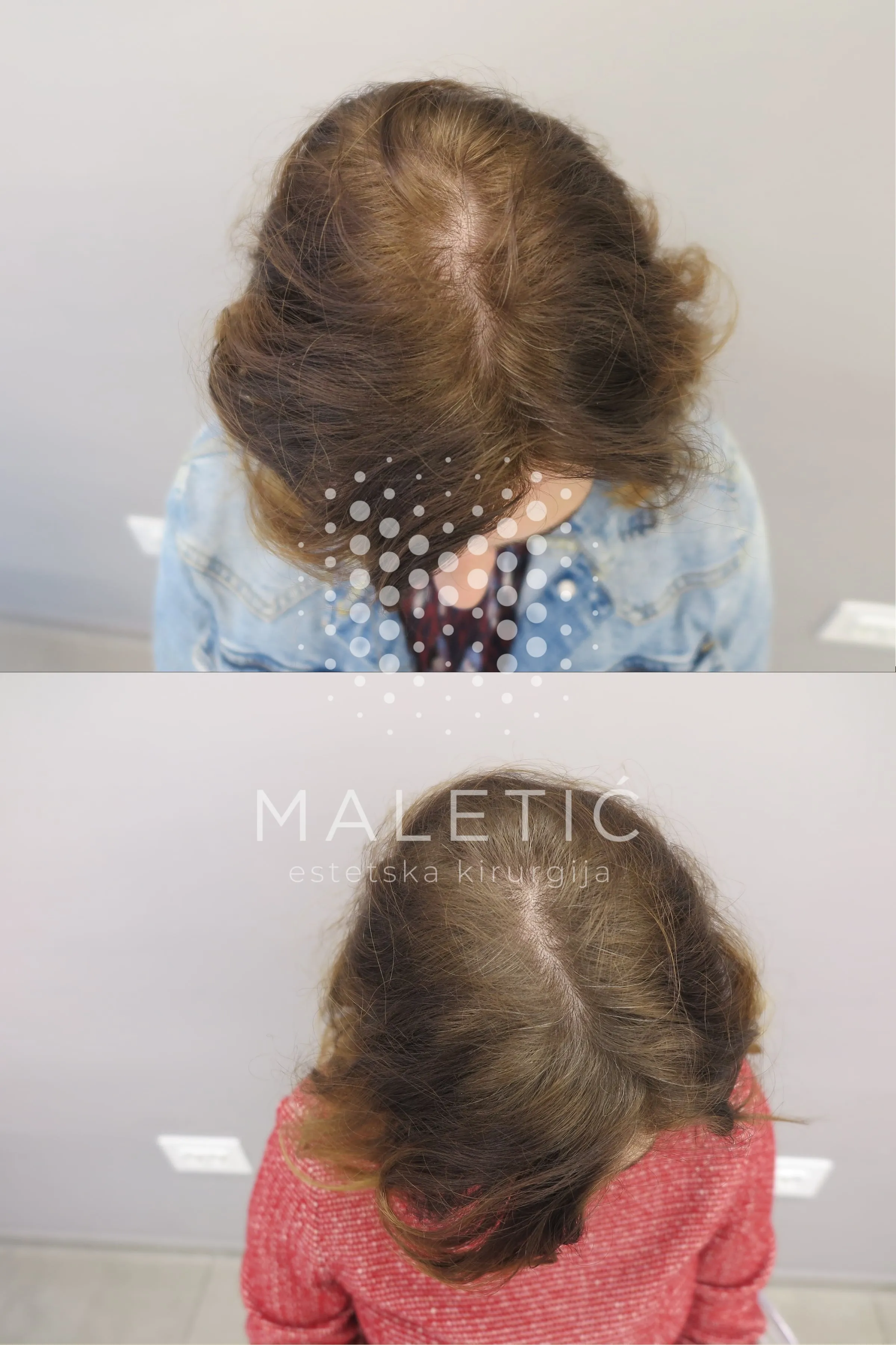
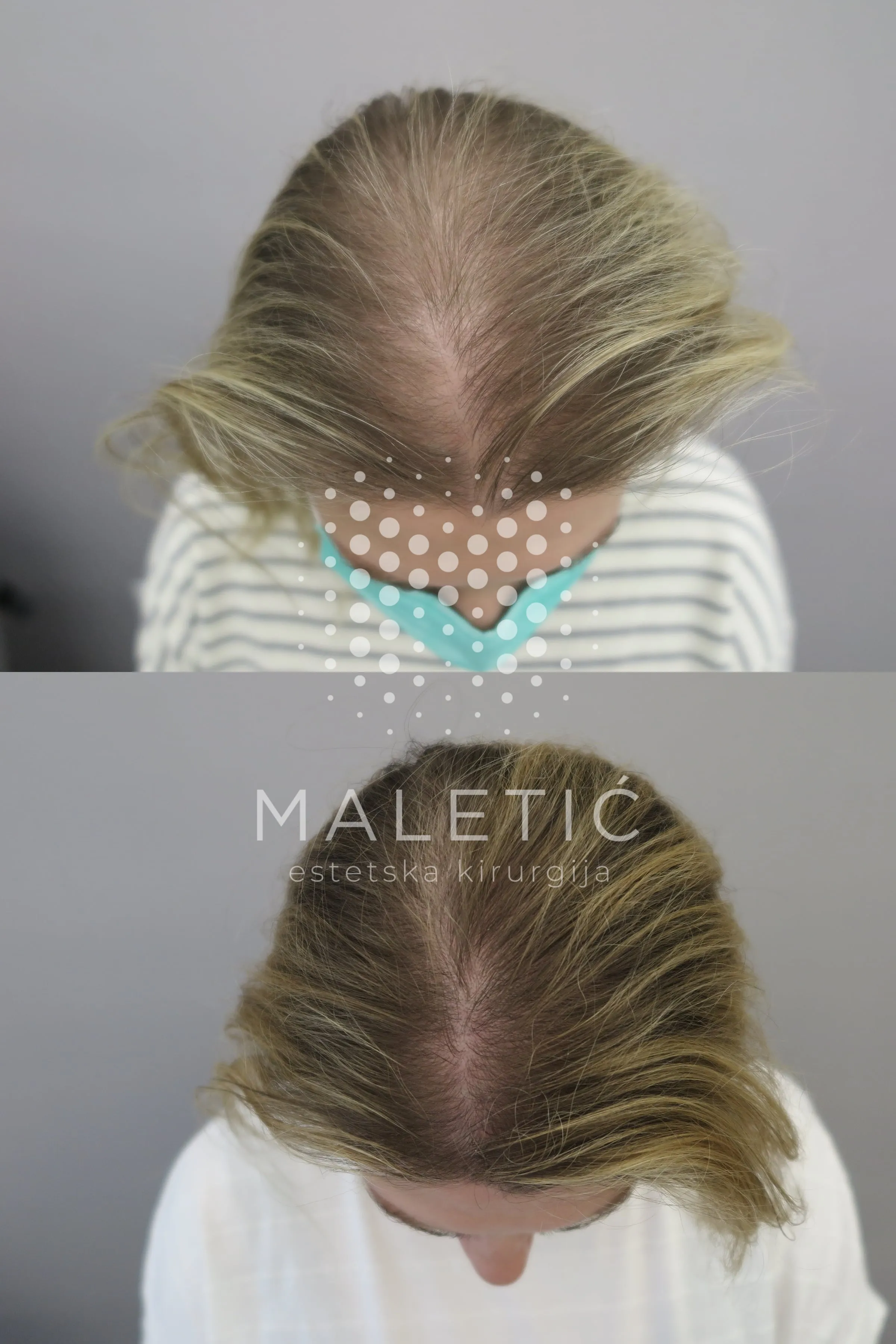
Before and after a scalp filler
Before and after, scalp filler, real patients of Polyclinic Maletić.
Who we are
Who will be taking care of you
The Hair Center is led by Ana Maletić, MD, PhD, a specialist in plastic, reconstructive, and aesthetic surgery. She holds the FISHRS and ABHRS Diplomate titles, is the only physician in Croatia with the ABHRS Diplomate title and one of 260 physicians worldwide to have earned it, and is the only physician from Croatia in regular membership of the ISHRS. In March 2026 she defended her doctoral thesis on the connection between hair transplantation and biopsychosocial factors of health.
The treatment is performed by a physician who deals with the diagnostics and treatment of hair loss every day, and who assesses whether the scalp still has active follicles the therapy can act on. The Polyclinic has been operating since 1998; it was founded by Dr. Ana’s parents, and today two generations of the same family care for patients. At both locations the treatment is performed with the same equipment and by the same protocol.
Meet the whole team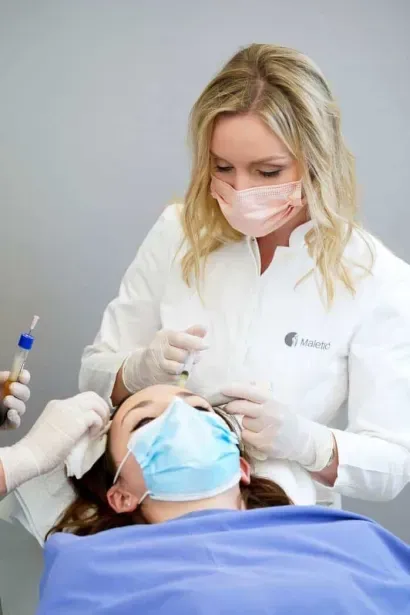
Watch
Dr. Ana Maletić on hair
If, before deciding, you find it easier to hear the physician than to read, in these two conversations Dr. Ana Maletić explains how she approaches hair loss and which methods for strengthening hair exist.
Dr. Ana Maletić on hair health and care
Dr. Ana Maletić on methods for strengthening hair
Price
Price and the first step
Prices for one hair filler treatment and a package of four treatments are listed in the table below. The price of the trichoscopic scalp analysis is listed in the table below.
At the examination we assess the condition of your scalp and explain the findings to you — including the possibility that the filler is not indicated in your case. You can also see the prices of all treatments in the price list, and arrange an appointment through the contact page for Zagreb or Daruvar. You will find the other scalp therapies in the Hair Center.
If you have noticed your hair thinning, a scalp examination is the first step toward establishing the cause and choosing a suitable therapy. In the earlier phase of hair loss there are usually more therapeutic options.
-
Hair loss treatment with a hair filler
-
Hair loss treatment with a hair filler – package of 4 treatments
-
Trichoscopic scalp analysis (TrichoLAB FotoFinder)
Which method for whom
Patients most often ask us which hair therapy is best. There is no universally best therapy: each person’s hair loss has its own cause, stage, scalp condition and degree of follicle preservation. The same method may therefore work well for one person but not another.
We therefore build the treatment plan around a detailed scalp examination and, when needed, a health assessment. After trichoscopic analysis, we know the type and stage of hair loss and whether follicles with regenerative potential remain. The findings lead to one therapy or a combination of complementary methods. Sometimes they show that treatment makes no sense in your case; we then discuss transplantation or monitoring, depending on the findings. You will hear this at the first examination, not after several paid treatments.
Below is an overview of the methods we perform, how they differ, and when each one comes into consideration.
| Method | How it works | When it comes into consideration |
|---|---|---|
| Scalp mesotherapy | Delivers a preparation of vitamins, minerals and amino acids, composed according to the findings, into the scalp skin. | For weakened, thinning hair, early-stage thinning, and increased shedding after childbirth, illness, or a longer period of stress. |
| PRP treatment | Uses plasma from your own blood and the growth factors it contains, so the treatment involves drawing your blood and preparing it. | For increased shedding and thinning, when the follicles still exist but produce a thinner, weaker hair. |
| Polynucleotides | Purified DNA fragments that reduce inflammation in the scalp and stimulate the formation of new blood vessels, improving the scalp’s blood supply. | For diffuse thinning and a sensitive scalp, and when you prefer a solution that does not involve drawing blood. |
| Scalp filler | Delivers a complex of peptides and hyaluronic acid into the scalp skin that acts on the follicle itself. Unlike facial fillers, the goal is not added volume but strengthening the existing hair. | For weakened, thin hair and in the earlier phase of thinning, while the follicles are still active. |
| Laser hair growth treatment | Uses a medical Er:YAG laser to improve the scalp’s blood supply and encourage follicles to shift from resting into the growth phase, with no needles and no downtime. | For increased shedding and for strengthening existing hair, on its own or alongside other therapies. |
| Hair transplant | Your own follicles are moved from the donor region to areas where hair is absent or thinning. | When certain regions no longer have active follicles, because no treatment can bring back hair that is gone there. |
How it works
Delivers a preparation of vitamins, minerals and amino acids, composed according to the findings, into the scalp skin.
When it comes into consideration
For weakened, thinning hair, early-stage thinning, and increased shedding after childbirth, illness, or a longer period of stress.
How it works
Uses plasma from your own blood and the growth factors it contains, so the treatment involves drawing your blood and preparing it.
When it comes into consideration
For increased shedding and thinning, when the follicles still exist but produce a thinner, weaker hair.
How it works
Purified DNA fragments that reduce inflammation in the scalp and stimulate the formation of new blood vessels, improving the scalp’s blood supply.
When it comes into consideration
For diffuse thinning and a sensitive scalp, and when you prefer a solution that does not involve drawing blood.
Scalp filler
How it works
Delivers a complex of peptides and hyaluronic acid into the scalp skin that acts on the follicle itself. Unlike facial fillers, the goal is not added volume but strengthening the existing hair.
When it comes into consideration
For weakened, thin hair and in the earlier phase of thinning, while the follicles are still active.
How it works
Uses a medical Er:YAG laser to improve the scalp’s blood supply and encourage follicles to shift from resting into the growth phase, with no needles and no downtime.
When it comes into consideration
For increased shedding and for strengthening existing hair, on its own or alongside other therapies.
How it works
Your own follicles are moved from the donor region to areas where hair is absent or thinning.
When it comes into consideration
When certain regions no longer have active follicles, because no treatment can bring back hair that is gone there.
The methods are often combined, because the same scalp can simultaneously hold weakened follicles and areas where hair no longer grows. Then one method preserves and strengthens what is left, while the other replaces what has been permanently lost.
It is equally important to know what these methods cannot do. No therapy creates new follicles, so where a follicle has been permanently lost, no number of treatments can change the situation; transplantation is indicated. If hair loss is linked to thyroid disease, nutrient deficiency or a hormonal change, that condition is treated separately, with scalp therapy alongside it rather than instead of it.
The right method is the one that suits your scalp condition. Every plan therefore begins with analysis and discussion, followed by treatment selection.
Patient reviews
What our patients say
Reviews taken from our Google Business profiles, Zagreb and Daruvar, translated from Croatian.
★★★★★
“A month ago I had an FUE hair transplant with Dr. Ana Maletić. From the professional side, my hair was done perfectly. I was lucky that my hair did not shed and started growing right away. Dr. Maletić’s expertise is obvious and makes her, without question, the leader in this field in Croatia. But my real satisfaction and gratitude lie in how the Polyclinic treats its patients. They are highly professional, yet approachable and compassionate at the same time. Nurses Matea M. and Valerija left a positive mark on my whole experience and made it more pleasant and calming. To anyone in Croatia looking for a hair transplant, I warmly recommend this Polyclinic. You will get top results and excellent care!”
★★★★★
“I had a hair transplant and I am more than satisfied with this extraordinary, exceptionally professional, life-changing procedure! A big thank you to Dr. Ana, Danijela, Romana, and everyone else who took part in this wonderful experience. My sincerest thanks! Marko S.”
★★★★★
“All praise to the entire staff of the polyclinic. I have already had my second PRP scalp treatment and I can only commend the whole team. I would especially like to praise the doctor for her exceptional expertise, patience, and warm approach. From the first examination to the procedure itself I felt safe and informed. The whole course of treatment was professional and well organized — I received clear and detailed instructions before, during, and after the procedure, which gave me extra confidence. The procedure itself was stress-free, with every step explained along the way, which meant a lot to me. The atmosphere is pleasant and relaxing, and the staff exceptionally kind and helpful. I am very satisfied with the results so far and look forward to further progress. I definitely recommend it to anyone considering a PRP scalp treatment — you are in safe and expert hands!”
★★★★★
“A few years ago I saw Dr. Ana Maletić for a facial hair correction using the FUE method, which made my beard somewhat denser. The results are fantastic — the work was done with such dedication and care. From the first meeting at the polyclinic she radiated confidence and knowledge of her work, along with a readiness and kindness to answer every question I had. All recommendations for Dr. Ana and her entire professional and friendly team.”
★★★★★
“I have been their patient and admirer for years. They have always known how to make my mom and me feel comfortable and welcome. My mom had a neck lift six years ago, and today I came in for PRP for hair growth. I cannot recommend them enough. Thank you, Ana!”
★★★★★
“I am very satisfied with Dr. Maletić’s results, from the beginning to the end of the hair transplant process. Five months after the procedure my hair looks phenomenal. The results I got, considering the number of grafts transplanted, pleasantly surprised me when compared with other clinics outside Croatia. As for the price, there is no big difference compared to clinics abroad, while the quality and expertise are on the level of top clinics. A big plus is that I did not have to travel outside the country, which made the whole process far less stressful for me.”
★★★★★
“I have rarely experienced such a professional, coordinated, and harmonious team. The atmosphere during the hair transplant was so pleasant that they even treated me to the occasional musical number. That relaxed atmosphere made the boredom of the procedure easier to bear. Although I do wonder whether some of you might be better off on a stage than in an operating room. Once again, a big thank you — I am already looking forward to the results in a few months!”
★★★★★
“A great experience, team, and final result. In short, I had an eyebrow transplant. Everything went exactly as Dr. Ana Maletić explained. The whole team was very kind and professional from start to finish, and I am now at peace because I finally have eyebrows. They look very natural, and the density is just as it should be. All recommendations!”
★★★★★
“A more than positive experience at Polyclinic Maletić, both in Zagreb and in Daruvar. I had a hair transplant and I am very satisfied with the approach and the procedure. I recommend it to everyone, especially to women who, like me, lost their hair after an illness. Once again, thank you to the kind team, and especially to Dr. Ana Maletić.”
Questions and answers
Frequently asked questions
Is a scalp filler the same as a lip or facial filler?
It is not, although the name is confusing. A facial filler adds volume beneath the skin, while a scalp filler shapes nothing — it delivers peptides and hyaluronic acid into the scalp skin to stimulate follicle activity. The goal is not to fill space but to strengthen the hair and slow its shedding.
Does a scalp filler treatment hurt?
You can feel it, but only briefly. We inject the filler with very fine needles into the superficial scalp skin, then massage the area. Anesthesia is usually unnecessary, but local anesthesia can be used by arrangement if you are more sensitive. Vibration at the injection site is usually sufficient to ease discomfort.
How many scalp filler treatments are needed?
Four treatments over eight weeks are most often recommended, approximately two weeks apart. We determine the exact number and schedule according to the scalp findings, as not all types of hair loss respond equally. After the series, we analyse the scalp again before discussing any continuation.
How does the filler differ from PRP and mesotherapy?
All three therapies deliver active substances into the scalp, but different ones. PRP uses your own plasma, mesotherapy uses nutrients composed according to your findings, and the filler uses a complex of peptides and hyaluronic acid. Which therapy suits you is assessed based on the scalp analysis. When there is an indication, some of the methods can also be combined.
Does the filler help if I have already lost the hair on my crown?
No. The filler acts on follicles that have weakened but are still alive. Where there is no follicle left, no injection can bring it back, so the filler is not a solution for a bald crown. In that case it is more useful to consider a hair transplant than to go through a series of treatments with no expected benefit.
Who is a scalp filler intended for?
It is used in men and women for weak, fine hair, early thinning and hair loss after childbirth, illness or stress. It is most useful in the earlier stages of hair loss. An examination shows whether your scalp is at that stage.