
Since 1998 · Zagreb & Daruvar
Eyelid Surgery in Croatia
With blepharoplasty we remove excess skin and address prominent fat pads of the upper and lower eyelids. We perform the procedure in our own operating rooms in Zagreb and Daruvar, with a radiofrequency knife and resorbable sutures that need no removal.
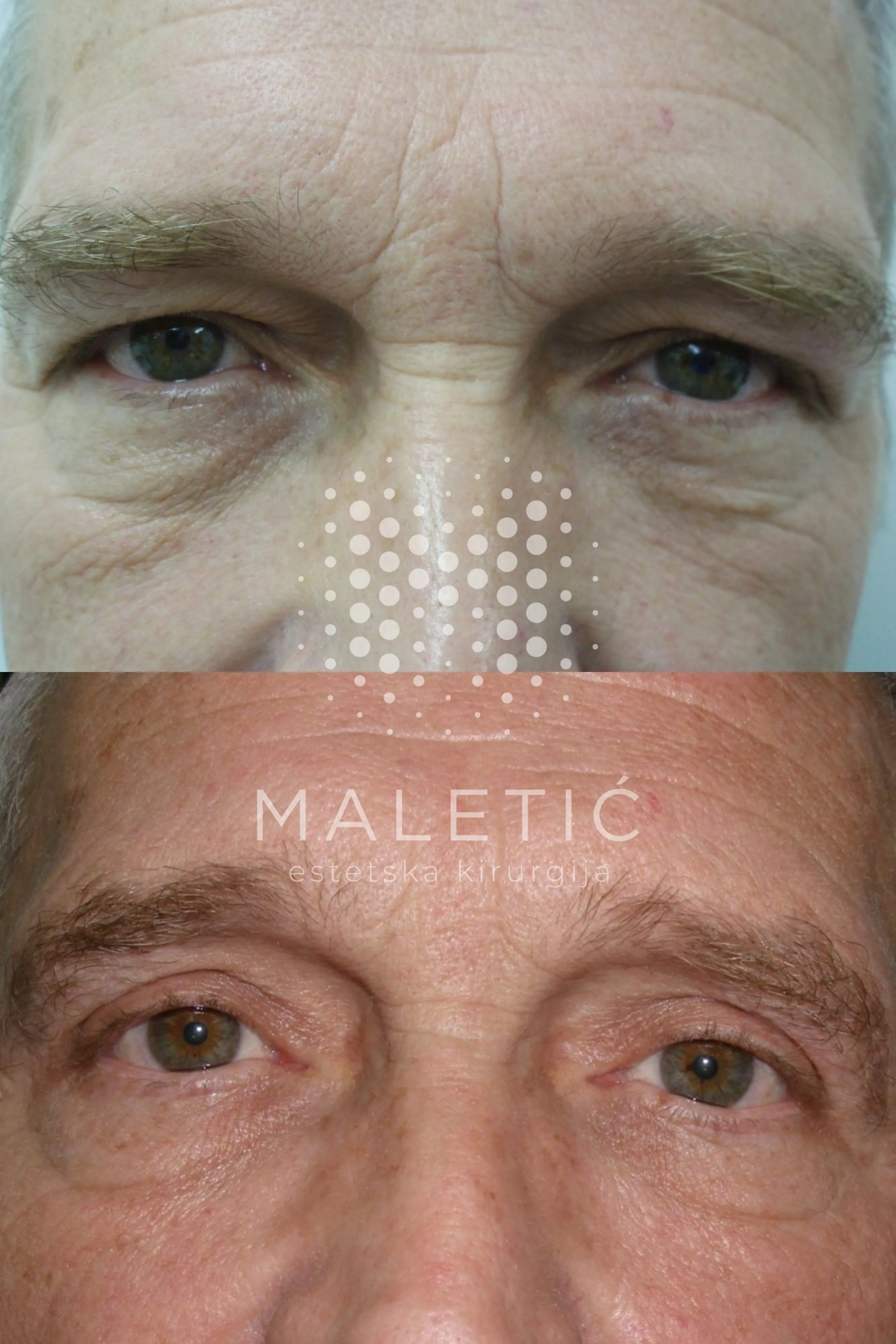
Changes around the eyes are not always caused by excess eyelid skin alone. A similar look can come from a lowered eyebrow, ptosis of the eyelid margin, prominent fat pads, or changes in skin quality. That is why the procedure is preceded by an exam that establishes the cause of the concern and plans how much skin and fat can be safely removed while preserving normal closure and function of the eye.
Is this for me?
Drooping eyelids and bags under the eyes — what is actually happening
The skin of the eyelids is the thinnest skin on the face, and over time it can lose its elasticity. At the same time the muscle around the eye weakens, and fat pads that used to sit deeper in the eye socket become more prominent. On the upper eyelid the excess skin can reach the lashes, while on the lower eyelid visible bags can form.
Excess skin on the upper eyelids can make applying makeup harder, hide the natural eyelid crease, and create a feeling of heaviness, especially toward the end of the day. Prominent fat pads of the lower eyelids can give the impression of permanent swelling under the eyes. With a larger excess of upper eyelid skin, functional symptoms can also appear, such as narrowing of the upper field of vision.
“The goal of blepharoplasty is not to change the features of the face, but to remove excess skin and prominent fat pads while preserving the natural position and function of the eyelid.”
Excess skin, fat pads, or something else
Different conditions can stand behind the same look. Excess upper eyelid skin folds over and crosses the natural crease. With prominent fat pads, the problem is not the skin but volume, most often below the eye. With ptosis, the eyelid margin itself has dropped, because the muscle that lifts it has weakened — and that calls for a different procedure.
Different causes of changes around the eyes can look alike but require different approaches. At the exam we assess the excess skin, tissue elasticity, the position of the eyebrow, the position of the eyelid margin, and the amount of fat tissue. Based on those findings we determine whether blepharoplasty is the right procedure and how extensive the correction needs to be.
When surgery is not the answer
When blepharoplasty will not help you
The result of blepharoplasty depends heavily on a correctly established indication. If the cause of the change is not excess skin or prominent fat tissue of the eyelids, the procedure will not solve the main problem.
What blepharoplasty does not solve
The procedure removes excess skin and addresses prominent fat pads. The dark pigmentation of under-eye circles, fine surface wrinkles around the eyes, and the skin color in that area remain unchanged — so blepharoplasty is not the right procedure if those changes are your main concern.
When it is better to wait
With dry eyes we specifically assess whether the procedure could worsen the existing symptoms. Extra caution is needed with thyroid conditions that affect the eye socket, blood clotting disorders, and blood-thinning medication. In some of those cases the procedure needs to be postponed or not performed at all. The exam determines what needs to be treated or adjusted before surgery, and under which conditions the procedure would be possible later.
When the concern is functional, not aesthetic
In some people the excess upper eyelid skin crosses the edge of the eye and narrows the field of vision. Signs of a functional problem can include constantly raising the eyebrows to see better, tension in the forehead, and difficulty keeping the eyes open toward the end of the day. The medical indication is confirmed by an exam and an assessment of the skin's position relative to the eye.
Types of procedure
Upper and lower blepharoplasty — what each one involves
Upper blepharoplasty
We place the incision in the natural crease of the upper eyelid, where it is generally discreetly visible after healing. We remove the excess skin and, when needed, part of the fat tissue. The procedure takes 45–60 minutes.
Lower blepharoplasty
The approach can be through the inside of the eyelid, with no external incision, or through an incision just below the lower lashes. The fat pads that create the bags are removed or repositioned, and excess skin is removed as needed. The procedure takes 60–90 minutes.
Combined blepharoplasty
The upper and lower eyelids can be operated on during the same procedure, which takes approximately two hours. Recovery is not significantly longer than after surgery on the upper or lower eyelids alone.
How it is performed
What the procedure looks like at Polyclinic Maletić
The procedure begins with marking the incision lines while you are sitting up. The plan is adapted to the shape of your eye, the position of the eyebrow, and the amount of excess skin, because the extent of removal is determined by the individual anatomy of the eyelid.
After the marking, local anesthesia is applied, so pain is generally not felt during the procedure, although pressure and some discomfort are possible. We perform the procedure with a radiofrequency knife, which cuts and coagulates tissue at the same time, so bleeding and the resulting swelling are smaller than with a classic incision. We close the wound with resorbable sutures that dissolve on their own and require no later removal.
We perform the procedure in our four operating rooms equipped with air-recuperation systems. After a short postoperative observation you go home the same day.
- Duration
- 45–120 minutes, depending on the extent
- Anesthesia
- local, with sedation or general anesthesia available on request
- Recovery
- back to everyday activities in 8–10 days
- Performed by
- the surgical team of Polyclinic Maletić
Why us
Why choose us for your eyelid surgery
Precise incision planning
The incision line is drawn according to the shape of your eye, the position of the eyebrow, and the elasticity of the skin — individually for every procedure.
Aesthetic surgery since 1998
Polyclinic Maletić is a family-run institution that has practiced facial aesthetic surgery continuously for almost three decades.
Four operating rooms
We perform the procedure in our own operating rooms equipped with air-recuperation systems, under conditions suited to surgery around the eye.
An exam that finds the cause
The examination distinguishes excess skin, prominent fat pads, eyelid ptosis, and other causes of changes around the eye.
Radiofrequency knife
The radiofrequency knife cuts and coagulates tissue at the same time, so bleeding and the resulting swelling are smaller than with a classic incision.
No stitches to remove
We use resorbable sutures that dissolve on their own, so there is no later removal.
Zagreb and Daruvar
Two locations, the same team, and the same standard. You choose the one that suits you better.
Continuity of care
From the exam and anesthesia to the last follow-up, the same medical team stays with you.
Honest about the risks
Possible risks and complications
Blepharoplasty is a surgical procedure and carries the possibility of side effects and complications. Swelling and bruising are expected, and in some people they can last around ten days. Temporary eye dryness, a stinging sensation, and mild asymmetry — which may also exist before the procedure — can occur. The way a scar heals and matures is individual. More rarely, a temporary change in the position of the lower eyelid can appear.
Removing too much skin can make it harder to close the eye fully and increase dryness, while removing too much fat tissue can give the eyelid a hollowed look. That is why the skin and fat tissue are removed sparingly, according to the extent measured and marked beforehand.
“In blepharoplasty, how much skin we leave matters just as much as how much we remove.”
If a symptom or change that worries you appears after the procedure, contact the Polyclinic for a follow-up exam. At the follow-up we assess the course of healing, the position of the eyelid, and the need for further monitoring.
Recovery
Recovery, day by day
Days 1 to 3. Rest, cold compresses, and sleeping with your head elevated. Swelling and bruising are at their most pronounced, and that is expected.
Days 4 to 7. The swelling gradually subsides and lighter outings become possible. Remaining bruises can be partly hidden behind sunglasses.
Days 8 to 10. Most people can return to their usual activities, office work, and makeup. Any remaining traces of the procedure are usually less noticeable in this period.
After 2 to 3 months. The final look of the eyelids is assessed, once the skin settles, the swelling resolves, and the scar gradually fades. The eyes can look more open, with the natural expression of the face preserved.
Real results
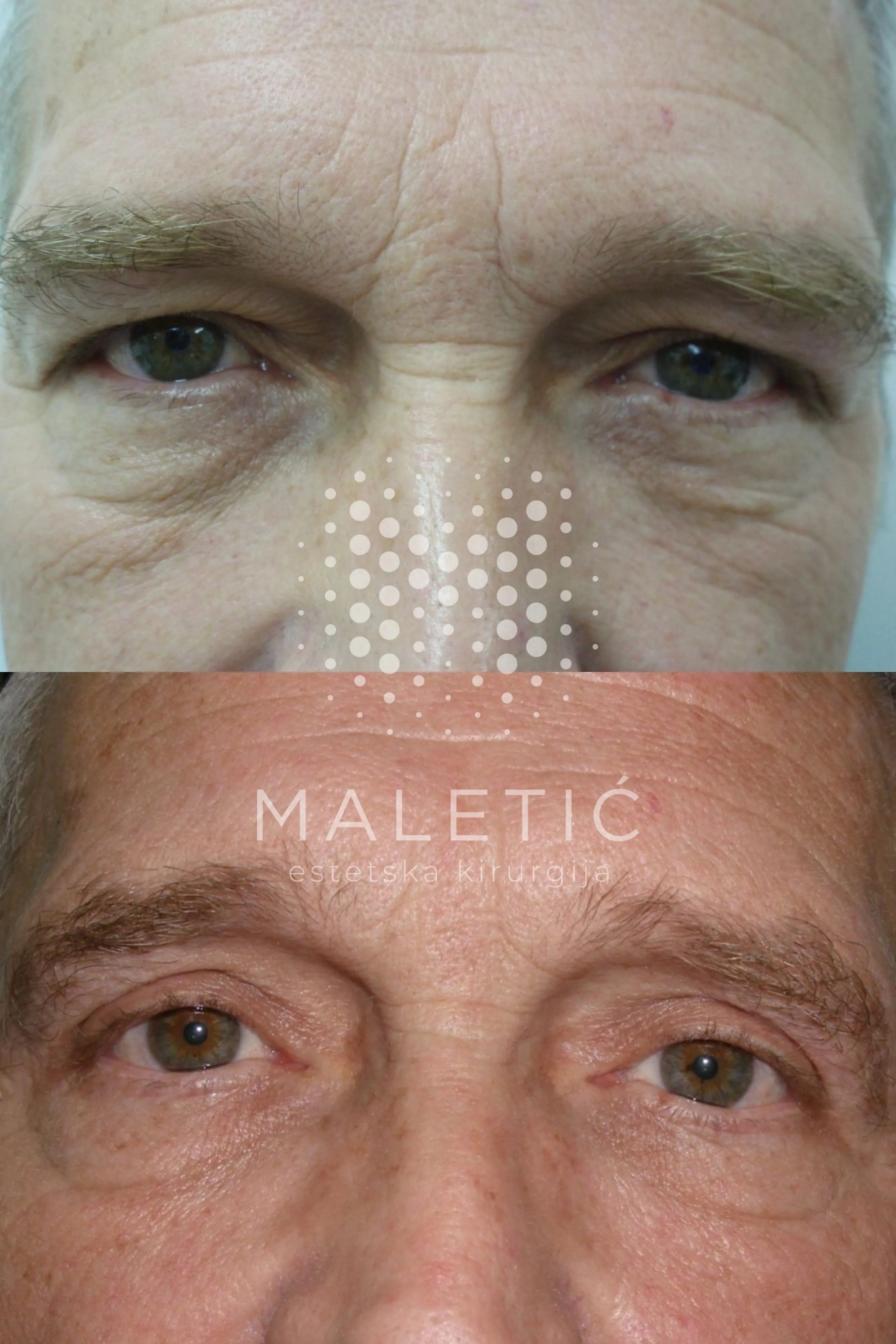
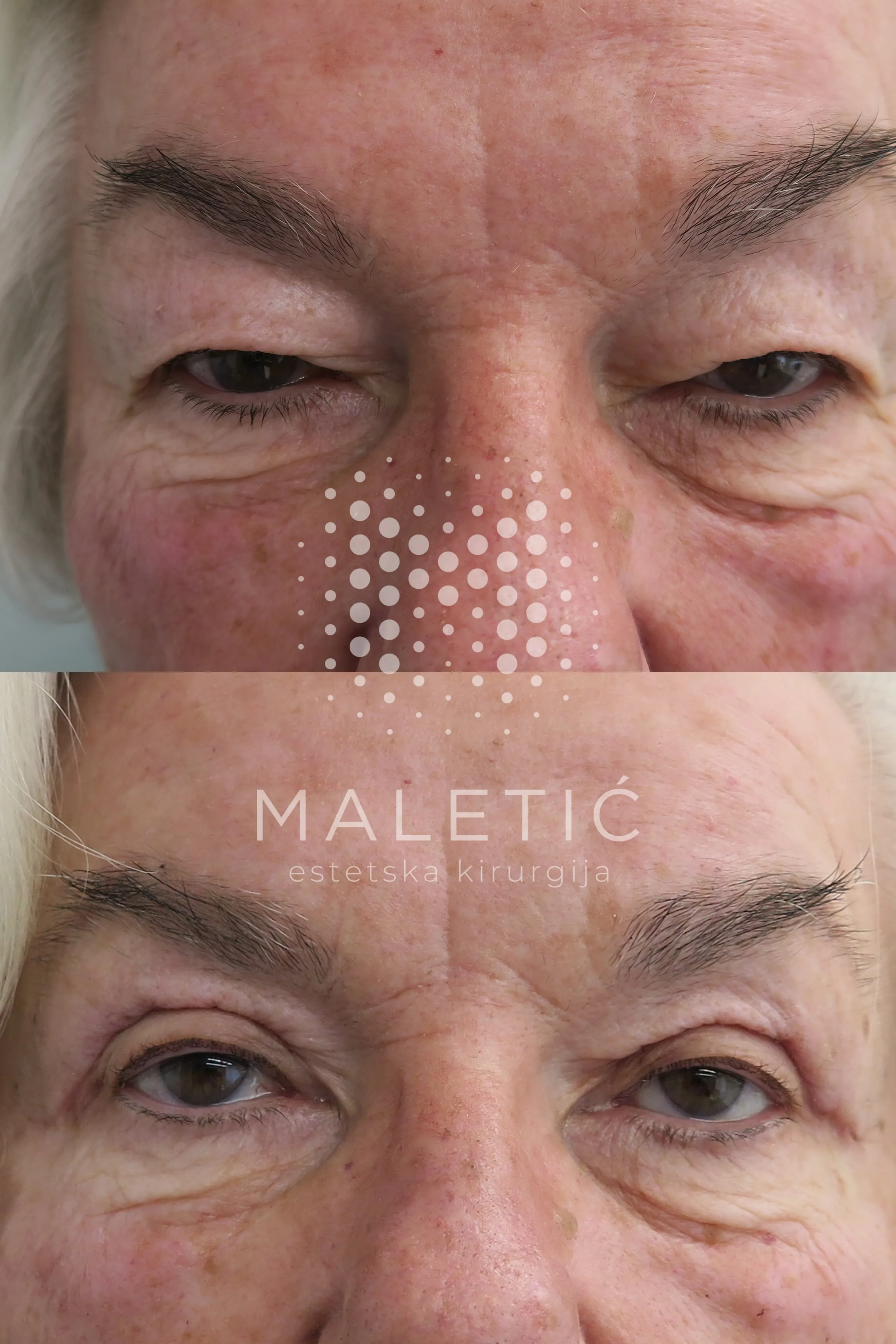
Before and after eyelid surgery
We show results only with written patient consent.
.CYlZaa4K_Z2dXWd3.webp)
Who we are
Who will be taking care of you
Polyclinic Maletić is a family-run institution founded in 1998 in Daruvar, and today it operates in Daruvar and Zagreb. It was founded by a surgeon and an anesthesiologist, and today the Polyclinic is led by their daughter, representing the second generation of the family.
Blepharoplasty is performed by our surgical team — surgery specialists with many years of experience in facial procedures, available in Zagreb and Daruvar.
Anesthesia and patient monitoring are led by the co-founder of the Polyclinic, a specialist in anesthesiology, reanimatology, and intensive care. Nurses stay with you through preparation, the procedure, postoperative observation, and follow-up exams.
The consultation is free of charge. During the conversation and exam we assess the cause of the changes on your eyelids, what the procedure can achieve, its limits, and the expected course of recovery.
Meet the whole team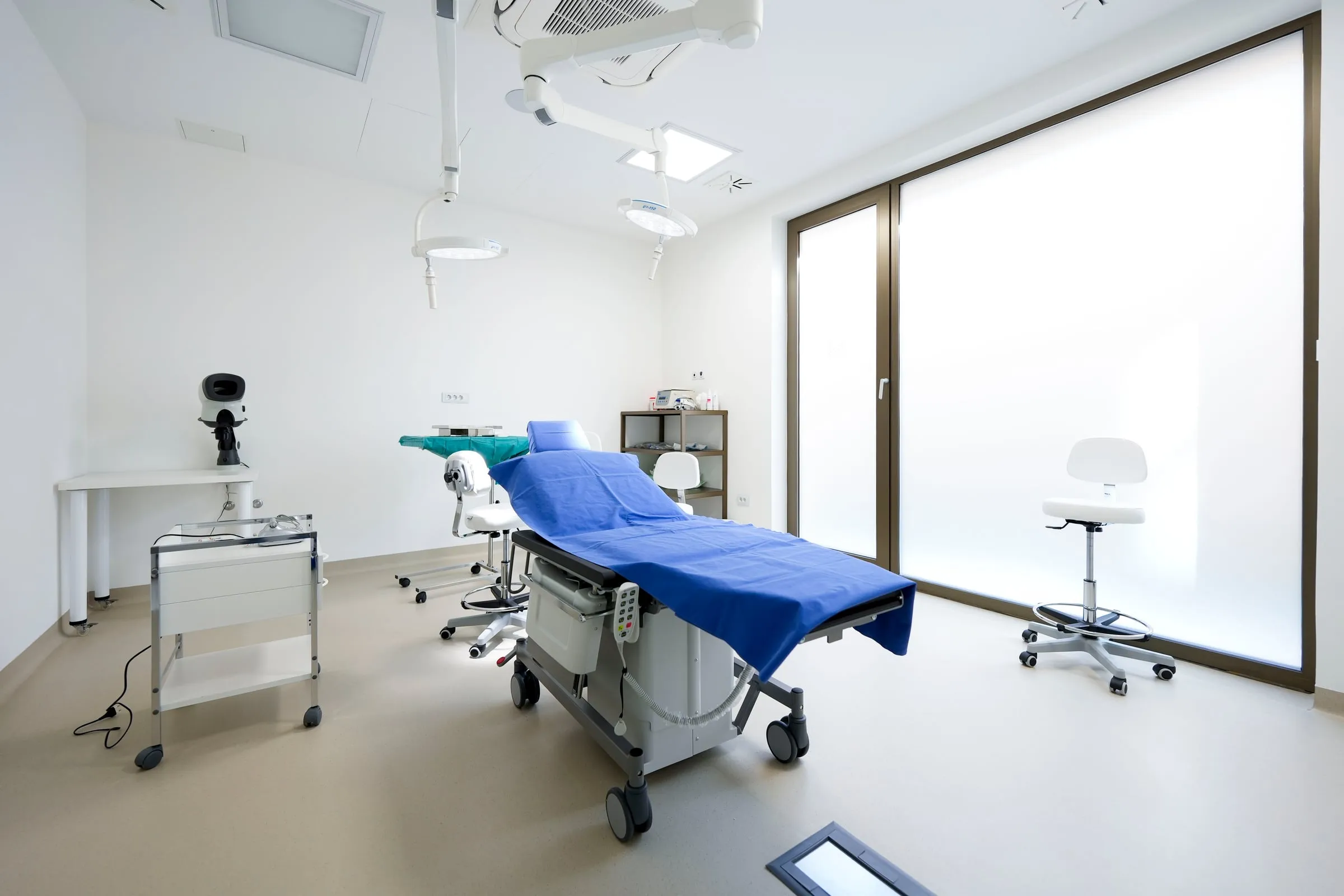
The result
The result once recovery is complete
Once the swelling resolves, we assess the position of the eyelid, full closure of the eye, blinking, and the preservation of the natural expression of the face. If the excess upper eyelid skin narrowed the upper field of vision before the procedure, removing it can improve visibility and reduce the need to constantly raise the eyebrows or tilt the head back. In some patients this can also ease tension in the forehead.
Removing the excess skin can make the natural crease of the upper eyelid visible again and reduce the feeling of heaviness around the eyes. The degree of change depends on the initial findings and the extent of the procedure.
Blepharoplasty does not stop the further aging of the skin and tissues of the eyelids.
Price
Price and the first step
Upper eyelid surgery costs €1,500.00, lower eyelid surgery €1,800.00, and the combined procedure on the upper and lower eyelids €3,000.00. The procedure is performed under local anesthesia as standard; if you choose general anesthesia, the surcharge is €500.00.
The final amount depends on whether the procedure is performed on the upper, lower, or both eyelids, and whether general anesthesia is chosen. The prices of all procedures are also available in the price list.
-
Upper eyelid surgery
-
Lower eyelid surgery
-
Upper and lower eyelid surgery
Patient reviews
What our patients say
Reviews taken from our Google Business profiles, Zagreb and Daruvar, translated from Croatian.
★★★★★
“Blepharoplasty, 4D laser, and double chin. Perfect. All recommendations!”
★★★★★
“Since high school I watched the double chin I inherited from my father grow more and more pronounced — and 15 years later, the double chin is gone. A big thank you to Dr. Maletić and the whole team for granting my wish. The procedure was painless, and so was the recovery, and the results were visible after just a few days. The entire team was exceptionally kind and cheerful, and the atmosphere very pleasant. I left the polyclinic satisfied, and when, two days after the swelling went down, I saw the double chin was gone, my satisfaction knew no bounds. I warmly recommend Polyclinic Maletić.”
★★★★★
“My experience with breast augmentation with Dr. Maletić in Daruvar was excellent. I am extremely satisfied with the result. All the nurses are very kind and professional. I absolutely recommend them.”
★★★★★
“All praise for Polyclinic Maletić in Daruvar! I had lip augmentation with fillers and I am very satisfied with the result. I would especially like to commend Dr. Mario Bartol, who is exceptionally kind, professional, and has a wonderful approach to patients, which made me feel comfortable and safe throughout the whole treatment. All the nurses are also very kind, accommodating, and professional. I warmly recommend them to anyone considering aesthetic treatments!”
★★★★★
“Laser acne treatment is the only treatment that has helped me, and I would not choose any other facial treatment over it. Dr. Ines is one of the kindest people I have ever met and always has useful advice. Kind staff and top-level service — I warmly recommend her to everyone!”
★★★★★
“I had a wart on my face removed by laser. A very professional service with excellent results. The wart was quite large, but after just one treatment it was gone. All recommendations!”
★★★★★
“I recently had a varicose vein procedure. All praise to the entire team.”
★★★★★
“The best team of physicians, exceptionally professional and kind. I have been loyal to Polyclinic Maletić for more than 10 years and I am always satisfied with the results. Thank you.”
★★★★★
“I came to Dr. Maletić with a big problem and a lot of stress. I was met with such warm empathy and kindness, and patience in answering all my questions. Thank you, Dr. Maletić, for your advice and sincere support. I know I can always turn to her for advice, and that means a lot to me. The staff of the Zagreb polyclinic are also very accommodating and kind. Thanks to them as well.”
★★★★★
“Dr. Maletić’s practice, both in Daruvar and in Zagreb — and I have had several procedures — I can only recommend, because I felt very comfortable there and in expert hands!”
Questions and answers
Frequently asked questions
How long is the recovery after eyelid surgery, and when can I go back to work?
Swelling and bruising are most pronounced in the first three days, the swelling subsides by day seven, and most people return to everyday activities and office work on day eight to ten. The final look of the eyelid is seen after two to three months, once the skin settles and the scar fades.
Will people be able to tell I had my eyelids operated on?
In upper blepharoplasty the incision is placed in the natural crease of the eyelid, so after healing it is usually minimally visible. In lower blepharoplasty the incision is often made on the inside of the eyelid, with no external scar. The procedure is planned to remove the excess tissue while preserving the natural expression of your face.
Does blepharoplasty fix dark circles and wrinkles around the eyes?
Blepharoplasty removes excess skin and addresses prominent fat pads, but the dark color of under-eye circles and the fine wrinkles around the eyes remain. If pigmentation or surface wrinkles are the main concern, blepharoplasty will not deliver the change you expect.
Can too much skin be removed?
It can, and that is exactly why the skin is removed sparingly. If too much is taken, closing the eye becomes harder and the feeling of dryness increases. That is why the incision line is drawn before the procedure, according to your anatomy — not to a preset measure.
How long does the result last, and can the eyelids loosen again?
The result of blepharoplasty can be long-lasting, but the procedure does not stop the aging of the skin and the surrounding tissues. After a number of years, some people may develop a certain amount of excess skin again, and the extent of those changes is individual.
Is the procedure painful, and do I need general anesthesia?
The procedure is performed under local anesthesia as standard, so pain is generally not felt during the operation, although pressure and some discomfort are possible. Mild discomfort can appear in the first days of recovery and is eased with common painkillers. At your request, sedation or general anesthesia is possible, which is agreed with the anesthesiologist before the procedure.
Can blepharoplasty be done at a younger age?
It can. Excess eyelid skin is not always a consequence of age — in some people it is hereditary and visible as early as their twenties or thirties. Age is not the measure; the condition of the eyelid is.