
Since 1998 · Zagreb & Daruvar
Facelift in Croatia
A facelift lifts the descended tissues of the face and neck, tightens the deeper layers, and removes excess skin. At the exam we assess the degree of laxity and the condition of the skin, and whether a mini lift, an SMAS facelift, the deep plane technique, or another method fits your findings.
Descent of the cheeks, loss of a clear jawline, and lax skin of the neck develop to different degrees and do not always call for the same method. A facelift is intended for more pronounced descent of the deeper tissues and for excess skin that cannot be removed with injectable or laser treatments. The exam establishes whether surgery is indicated and which technique matches your findings.
Is this for me?
What a facelift is, and when we (do not) recommend it
A facelift is a surgical procedure that lifts the descended tissues of the face and neck, removes excess skin, and reinforces the deeper layers, including the SMAS and the platysma of the neck. Working on the deeper layers allows the skin to adapt without excessive tension. The procedure is most often applied for descended cheeks, a weakened jawline, a double chin, and lax skin of the neck.
A facelift does not act on every change in the facial area. Surface and expression lines, loss of volume, sun damage, and pigmentation call for other methods, such as Botox, dermal fillers, or dermatological and laser treatments. At the consultation we assess whether the main problem is excess skin and descended tissue — or a change that surgery will not act on.
The goal of a facelift is to lift the descended tissues and restore the contours of the face and neck, while preserving the recognizable features of your face.
Types of facelift
Types of facelift: mini, SMAS, and deep plane
There is no single technique that suits every finding. The choice depends on the condition of the face and neck, your age, the degree of laxity, and the result you want to achieve.
Mini facelift (S-lift)
A mini facelift is performed through smaller incisions and with a shorter recovery, for earlier signs of aging and mild to moderate laxity. Suitability is determined by the extent of the change, not just the patient's age.
SMAS facelift
The SMAS facelift is the classic method, in which both the skin and the deeper SMAS layer are reinforced. It is applied for moderate to pronounced facial laxity, and the result is generally long-lasting.
Deep plane facelift
The deep plane facelift is a more extensive technique in which the deeper ligaments of the face are released and repositioned. It is applied for advanced descent of tissue and more pronounced changes, when the findings call for work in a deeper anatomical plane.
The SMAS and the platysma — not just the skin
In the modern facelift, the emphasis is on reinforcing the deeper layers, the SMAS and the platysma of the neck, while the skin adapts to the new position without excessive tension. This approach reduces the possibility of a tight look to the skin.
Anesthesia and the course of the procedure
Anesthesia and the course of the procedure
We most often perform a facelift under local anesthesia with sedation. During the procedure, pain is controlled and the patient is relaxed. Recovery is generally faster than after general anesthesia, which is also possible by agreement with the anesthesiologist and at the patient's request.
The procedure takes approximately three hours. The incisions are placed in the natural folds in front of and behind the ear and partly in the scalp, so that after healing they are as discreet as possible. During the procedure the SMAS and the platysma are reinforced, excess skin is removed, and the incisions are closed with resorbable sutures, which is why stitches usually do not need to be removed. Depending on the extent of the procedure, after resting and cooling you either go home or stay at the Polyclinic until the next day.
- Duration
- about 3 hours
- Anesthesia
- local with sedation
- Recovery
- 7–14 days
- Performed by
- Duško Maletić, MD, MSc
Why us
Why choose us for your facelift
Face and neck surgery since 1998
We have performed face and neck surgery for more than 27 years, and the Polyclinic is today an internationally recognized reference center.
Our own anesthesiology team
Anesthesia and postoperative monitoring are led by Ines Maletić, MD, specialist in anesthesiology, reanimatology, and intensive care.
Mini lift, SMAS, and deep plane
The technique is chosen according to the degree of laxity, the condition of the face and neck, and the result you want to achieve.
Tightening the SMAS and platysma
The procedure includes reinforcing the deeper layers of the face and neck, while the skin adapts to the new position of the tissue without excessive tension.
Resorbable sutures
The sutures dissolve on their own, so stitches usually do not need to be removed.
Two generations of the family
Two generations of the family work at the Polyclinic today, with continuity of care from the exam to follow-up visits.
Operating rooms with air-recuperation systems
The procedure is performed in our own operating rooms equipped with systems for continuous air purification.
Planned and performed by the surgeon
The facelift is planned and performed by Duško Maletić, MD, MSc, specialist in surgery and founder of the Polyclinic.
A surgical plan and the costs
After the exam, we explain the chosen technique, the expected course of recovery, the possible risks, and the final price.
A face and neck examination
At the consultation we assess the degree of laxity, the amount of excess skin, and the condition of the deeper tissues.
Why trust us
When a facelift is not the right method
If the main problem is expression lines, loss of volume, or skin quality, Botox, dermal fillers, or laser treatments may be more appropriate.
A facelift is an extensive surgical procedure intended for more pronounced descent of tissue and excess skin. If the main problem is expression lines, loss of volume, or changed skin quality, Botox, dermal fillers, or 4D laser tightening of the face, neck & décolletage may be more appropriate. If the changes do not yet call for surgery, monitoring and reassessment may be recommended. The prices of the available treatments are in the price list.
When comparing offers, it is worth checking which technique is performed, whether the procedure includes work on the SMAS and the platysma, what type of anesthesia is planned, and what is included in postoperative follow-up. Different techniques differ in extent, in the duration of the procedure, and in the course of recovery.
Possible risks and complications
Like any surgical procedure, a facelift carries the possibility of side effects and complications. Swelling and bruising are expected reactions and most often subside within ten to fourteen days. Less commonly, a hematoma, infection, slower healing, a temporary change in skin sensation, or transient weakness of a branch of the facial nerve may occur. Individual risks are assessed at the exam and explained as part of informed consent.
Recovery after a facelift
On the first day the wound is dressed and the hair is washed, and from then on a special compression garment is worn. Swelling and bruising are most pronounced on the second and third day, when rest and cold compresses are needed, and they begin to subside between the seventh and tenth day. Most patients return to everyday activities between the eighth and fourteenth day, while the sutures gradually dissolve. The final result takes shape over three to nine months, and how long it lasts depends on the technique, the initial findings, and the further aging process.
Swelling and bruising, peak
days 2–3
Office work
days 4–5
Swelling subsides
days 7–10
Everyday activities
days 8–14
Final result
3–9 months
Combined procedures
A facelift combined with other procedures
A facelift can be combined with other procedures when different changes to the face call for acting on several anatomical structures.
Among surgical procedures, a facelift can be combined with blepharoplasty, a brow lift, and lipofilling to replace lost volume of the cheeks and cheekbones. Nanofat can be applied to act on skin quality. After recovery, Botox for remaining expression lines, dermal fillers, a chemical peel, or laser treatments can be applied for changes in skin quality and texture.
Whether the facelift is performed on its own or combined with another procedure is decided at the consultation, according to the findings, the extent of the operation, and the expected result.
Who we are
Who will be taking care of you
The facelift is planned and performed by Duško Maletić, MD, MSc, specialist in surgery and founder of the Polyclinic, which he established in 1998. He has more than 27 years of experience in this field and has performed more than a hundred facelift operations. Nurses accompany you from preparation to the last follow-up visit, and the next generation of the family works at the Polyclinic today.
Meet the whole team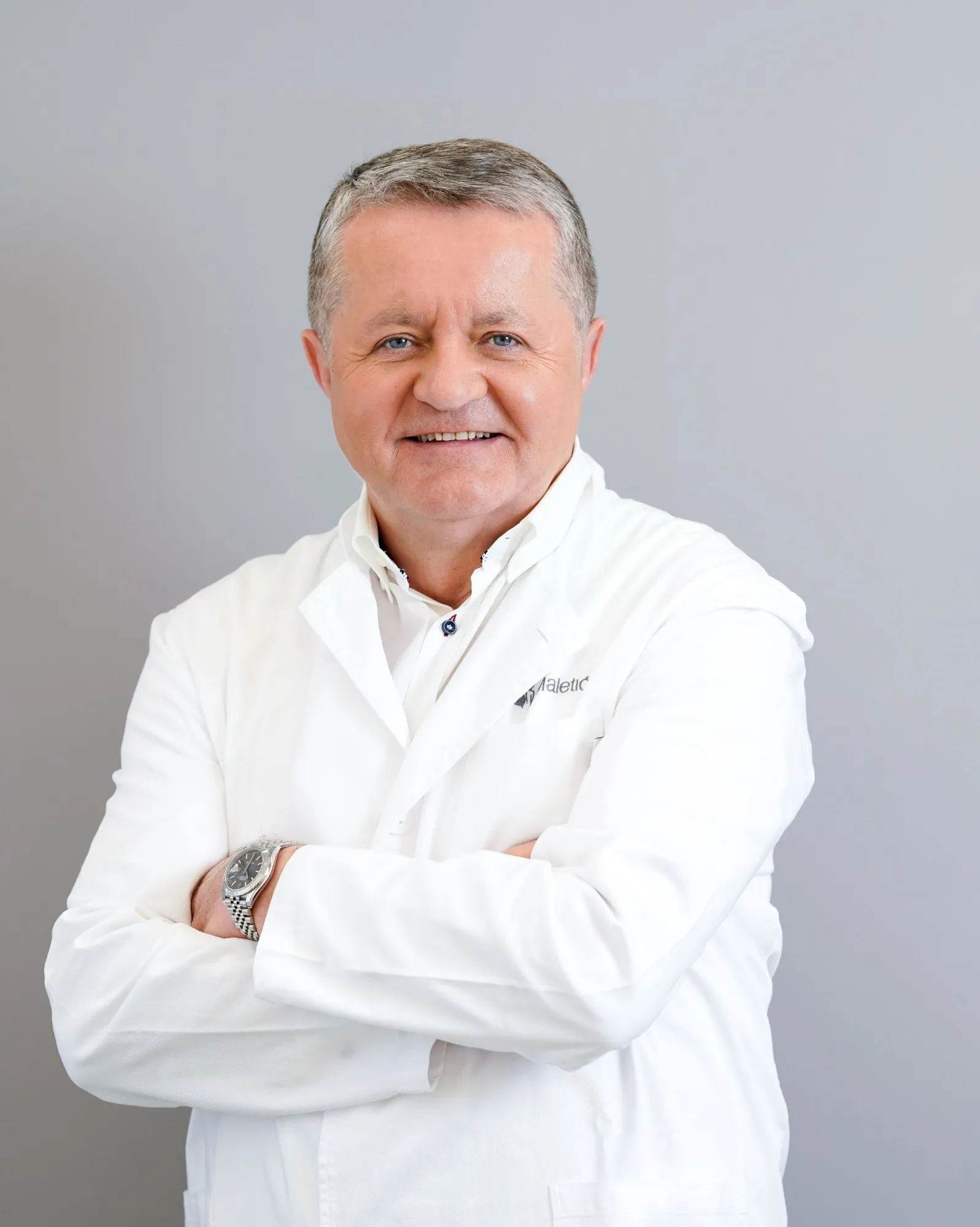
A word from the expert
Everything you need to know about a facelift
Watch the video in which Duško Maletić, MD, MSc, explains everything you need to know about a facelift.
The result
The result once recovery is complete
Once the swelling subsides, we assess the position of the tissues, the mobility of the face, and the clarity of the contours of the jawline and neck. Facial expression is generally preserved, because the procedure does not change the basic muscles of expression, but in early recovery a feeling of tightness and altered skin sensation may be present. These changes gradually settle over two to three months.
How visible the change is depends on the initial degree of laxity, the chosen technique, and the course of healing.
A facelift by itself does not change the quality of the skin. Sun damage, fine lines, and uneven pigmentation remain, and they call for other treatments.
Price
Price and the first step
The consultation is free of charge. The price of the procedure depends on the technique and its extent, and it includes the preoperative workup, the procedure with anesthesia, dressings, follow-up visits, and postoperative instructions. The final amount is determined after the exam and the choice of technique. The prices of all procedures are available in the price list.
-
Classic SMAS facelift
-
Mini facelift (mini lift)
The price includes sedation or general anesthesia.
See the full price listPatient reviews
What our patients say
Reviews taken from our Google Business profiles, Zagreb and Daruvar, translated from Croatian.
★★★★★
“My experience with breast augmentation with Dr. Maletić in Daruvar was excellent. I am extremely satisfied with the result. All the nurses are very kind and professional. I absolutely recommend them.”
★★★★★
“Since high school I watched the double chin I inherited from my father become more and more pronounced — and 15 years later, the double chin is gone. A big thank you to Dr. Maletić and the whole team for making my wish come true. The procedure was painless, as was the recovery, and the results were visible after just a few days. The whole team was extremely kind and cheerful, and the atmosphere very pleasant. I left the polyclinic satisfied, and when I saw, two days after the swelling went down, that the double chin was gone, my satisfaction knew no bounds. I warmly recommend Polyclinic Maletić.”
★★★★★
“All praise for Polyclinic Maletić in Daruvar! I had lip augmentation with fillers and I am very satisfied with the result. I would especially like to praise Dr. Mario Bartol, who is extremely kind and professional and has a wonderful approach to patients, which made me feel comfortable and safe throughout the treatment. All the nurses are also very kind, helpful, and professional. I warmly recommend them to anyone considering aesthetic treatments!”
★★★★★
“Laser acne treatment is the only treatment that helped me, and I would not choose any other facial treatment over it. Dr. Ines is one of the kindest people I have ever met and always has useful advice. Kind staff and top-level service — I warmly recommend her to everyone!”
★★★★★
“I had a wart on my face removed by laser. A very professional service with excellent results. The wart was quite large, but after just one treatment it was gone. All recommendations!”
★★★★★
“I recently had a varicose vein procedure. All praise to the whole team.”
★★★★★
“Blepharoplasty, 4D laser, and double chin. Perfect. All recommendations!”
★★★★★
“The best team of physicians, extremely professional and kind. I have been loyal to Polyclinic Maletić for more than 10 years and I am always satisfied with the results. Thank you.”
★★★★★
“I came to Dr. Maletić with a big problem and a lot of stress. I was met with such warm empathy and kindness, and patience in answering all my questions. Thank you, Dr. Maletić, for the advice and sincere support. I know I can always turn to her for advice, and that means a lot to me. The staff of the Zagreb polyclinic are also very helpful and kind. My thanks to them as well.”
★★★★★
“Dr. Maletić’s practice, both in Daruvar and in Zagreb — and I have had several procedures — I can only recommend, because I felt very comfortable and in expert hands there!”
Questions and answers
Frequently asked questions
How do you avoid an overly tight look after a facelift?
The procedure is planned so that the deeper layers, the SMAS and the platysma, are reinforced, while the skin adapts without excessive tension. This reduces the possibility of a tight, unnatural look, and the goal is to lift the descended tissues while preserving the recognizable features of your face.
Do I need a facelift, or is Botox, filler, or laser enough?
The choice depends on the cause of the change. Botox acts on expression lines, fillers replace lost volume, and laser treatments act on the quality and surface of the skin. A facelift is intended for more pronounced descent of tissue and excess skin of the face and neck. The exam determines which method matches your findings.
What anesthesia is used for a facelift?
A facelift is most often performed under local anesthesia with sedation, during which you are relaxed and pain is controlled. Recovery is generally faster than after general anesthesia. By agreement with the anesthesiologist, and at your request, general anesthesia is also possible.
Is a facelift painful?
During the procedure, pain is controlled with anesthesia. In the first days after the operation, discomfort, sensitivity, and a feeling of tightness may appear, and these can be relieved with common painkillers.
How long does recovery take, and when do I go back to work?
Swelling and bruising are most pronounced on the second and third day, and begin to subside between the seventh and tenth day. Some patients return to office work after four to five days, depending on how visible the signs of the procedure are, while most return to everyday activities between the eighth and fourteenth day. The final result takes shape gradually, over three to nine months.
How long do the results of a facelift last?
The result of a facelift is long-lasting, but the procedure does not stop the further aging of the skin and deeper tissues. How long the effect lasts depends on the technique, the initial findings, skin quality, lifestyle, and the individual aging process.
Can I combine a facelift with other procedures?
Yes. A facelift can be combined with blepharoplasty, a brow lift, or lipofilling. After recovery, Botox, dermal fillers, or laser treatments can also be applied for changes a facelift does not act on. The combination is determined according to the findings and the extent of the operation.